
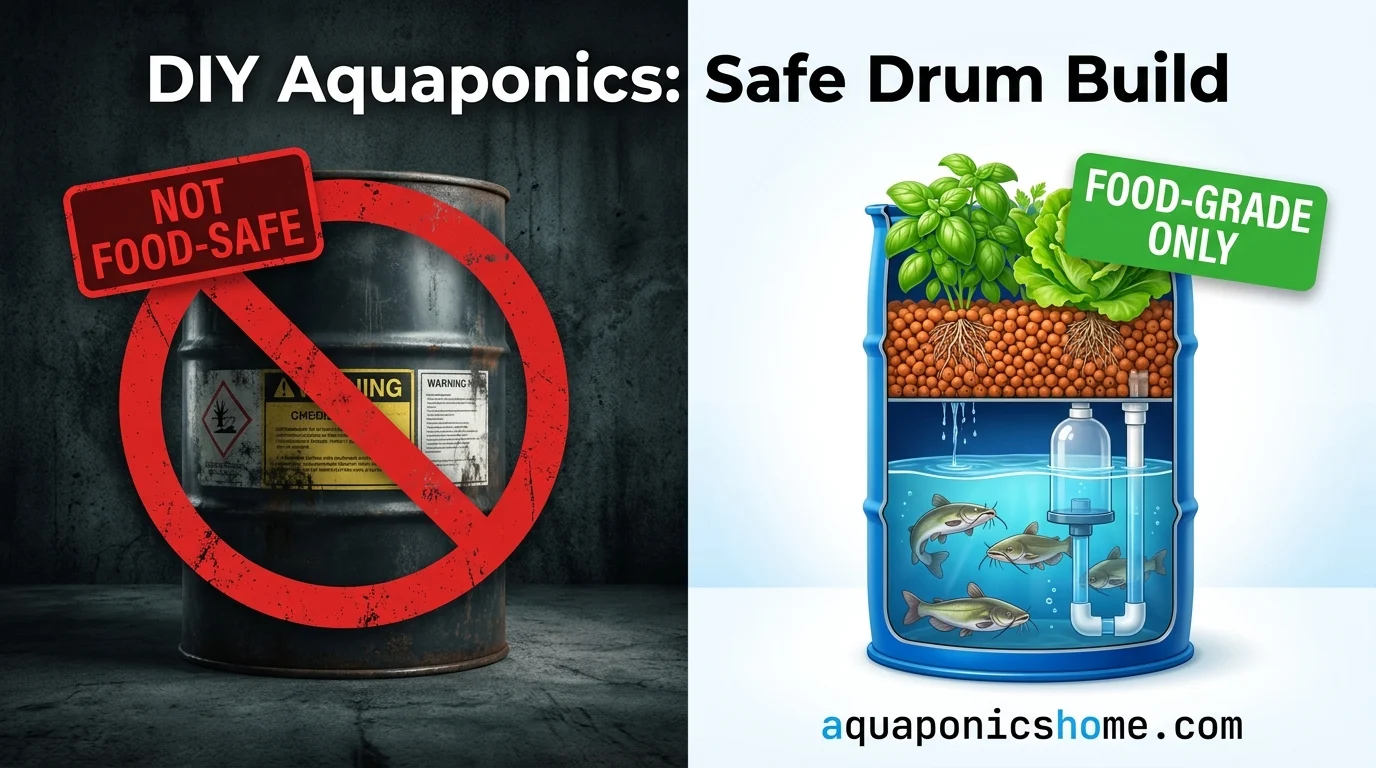
A DIY aquaponics barrel build does work, and it is the cheapest version that is not a toy. A plastic drum becomes the fish tank and the grow bed, a small pump moves water up, and gravity brings it back. Almost every other part is ordinary hardware. One condition decides the whole project: you have to know what that drum held before you got it. If nobody can tell you, do not grow food in it.
That last sentence is the part the build videos skip, so I am putting it first.
I have run small systems on a rented balcony in Dhaka for about three years. I am not an aquaponics scientist, and my first batch of catfish did not survive the first month. I have rebuilt twice, and that is the only reason I have anything useful to say about cheap builds: I have watched what actually fails.
What a barrel build actually is
The idea takes one paragraph. You cut a large plastic drum so that one part holds water and fish, and another part sits above or beside it holding grow media and plants. A small submersible pump lifts water from the fish side into the media. Bacteria living on every rough surface of that media convert fish waste into something plants can absorb, and the water drains back down to the fish.
That is the entire machine. There is no filter to buy, because the media bed is the filter. There is no nutrient bottle, because the fish are the nutrient supply.
Most people build this as a media bed on a flood and drain cycle, which is what I run and what I would pick again for a first system. It is forgiving in a way the neater looking designs are not.
The question that decides whether you build at all
Here is where the cheap build stops being a money question.
Drums are cheap secondhand precisely because they already carried something. Many carried food ingredients. Some carried detergents, solvents, agricultural chemicals or industrial fluids. On a resale pile, after a wash, they look identical.
The Southern Regional Aquaculture Center’s fact sheet Principles of Small-Scale Aquaponics (SRAC Publication No. 5007, Mullins, Nerrie, Sink and Beem, 2017), published through Oklahoma State University Extension, lists barrels and bulk containers as acceptable tank material, and then adds the condition: only used bulk containers that held food-grade material and have been thoroughly washed should be used.
That condition has two halves, and most build guides quote only the second one. Washing is required. Washing is not what makes the container acceptable. What makes it acceptable is that it held food-grade material in the first place. A scrubbed drum with an unknown history is still a drum with an unknown history.
So the test, before you spend anything:
- Is there a food-grade marking on the container itself that you can read? Not on the seller’s sign. On the drum.
- Can someone who knows, rather than guesses, tell you what was in it? “Some kind of chemical, I think it was fine” is a no. So is “it came off a food line” from a person with no connection to that line.
- Are you willing to walk away? That is the real test. Every other part of this build has a substitute. This one does not.
If any answer is no, the drum is not for a system that grows food. It might be fine holding rainwater for an ornamental plant. It is not fine feeding you. I am deliberately not naming a plastic code or a standard number here, because marking systems vary and I would rather you ask the question than memorize a symbol. The fuller version of the contamination question is in whether aquaponic food is actually safe to eat.
What the build has to get right, in order of consequence
Cheap builds fail in a predictable order. Sorted by what hurts most when it goes wrong:
| What | Why it matters | You got it right when |
|---|---|---|
| Container provenance | An unknown drum can put something into your food loop that no water change removes | You can name the previous contents and you read the food-grade marking yourself |
| Support and level | A tilted bed drains unevenly, so one end stays waterlogged | Water sits level across the media when the bed is full |
| The drain | This is the failure that empties the system onto the floor overnight | It drains faster than the pump fills, tested over a full cycle |
| The pump path | Kinks, a pump sitting in bottom sludge, or an outlet blasting one spot all cause trouble | Water arrives as a trickle spread across the media |
| Where overflow goes | Water escapes eventually, and gravity picks the destination | You can point at the spot, and you accept it |
| Rinsed media | Media dust clouds the water and stresses fish on day one | The rinse water finally ran clear |
Only one row there is about the barrel. The rest is about water going where you intended.
Weight: the arithmetic you can do, and the question I will not answer
Water is heavy, and this is the one place I will give you numbers, because they are not mine.
As the U.S. Geological Survey’s Water Science School states, a gallon of water weighs about 8.34 pounds. A liter of water weighs about 1 kilogram. That is the whole calculation: take the volume your container actually holds, multiply, then add the media, which is heavier again once soaked, plus the container and any frame.
Do that arithmetic before you build, not after. The full version, wet media included, is in how heavy a small aquaponics system really is.
What I will not do is tell you whether your balcony, roof or floor can carry the result. I have no way to know that, and neither does anyone else writing about this from a keyboard. That answer comes from a qualified structural engineer, or from your building’s own records and management.
The drain is the part that fails
My worst night in three years was a siphon that stopped draining while I slept. I woke to water across the balcony. The fish, the plants and the pump had nothing to do with it. The drain did.
Cheap builds concentrate risk here, because the drain is the part people improvise most freely and test least. Run full cycles with plain water, several times, before a single fish goes in. Then imagine the drain blocking completely and ask where the overflow goes. If the honest answer is the neighbor’s balcony or the flat below, fix that before anything else. The planning exercise is in what to do about leaks and overflow before they happen.
What the cheapness actually costs you
I like this build. I still want you to know what the savings buy.
The shape works against you. A drum is round and deep. Cut it for a grow bed and you get curved walls and an awkward planting surface, which is a small annoyance every time you plant, harvest or reach in.
Small water volumes swing fast. Less water means temperature, and everything dissolved in it, moves quicker when something goes wrong. Smaller is not easier, which is the least intuitive thing about starting out, and the size question has its own page: what size tank a small system actually needs.
Reaching in and cleaning is harder than in a wide, shallow container, and the maintenance you avoid is the maintenance that does not happen. My first catfish died because I over-cleaned. Neither that nor the neglect that followed was a plan; both came from how awkward the container was.
Barrel, bucket, old aquarium or tote
The cheapest container is usually the one you already have, or the one you can source without a mystery attached.
| Container | Best when | Watch out for |
|---|---|---|
| Plastic drum | You want the cheapest real system and can verify its history | Provenance, curved grow surface, awkward reach |
| Buckets | You want to test a design before committing to one | Very little water, so it stays a demonstration |
| Old aquarium | You already own one and want to watch the fish. See turning a spare aquarium into a system | Glass, and weight landing on furniture |
| Bulk tote | You want the standard hobby build and have the floor space. See whether an IBC tote is too big for you | Same provenance problem, only larger |
What two rebuilds changed
The first time, I built for the system I wanted. The second time, I built for the failures I had already had. That is the whole difference, and it cost nothing.
In practice it meant deciding where water would go before deciding where plants would go, and refusing containers I could not account for even when the price was good. I grow leafy greens and herbs on a modest budget. I have never regretted a refusal. I have regretted shortcuts.
If you build one thing this month, build the drain and test it with plain water.
FAQ
Can I use a barrel that held chemicals if I clean it very thoroughly?
No. SRAC Publication No. 5007 sets both conditions together: the container must have held food-grade material and must have been thoroughly washed. Washing does not upgrade an unknown drum into an acceptable one. If you cannot establish what was in it, use it for something that is not food.
Do I really need a bell siphon?
No. A bell siphon gives you a flood and drain rhythm without a timer, which is elegant when it works. A simple overflow that returns water continuously is easier to build and fails more gently. Mine is the reason I now say start with the simplest drain you can test.
Can a barrel system feed a family?
Not realistically. It grows leafy greens and herbs well, which is a real return on a small budget, and it teaches you the system. Treat anything beyond that as a bonus rather than a plan.
Can I buy everything at a hardware shop?
Almost. Pump, tubing, fittings and media are all general hardware items, and grow media has budget substitutes that work fine. The container is the exception, because a shop can sell you a drum without being able to tell you what it carried. That one item deserves the extra effort.