
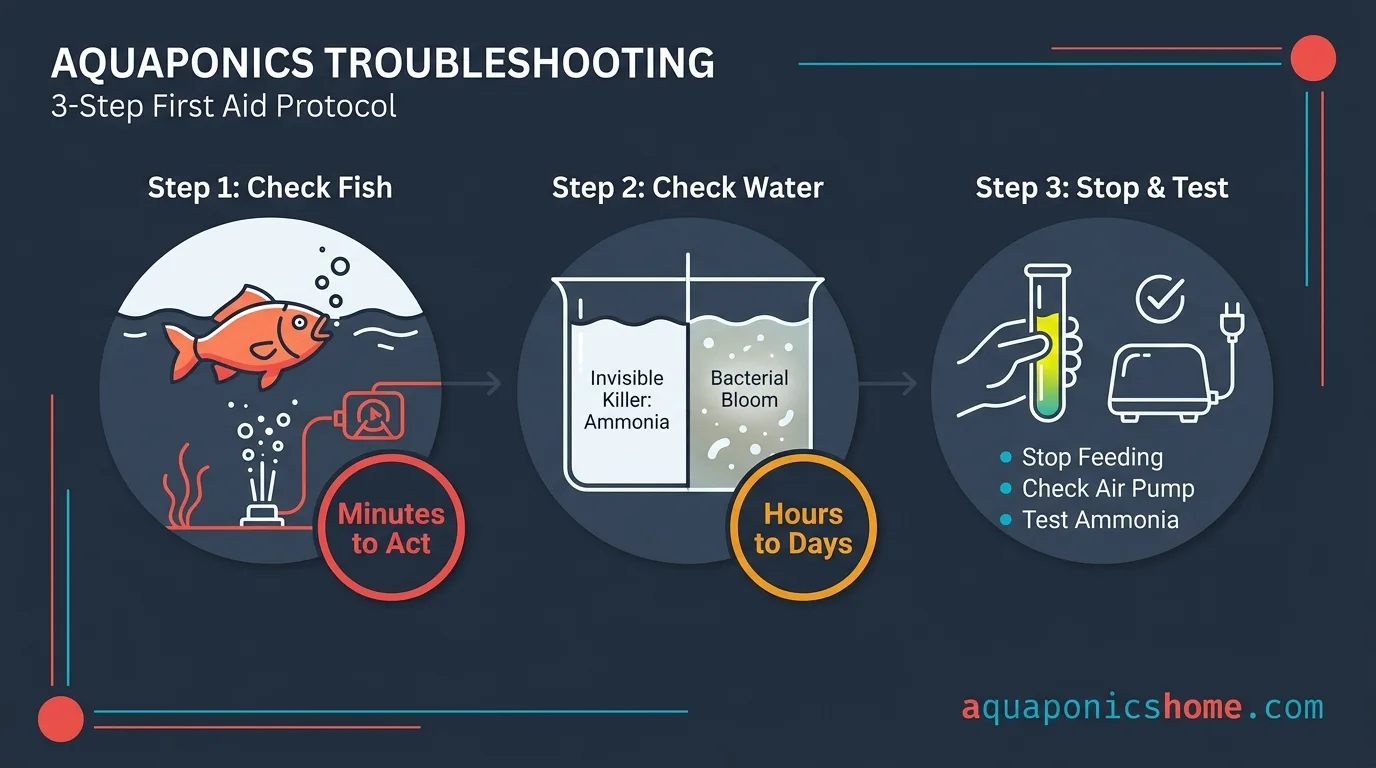
If something looks off, do this first: stop feeding, check that your pump and any air stone are actually running, and test the water for ammonia and nitrite.
Most losses trace back to oxygen or water chemistry, not disease. This page will not explain any single emergency in full. It sorts your symptom by how fast it can kill and sends you straight to the page built for it.
I have been doing small-scale aquaponics on a rented balcony in Dhaka for about three years, and my first batch of catfish did not survive the first month. I was not a scientist then and I am not one now.
What follows is the sorting system I wish someone had handed me that first week, instead of a wall of possible causes with no order to them.
How to use this page
This is not an encyclopedia entry. It will not teach you everything about ammonia, oxygen, or a stalled cycle in one long scroll, which is what most competing troubleshooting pages already do. Ask yourself three questions in order:
- What do I actually see right now? A symptom, not a guess at a cause.
- How fast does that kind of problem usually kill? Minutes, hours, or days changes what you do next.
- Where do I go to actually fix it? Most of the time, that is one specific page on this site, not this one.
Work through the next two sections, then the table, and you will have your answer in about the time it takes to read this page.
Look at the fish first
Fish tell you more than the water does, and they tell you faster. Gasping at the surface, mouths working, crowding near the pump outflow, is an oxygen problem that can turn fatal within the hour.
One or two fish dead with no obvious cause, while the rest look fine, is a different and less urgent picture than all of them acting distressed at once. Clamped, sluggish, or hiding fish that are still upright and breathing buy you a little more time to test before you act.
Only after you have looked at the fish should you look at the water, because a fish that is actively gasping does not wait for a water test.
Look at the water second
Color and clarity tell a rough story before your test kit confirms it. Water that has gone milky or cloudy overnight, with fish otherwise calm, usually points to a bacterial bloom, overfeeding, or a system still cycling.
Water that looks completely normal while fish are dying is the more dangerous pattern: ammonia and nitrite give no visual warning at all, so a test kit is not optional here.
If you recently scrubbed the tank, rinsed the media, or did a deep clean, hold that fact in mind for the table below. It matters more than people expect.
The kill-speed table
Work down this table in order. The categories near the top can kill in hours. The ones lower down are still serious, just slower.
| What you see | Likely cause category | How fast it can kill | Where to go |
|---|---|---|---|
| Fish crowding at the surface, mouths open, gasping | Low oxygen: pump or air stone failure, heat, overcrowding | Minutes to a few hours | Fish dying triage, oxygen section |
| Fish dying or already dead, water looks clear | Ammonia climbing, often a new or recently disturbed system | Hours to a couple of days | Fish dying triage, ammonia and nitrite section |
| Ammonia came down but fish keep dying anyway | Nitrite spike, the second wave that follows an ammonia crisis | Hours to a couple of days | Fish dying triage, same section |
| Water turned milky or cloudy overnight, fish look okay so far | Bacterial bloom, overfeeding, or a system still cycling | Days, unless fish start showing distress too | Watch and retest; if fish struggle too, treat it as the row above |
| You cleaned or scrubbed the system recently and fish are now dying | Starved biofilter: the bacteria colony that processes waste was stripped out | Days | Cycling without killing your fish |
| Only some fish affected, visible spots, frayed fins, or odd behavior, water tests clean | Possible illness, not a water or hardware failure | Varies, treat as urgent | An aquatic veterinarian or a university extension aquaculture service, see below |
If more than one row applies at once, work from the top. Oxygen and ammonia get handled before you worry about a slow cloudy-water bloom.
What each category is, briefly
Gasping at the surface: oxygen, not disease. A stopped pump, a clogged air stone, warm water holding less oxygen, or an overcrowded tank. It is mechanical and fast to fix. Fish dying triage covers restoring aeration immediately.
Ammonia and nitrite: the invisible killers. Fish waste and uneaten food release ammonia, which a healthy bacterial colony converts step by step into the nitrate your plants use. When that colony is missing, young, or damaged, ammonia and then nitrite build up with no visible warning. This is the most common cause of unexplained deaths, and fish dying triage is built to walk you through it with a test kit in hand.
Cloudy water: usually mild, but watch it. A bacterial bloom or overfeeding clouds the water without necessarily harming fish yet. If fish start showing distress while the water is cloudy, stop treating it as mild and move to the ammonia and nitrite category above instead.
The starved biofilter: the mistake careful people make. Scrubbing the tank or rinsing media until it looks spotless strips out the bacteria colony living on those surfaces, not floating in the water. Ammonia has nowhere to go, and the crash can take a day or two to show. Cycling without killing your fish explains why those bacteria matter and how routine maintenance can keep them alive.
When it might not be the system at all
Sometimes the water tests clean, the pump is running, oxygen is fine, and fish are still struggling: white spots, frayed fins, ulcers, unusual swimming, or only some fish affected while the rest look normal. That pattern points away from a water or hardware failure and toward possible illness.
This site does not diagnose fish disease and will not name a condition or suggest a treatment, here or anywhere else. That is a real limit: the wrong medication can kill your bacteria and your plants along with whatever it was meant to treat, and in a system you plan to eat from, an undiagnosed medication is a food-safety question too, not only a fish-welfare one.
If your water and hardware check out clean and fish are still sick, the honest next step is an aquatic veterinarian or your local university’s Cooperative Extension aquaculture program, not a bottle bought on a guess.
My own first-batch disaster
I did not lose my first catfish to neglect. I lost them to being too careful in the wrong way. I scrubbed the tank, rinsed the media until it looked new, and kept the whole system spotless, because that felt like the responsible thing to do.
What I actually did was strip out the bacteria colony that was quietly keeping the water safe. Ammonia built up with nothing left to process it, and my fish paid for my tidiness within days.
The lesson most pages online will not tell you plainly: the cause of a fish death is usually invisible, and it usually started before you noticed anything wrong. That is why this page exists as a sort, not a single story.
Your symptom might be my old mistake, or something else entirely, and the table above is how you tell the difference fast instead of guessing.
What this page will not do
It will not give you a dose, a treatment schedule, or a number to treat as a universal safe level for ammonia, nitrite, or pH. Those specifics belong on the dedicated pages this site links to, and your own test kit’s documentation, not compressed into a paragraph whose whole job is speed.
It will not diagnose a sick fish. And it will not pretend every problem already has its own page here: hardware failures (a flooded siphon, a dead pump, a slow leak) and slower problems (green water, an odd smell, pH that will not settle, low nitrate) are real categories this site plans to cover.
Until they do, if fish are visibly struggling because of one of them, treat it as an oxygen or ammonia emergency first and start at the top of the table.
If you are just getting started
If you have not stocked fish yet, or you are still in the first few weeks, the honest fix for most of this page is prevention. Cycle the system before any fish go in, and read balcony aquaponics and your first thirty days for the order things should actually happen in.
Almost every emergency here traces back to skipping a step early on, and slowing down now is far cheaper than firefighting later. Read more about how I learned this, slowly and the hard way, on my about page.
FAQ
My fish died. Is it safe to eat the rest of what I am growing?
Remove the body right away and test your water. A decomposing fish is a contamination question, not only a welfare one, especially if the water reaches the part of the plant you eat. See is aquaponics food safe for how that risk works and when the honest answer is to hold off.
I don’t know which category my problem falls into. What do I do?
Start at the top of the kill-speed table and work down. If you are unsure, treat it as the more urgent category rather than the milder one. Checking oxygen and testing ammonia and nitrite costs a few minutes and is never the wrong first move, even if it turns out not to be the cause.
How do I know if it’s my water and not disease?
Test the water first. If ammonia, nitrite, oxygen and temperature all check out and the pump is running, and only some fish are affected with visible signs like spots or frayed fins, that points toward possible illness rather than a system failure. That is the point to involve an aquatic veterinarian or a university extension aquaculture service, not to guess at a treatment yourself.
Can I prevent most of this instead of firefighting it?
Mostly, yes. Cycling the system properly before adding fish, and resisting the urge to over-clean it once fish are in, solves more problems than any emergency fix does. See cycling without killing your fish for the process.
Why doesn’t this page just tell me the safe ammonia or nitrite level?
Because a bare number without your pH, your temperature, and your test kit’s own documentation can be actively misleading, and this site is not going to hand you a figure to treat as universally safe. The pages this one links to walk through those numbers properly, attributed to named sources, as an action trigger rather than a guarantee.