
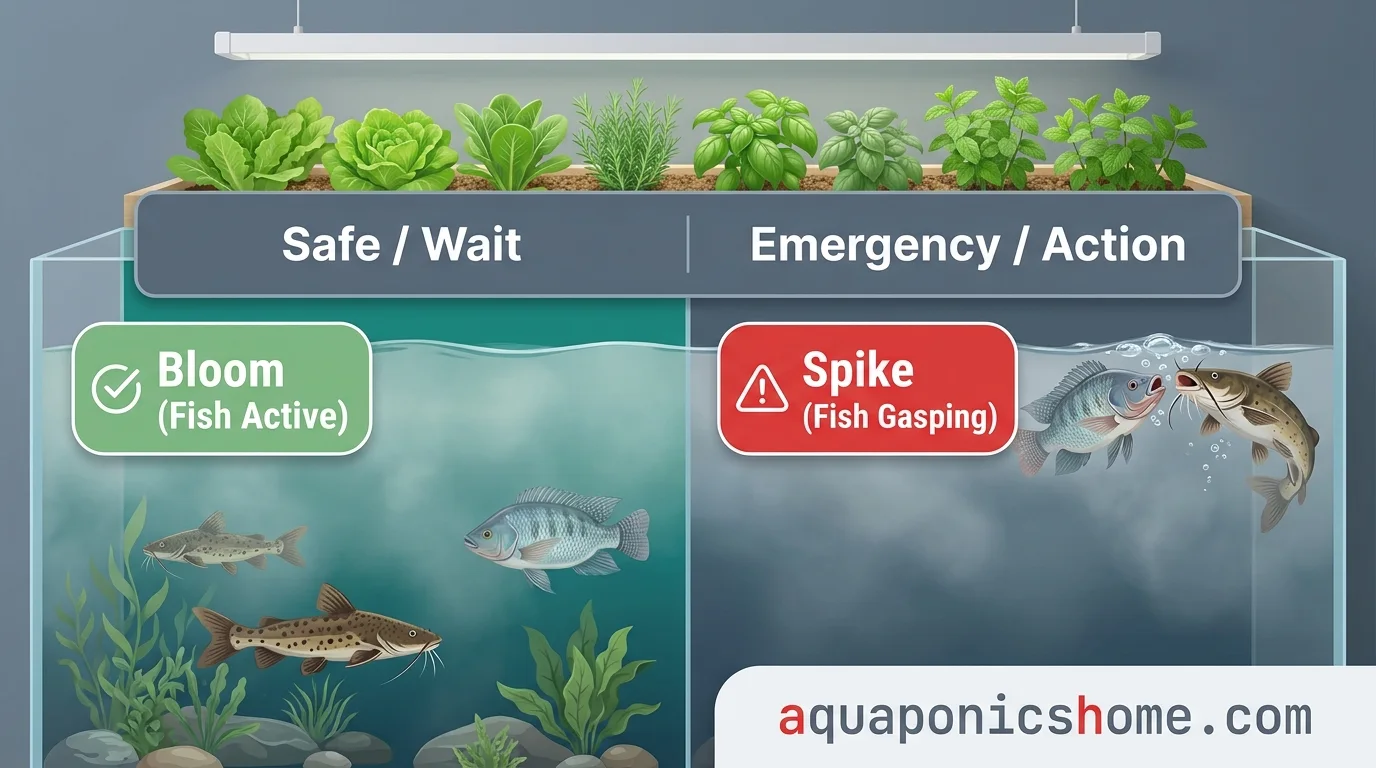
Cloudy aquaponics water usually means one of three things: a harmless bacterial bloom, common after cycling or a recent disturbance, that clears on its own in a few days; suspended solids from overfeeding or a disturbed media bed, fixable but not urgent; or a real problem, and the tell is not the water, it is the fish. If they are gasping, listless, or clustered at the surface, stop waiting it out and check your water chemistry now.
I have had cloudy water on my own Dhaka balcony setup more than once, and every single time the fish told me more than the water did. That is the habit this article is trying to hand you.
A harmless bacterial bloom: what it looks like
A bacterial bloom is a sudden, uniform haze, almost like skim milk stirred into the water. It usually shows up in a system that is new, was recently cycled, or just had a big change, more fish added, a filter cleaned, a large water top-up. The cause is a population of free-floating bacteria multiplying fast to catch up with a new food source, ammonia from fish waste that the established biofilter has not fully caught up with yet.
The reassuring part is the fish. In a genuine bloom, they behave normally: swimming, eating, not gasping. Give it a few days without doing anything drastic. If your system is genuinely brand new, this bloom can be part of the same settling-in period covered in cycling a system without killing your fish, and it is one more reason not to rush fish into an uncycled tank.
Suspended solids: what it looks like
This is a grittier, less uniform cloudiness than a bloom, sometimes with visible particles if you hold a glass up to the light. The usual causes are overfeeding, leftover food breaking apart in the water, or a media bed that got disturbed, stirred, rinsed too hard, or cleaned more aggressively than it should have been.
That last cause is personal for me. My first catfish batch died because I scrubbed my media bed clean, thinking I was helping. I washed away the very bacteria colony keeping the water safe, and the tank crashed. Disturbed media does not always cause a full crash, but it is exactly the kind of action that clouds water first and stresses a biofilter second. The fix for suspended solids is patience and restraint: feed less, let the system’s filtration catch up, and leave the media alone rather than “cleaning” it further. Read why media beds work the way they do if you are not sure what is actually living in yours.
When cloudy water is a real problem
Cloudy water on its own is rarely an emergency. Cloudy water plus fish that are struggling is a different situation entirely, and it deserves a different response. Watch for fish gasping at the surface, lying still on the bottom, refusing food, or looking listless compared to how they normally act. That combination means the cloudiness might be a symptom of a bigger water chemistry issue rather than the problem itself.
In that case, do not keep waiting to see if the water clears. Check your ammonia and nitrite readings. If you have never had to think about what those numbers mean or what to do about a spike, what to do when ammonia is climbing and handling a nitrite spike both walk through the next hour. If your fish look sick rather than stressed, sores, spots, unusual behavior beyond gasping, that is outside what a blog post should be diagnosing, and it is worth contacting an aquatic veterinarian or your local extension aquaculture service rather than guessing.
Telling the three apart
| What it looks like | Likely cause | What to check |
|---|---|---|
| Uniform, milky haze, water looks the same everywhere | Bacterial bloom, common after cycling starts or a recent big change | Fish behavior (normal?), how new or recently disturbed the system is, wait a few days |
| Gritty or particle-visible cloudiness, settles unevenly | Suspended solids from overfeeding or disturbed media | Recent feeding amounts, whether the media bed was cleaned, disturbed, or rinsed hard |
| Any cloudiness alongside gasping, listless, or off-food fish | Possible real water chemistry problem | Ammonia and nitrite readings now, not later |
The simplest home check
You do not need equipment for the first pass. Scoop a small jar of water and let it sit still for ten minutes. A bloom stays hazy and uniform. Solids tend to settle toward the bottom, leaving clearer water above. Neither of those tells you much if the fish are already struggling, so treat the fish as the tie-breaker every time, not the jar.
Also check the calendar in your head. Did you feed more than usual in the last day or two? Did you clean, rinse, or disturb the media bed? Did the system just finish cycling or get new fish? A cloudy tank with a clear recent cause behind it is almost never the emergency version.
What to do next, by branch
If it looks like a bloom and the fish are fine, do nothing drastic. Keep feeding normal, keep the filtration running, and give it a few days.
If it looks like suspended solids, cut feeding back to what the fish finish quickly, and resist the urge to clean the media bed further. That instinct is exactly what cost me my first batch of fish.
If the fish are struggling, test ammonia and nitrite immediately, and treat this as the priority over the cloudiness itself. If the water tests clean and fish are still not right, that is the point to bring in an aquatic veterinarian or a named extension aquaculture service rather than continuing to guess at home.
If you are not sure where any of this fits in your wider system, the troubleshooting starting point walks through how to work out what is actually wrong before you touch anything.
FAQ
How long does a bacterial bloom usually last?
In my experience it clears within a few days once the biofilter catches up, as long as nothing keeps disturbing the system in the meantime. If it is still cloudy after a week or more, or the fish start acting off, stop assuming it is a bloom and check your water chemistry.
Can overfeeding alone cause cloudy water?
Yes. Uneaten food breaks down and clouds the water directly, and it also adds to the ammonia load your biofilter has to process. Cutting feeding back to what the fish actually eat within a few minutes is usually enough to see the water clear.
I just cleaned my media bed and now the water is cloudy. Did I ruin my system?
Not necessarily, but back off and watch closely. Disturbing media clouds the water and can knock back the bacteria living on it. Watch the fish over the next day or two rather than cleaning anything further, and read up on what that media bed is actually doing before you touch it again.
Should I do a water change to fix cloudy water?
Not automatically. A partial water change is more useful once you know which of the three situations you are dealing with, especially if fish are struggling and you suspect ammonia or nitrite. Clearing a harmless bloom with a big water change just resets the process and can slow down a system that was settling in fine on its own.
When should I stop troubleshooting myself and call someone?
As soon as the fish look sick rather than simply stressed, or your ammonia and nitrite readings stay high after a water change and reduced feeding. That is the point to contact an aquatic veterinarian or a local extension aquaculture service instead of continuing to guess at home.