
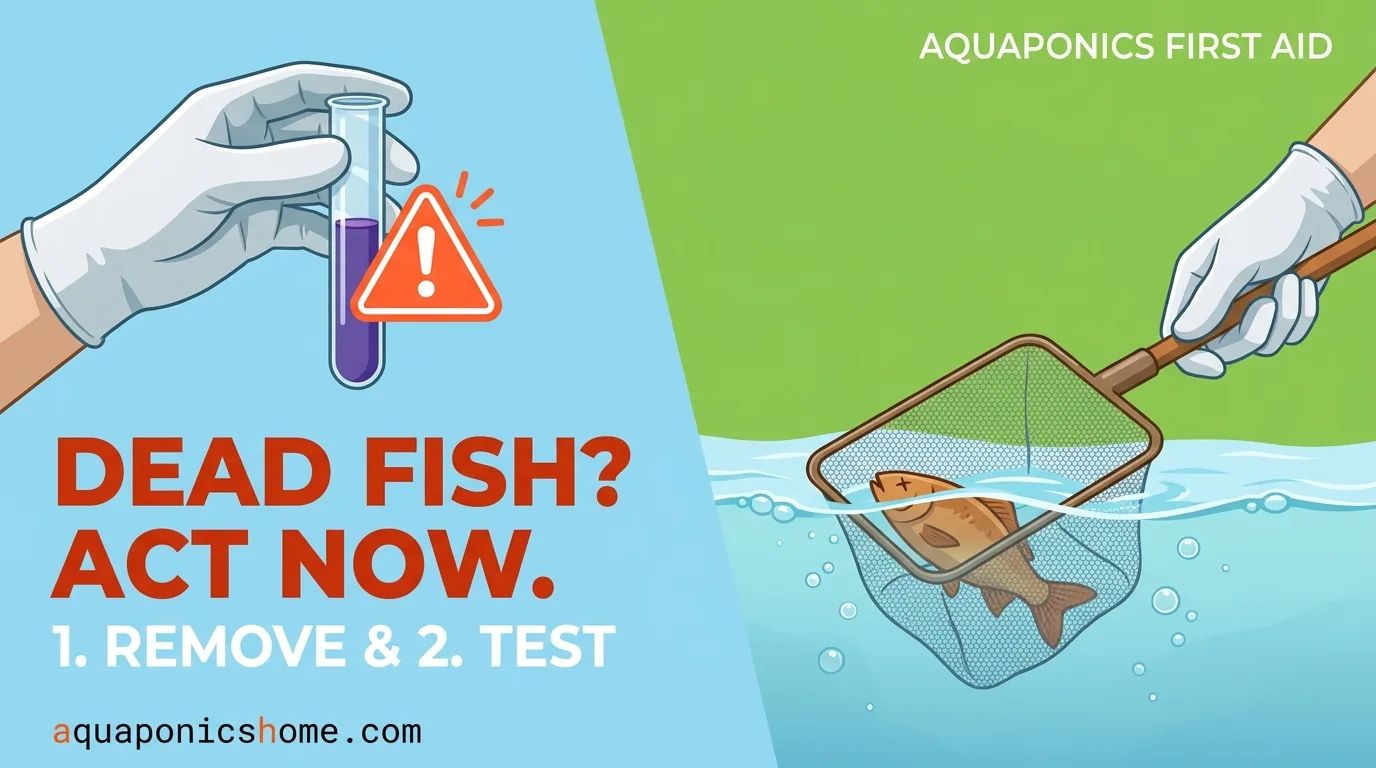
One dead fish does not automatically mean the rest of your tank is in danger, but it needs action now, not later. Remove the body immediately, test your water for ammonia and nitrite, and watch the remaining fish closely for the next hour. If this system also grows food you plan to eat, there is a second question underneath the first one: a decomposing fish is a food-safety consideration, not only a fish-welfare one.
I write this holding a memory I still do not enjoy revisiting. My first batch of catfish, on a rented flat’s balcony in Dhaka, did not survive its first month. I was not neglecting them. I had cleaned the system too thoroughly and starved the bacteria that kept the water safe, and by the time I understood what was happening, fish were already dying.
I am not an aquaponics scientist, and I am not going to pretend I know why any single fish in your tank died today. What I can give you is the order to do things in, right now.
The ten-minute action list
Work through this in order. None of it requires you to know why the fish died first.
- Remove the body right away. Net it out and keep it out of the water. Wash your hands or wear gloves if you have them, since you are handling something that was decomposing in water your plants also depend on.
- Test ammonia and nitrite immediately. Do not wait to see how the others behave first. A test kit gives you a number in a few minutes, and that number tells you far more than a visual check does.
- Look at the rest of the fish. Are they swimming normally, feeding interest aside, or are they gasping at the surface, clamping fins, or hiding? Note what you see rather than guessing at what it means yet.
- Hold off on feeding. Uneaten food adds to the same ammonia load a decomposing fish already adds. Skip this feeding while you assess.
- Act on what the test tells you. A clean reading means watch and retest in a few hours. An elevated reading means you have a water-chemistry problem to treat right now, not just a single loss to process. What to do when ammonia is climbing covers that next step in full.
That covers the physical ten minutes. Everything after this is about reading what you found correctly.
Why one dead fish still matters to the water
A dead fish does not stop affecting your system the moment it stops swimming. As it breaks down, it keeps adding to the ammonia load in water that your biofilter and your plants are both drawing from, and it is one more thing in the tank you did not put there on purpose. That is the practical reason removal comes first on the list above, not squeamishness.
I am not going to hand you a number for how fast that load builds or how long is too long, because I have not found a figure specific enough to a home aquaponics tank to trust, and a wrong number here is worse than no number. What I can tell you is what to do instead of guessing at a timeline: test now, and test again in a few hours. The reading will tell you more than a clock will.
Is this a one-off, or a warning sign?
This is the real question underneath “do I panic,” and the honest answer is that it depends on what else you find in the next hour, not on the fact of one death alone.
Leaning toward one-off: the rest of the fish are swimming, feeding, and behaving normally, and your ammonia and nitrite readings come back clean. Older fish, or one fish that was visibly smaller or weaker than the rest, dying alone with everything else testing fine is not unusual in a group of live animals.
Leaning toward a wider problem: more than one fish looks off, ammonia or nitrite reads elevated, or you recently did a deep clean, moved media, or the system lost power. If any of that lines up, treat it as an early warning rather than a coincidence, and work through the full troubleshooting sort rather than stopping at “one fish, must be fine.”
If your system is new, or you cannot remember the last time you tested, that gap in cycling is worth closing regardless of what today’s readings say. How to cycle a system without losing fish to it is the page for that.
The food-safety question this also raises
Most pages on this topic stop at “the water quality is fine” and never mention the other thing a decomposing fish means: it happened in water that, in an aquaponics system, also feeds the plants you may be planning to eat. That is squarely a food-safety question, not only a fish-welfare one, and it deserves a straight answer rather than silence.
I am not going to answer that question fully here, because it needs more room than a triage section can give it. Is aquaponics food actually safe to eat walks through where that risk really comes from, what a dead fish in the water specifically changes, and when the honest answer is to hold off on harvesting. If you found this fish and you were also planning to pick something today, read that page before you do.
What this page will not tell you
I will not guess what killed your fish, and neither will any other page on this site. Naming a likely disease or condition from a description alone is not something a blog can responsibly do, and a wrong guess can send you toward the wrong fix entirely.
If more than one fish dies over the following days, if you see visible signs like spots, frayed fins, or unusual swimming across several fish, or if losses continue even after your water tests clean, that pattern has moved past what a water-chemistry checklist can explain. At that point, the honest next step is an aquatic veterinarian or your local university’s cooperative extension aquaculture service, not a forum guess or a bottled treatment bought on a hunch.
This site does not publish disease diagnoses or treatment doses, here or anywhere else, because getting that wrong risks the rest of your fish, your plants, and anything you plan to eat from the system.
Reducing the odds next time
You cannot make this never happen again. Fish die, including in well-run systems. What you can do is shrink the chance that one death becomes several: test ammonia, nitrite, and pH on a regular schedule rather than only when something looks wrong, check on the fish for a minute or two at feeding time so a change in behavior does not go unnoticed for days, and resist the urge to scrub the system spotless.
My own first-batch loss came from doing that last one too well, not too little. The fuller version of that story, and how I run things differently now, is on my about page.
FAQ
One fish died and the rest look completely normal. Should I still test the water?
Yes, every time. A fish that looks fine now can still be affected by a reading you have not checked yet, and the test takes only a few minutes. Treat it as routine, not optional, whenever you find a body.
Can I tell what killed my fish just by looking at it?
Not reliably, and this site will not guess for you. A single fish found dead can have many explanations, and naming one without proper diagnosis risks acting on the wrong information. If you are worried about an ongoing pattern, an aquatic veterinarian or extension aquaculture service can look at more than a description can tell you.
Is it safe to eat what I harvest after finding a dead fish in the tank?
It depends on whether the water that fish decomposed in reaches the part of the plant you eat, and on how promptly you removed it. Is aquaponics food safe to eat walks through that question properly rather than guessing at an answer here.
How long should I wait before adding a new fish?
Wait until your ammonia and nitrite readings are stable and clean across more than one test, not just one good reading. If the loss points to an uncycled or disturbed system, treat that as the thing to fix first. Cycling without killing your fish covers what stable actually looks like.
Should I remove the dead fish before or after testing the water?
Before. Removing it stops it from adding further to the ammonia load while you test, and the test itself only takes a few minutes either way. Do not leave the body in while you go looking for a test kit.
A single dead fish is not a verdict on your whole system, and it is not something to shrug off either. Remove it, test, watch the others, and let the water tell you what to do next instead of your worst assumption.