
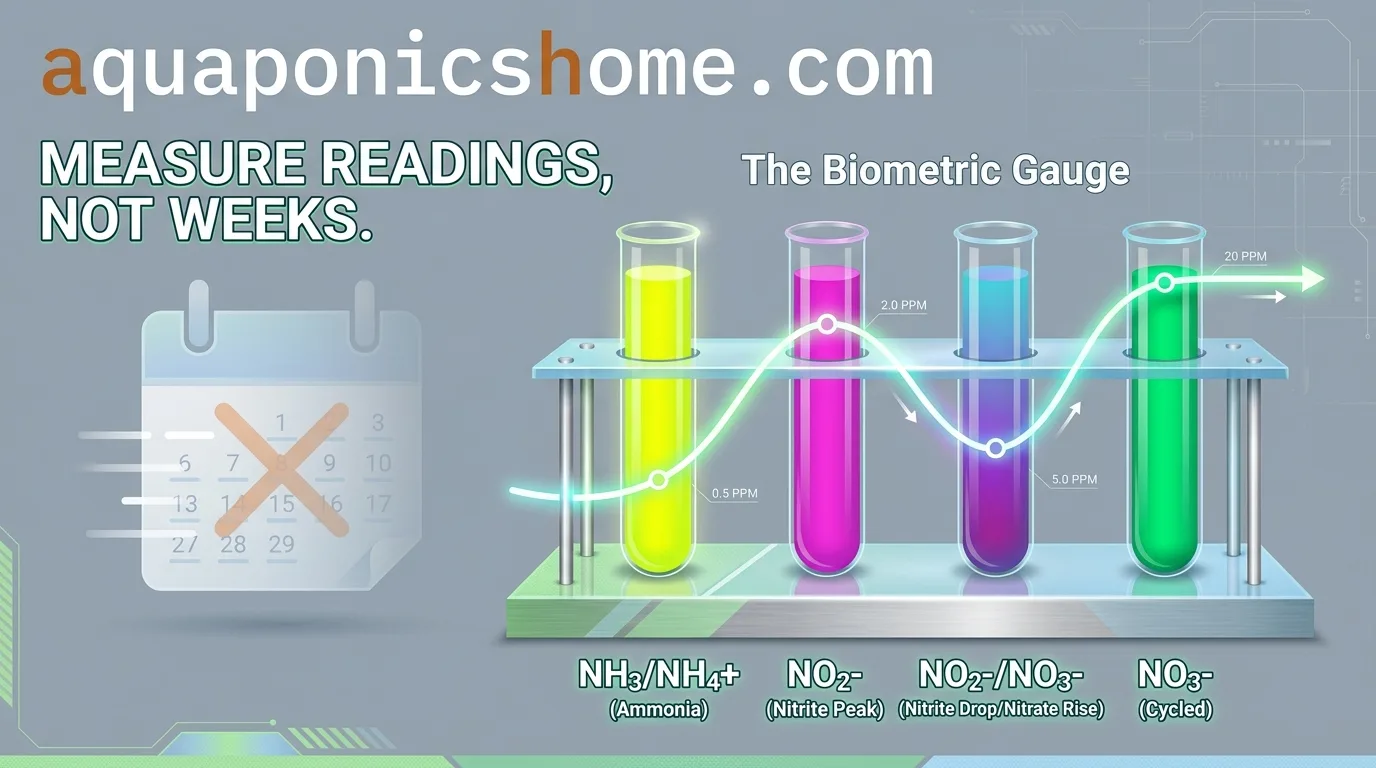
Short answer: stop measuring cycling in weeks and start measuring it in readings. The aquaponics cycling timeline runs through four recognizable stages, and your test kit tells you which one you are in: ammonia rises with nothing else showing, then nitrite appears while ammonia starts falling, then nitrite falls while nitrate appears, then ammonia and nitrite both sit at zero with nitrate present. Those stages always happen in that order.
How many days each takes depends on your water temperature, whether you seeded the system with established media, how big the system is and how consistently you fed the ammonia, which is why published week counts contradict each other.
If you are three weeks in and “nothing is happening,” you are probably in stage one, where nothing visible is supposed to happen.
The procedure for cycling is in the cycling guide. This article is only about reading where you are.
Why every published timeline disagrees with every other one
Search this question and you will be handed a number. You will also be handed a different number by the next result, and a third by the one after that. Some sources say a couple of weeks, some say a month or more, some say two months in cold water. They are all describing the same biological process.
They disagree because the process genuinely varies, and the variables are large:
- Water temperature. Nitrifying bacteria multiply faster when warm and slow down markedly when cold. This is the single biggest factor, and it is why a system started in spring behaves differently from the same system started in autumn. A warm balcony in a hot climate cycles faster than an unheated garage.
- What you seeded it with. A handful of media, gravel or filter material from an established, healthy system carries live bacteria and skips a chunk of the waiting. Starting completely sterile means waiting for the colony to arrive from the air and water on its own.
- System size and surface area. The colony has to grow large enough to process the ammonia load your system will actually carry. A bigger system, or one with a bigger stocked load waiting for it, needs a bigger colony.
- How consistently you supplied ammonia. Letting ammonia crash to zero for long stretches starves a young colony and stretches the timeline. Feeding it steadily does the opposite.
- How often you test. This one is not biological, but it changes your experience of the timeline completely. Testing every third day means you may miss the nitrite peak entirely and conclude nothing happened.
So a published week count is an average of other people’s conditions. It is not a schedule you are failing to meet, and using it as one causes two specific mistakes: adding fish at the calendar date rather than at the readings, and giving up on a system that was working normally.
The four stages, and how to tell which one you are in
This is the map worth having. Each stage is defined by what your test kit shows, not by a date.
| Stage | Ammonia | Nitrite | Nitrate | What is happening | What to do |
|---|---|---|---|---|---|
| 1. Loading | Rising, or holding where you dosed it | Zero | Zero | Ammonia is accumulating. The first bacterial group has not established yet. Nothing visible happens for a while, and that is normal | Keep the ammonia supply going. Test and record. Wait |
| 2. Handoff | Peaks, then starts falling | Appears and climbs | Zero or a trace | The ammonia oxidizers are working. Their product, nitrite, has nowhere to go yet | This is the proof it is working. Keep going. Do not add fish |
| 3. Second wave | Falls toward zero, clears quickly when dosed | Peaks, then falls | Appears and climbs | The nitrite oxidizers have established. This is usually the longest and most discouraging stage | Keep testing. Nitrite falling is the milestone that matters |
| 4. Cycled | Zero | Zero | Present | Both groups are established and the chain is complete | Confirm it holds for several days, then stock slowly |
If you can place yourself on that table, you know exactly how far you have come and roughly what is left, without any reference to a calendar. That is a better answer than a number, because it is about your system rather than someone else’s.
The chain behind the table, and why the stages happen in that order, is explained in the nitrogen cycle article.
Stage three is where people quit
Worth its own heading, because it is the predictable failure point and nobody warns you.
Stage two feels like progress. Ammonia peaked, ammonia is falling, something is clearly happening. Then nitrite arrives and sits there. And sits there. The nitrite-oxidizing group is the slower of the two to establish, so this stage often lasts longer than the one before it, and from the outside it looks like the system has stopped.
It has not stopped. A high nitrite reading with ammonia falling is evidence that step two is working perfectly and step three is still building. That is a system doing exactly what it should.
Two things go wrong here. People conclude the cycle has failed and start over, throwing away weeks of real progress. Or they conclude it must be nearly done and add fish into water with a high nitrite reading, which is the worst possible moment, because nitrite is the second wave that kills after you relax.
Wait it out. Nitrite falling to zero is the milestone, not ammonia falling to zero.
Slow or stalled?
The real question behind “it has been three weeks and nothing is happening” is whether you have a problem or a normal wait. Here is how to tell the difference honestly.
You are probably just slow if:
- You are in stage one and ammonia is present. Stage one is invisible by nature.
- Your water is cold, or the weather has turned.
- You started from nothing, with no seeded media.
- You are testing infrequently and comparing single readings rather than a trend.
You may genuinely be stalled if one of these is true:
- Your ammonia went to zero and stayed there with no nitrite ever appearing. That is not progress, it is a starved colony. The bacteria ran out of food before they established.
- You have been topping up with untreated tap water. Chlorine and chloramine are used specifically because they kill bacteria, including yours. Every untreated top-up sets you back.
- Your pH has drifted to an extreme. Nitrifying bacteria slow badly outside a moderate range. If pH has crashed, fix that before concluding the cycle failed.
- The water is very cold and staying cold. Not a fault, but it is a real cause, and no amount of waiting fixes a temperature problem.
- There is no flow, or no oxygen, where the colony lives. Nitrification is aerobic. A dead pump or a permanently flooded bed with no air exchange starves the colony the same way over-cleaning does.
Notice that four of the five are things you did, and all of them are fixable. A stall is almost never mysterious. It is almost always chlorine, starvation, pH, cold or oxygen.
Keep a log, because a single reading is not a position
The most useful thing I did on my second system cost nothing: a cheap notebook by the tank with the date, the time, and three numbers.
A single test result tells you almost nothing about cycling. Ammonia at a middling reading could be stage one on the way up or stage two on the way down, and those are completely different situations calling for completely different responses. Only the trend distinguishes them, and you cannot see a trend you did not record.
Record the date, ammonia, nitrite, nitrate, and a note about anything you changed: topped up, dosed ammonia, weather turned cold, added seeded media. When the readings do something confusing, the answer is usually in that notes column.
Test every couple of days rather than daily during fishless cycling. Daily testing burns reagent and tells you little, since these are colonies growing over weeks. But do not stretch it so far that you miss a peak entirely, which is the commonest reason people report that a stage “never happened.”
When to add fish, and how fast
The finish line is not a date, and it is not “ammonia is zero.” It is both toxic compounds at zero while nitrate is present, held for several consecutive tests rather than seen once.
Then stock slowly. A colony sized to the ammonia you were dosing is not automatically sized to a full tank of fish, and the way to find out is gradually.
Add a small group, test for several days, confirm ammonia and nitrite stay at zero, then add more. If a reading moves, the colony is not yet big enough for that biomass, and the answer is to stop adding, not to push on.
This is also the last point at which the fishless decision can still be made cheaply. If you have not stocked yet, the case for cycling fishless rather than with fish is worth reading before you buy anything alive.
And if you are cycling as part of a first build, the whole sequence sits inside your first thirty days, in order.
FAQ
How long does aquaponics cycling take?
There is no single honest figure, because it depends on water temperature, whether you seeded the system with media from an established one, system size, and how consistently you supplied ammonia. Published estimates vary widely and contradict one another for exactly that reason. Judge your progress by the stage your test results show rather than by a week count: ammonia rising, then nitrite appearing as ammonia falls, then nitrate appearing as nitrite falls, then both at zero.
It has been three weeks and nothing is happening. Is that normal?
Usually yes, if you still have ammonia present and no nitrite yet. That is stage one, and stage one is invisible by design because the first bacterial group is establishing before it produces anything you can measure. It is only a real stall if your ammonia went to zero and stayed there with no nitrite ever appearing, or if you have been adding untreated tap water, or if pH or temperature is extreme.
Why is my nitrite so high and not coming down?
Because the nitrite-oxidizing bacteria are the slower group to establish, so stage three routinely lasts longer than the stage before it. High nitrite with falling ammonia is evidence that the first half of the cycle is working. Keep supplying ammonia, keep testing, and do not add fish until nitrite reaches zero, because that reading is the dangerous one.
Can I speed up the cycling timeline?
Somewhat. Keeping the water warm, keeping pH in a moderate range, dechlorinating every top-up, maintaining a steady ammonia supply and seeding with media or filter material from an established healthy system all help. What you cannot do is skip stages. The order is fixed, and shortcuts that appear to skip a stage usually mean you missed it between tests.
How do I know for certain the system has finished cycling?
When ammonia and nitrite both read zero while nitrate is present, and that holds across several consecutive tests rather than appearing once. Use your own test kit’s documentation and a named extension aquaculture service for target figures rather than a number from a blog, then stock gradually and keep testing as you add fish.
I run small aquaponics systems on a rented balcony and my second system was cycled with a notebook and a cheap liquid test kit, which remains the whole toolkit this article requires. No cycling duration, ammonia threshold or nitrite threshold is published here on purpose: those figures vary with conditions and with the source, and a wrong number in a beginner’s hands is worse than no number. Use your own test kit’s documentation, a named university extension aquaculture service, or FAO’s small-scale aquaponics technical paper for target values, and consult a qualified aquatic veterinarian for anything concerning live fish.