
Yes, aquaponics tomatoes are possible in a small home system, but they are not lettuce with an attitude.
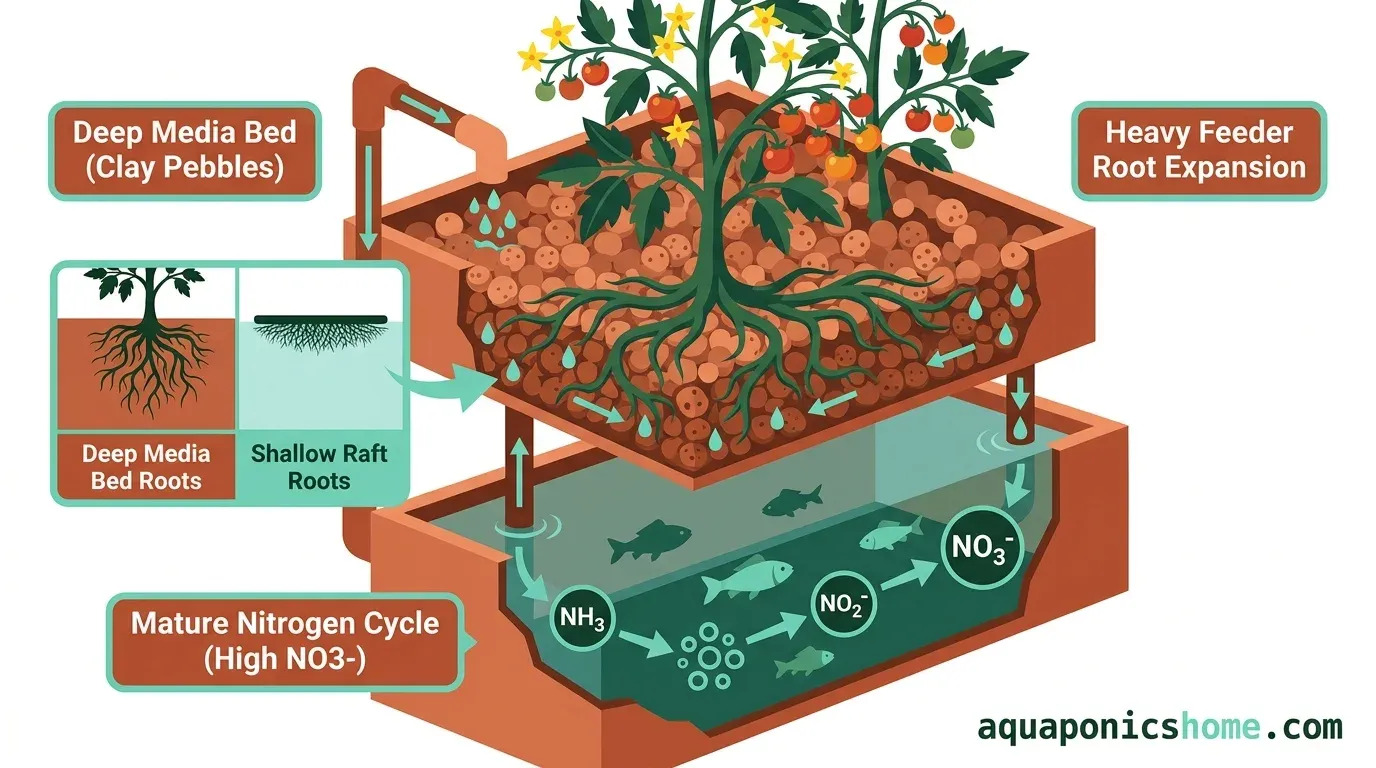
Tomatoes and peppers are heavy-feeding, fruiting nightshades that need a fully matured nitrogen cycle, a warmth window that stays inside a fairly narrow range, and a pollination method you provide yourself, since there is no wind or bees indoors. Skip any one of those and the plant does not die, it stalls: flowers drop before they set fruit, or fruit forms with a sunken black patch on the bottom instead of ripening.
This is what aquaponics tomatoes demand of a small system, what university extension research says about the temperature window that decides fruit set, and where the honest limits sit for a first-time grower.
Why Aquaponics Tomatoes Are Heavy Feeders, Not Easy Feeders
Leafy greens like lettuce and basil grow well in almost any cycled aquaponics system because they ask for relatively little: modest nitrate, mild light, and a shallow root run.
Tomatoes ask for more of everything. They are fruiting crops, which means the plant is not just building leaves, it is building flowers and then filling fruit, and that second stage draws heavily on nitrate and micronutrients the whole season, not just at the start.
That demand only gets met if the system’s bacterial colony is already established and converting ammonia to nitrate reliably. A system still early in its startup, where ammonia or nitrite is still spiking, cannot support a tomato plant the way it can support a young lettuce seedling.
If you are not certain your system has finished that startup phase, the biology behind it and how to tell it is done is covered in how the aquaponics nitrogen cycle actually works. Planting tomatoes into an unfinished cycle is one of the most common reasons a plant that should thrive instead sits yellow and stunted.
The System Needs Root Room, Not Just Nitrate
Tomato and pepper roots are larger and more extensive than a lettuce plant’s shallow web, and they need a growing medium that can hold that root mass upright once the plant is heavy with fruit.
A media bed, filled with clay pebbles or gravel, gives roots the depth and physical support a floating raft or a thin NFT channel cannot. That is also part of why media beds are the common default recommendation for a first system, a case laid out fully in why media beds are the right default design.
Root room is a space question as much as a media question, and a fruiting crop takes up more of a small tank’s real estate than a tray of herbs does.
Before committing a build to tomatoes, it is worth being honest about what a small tank can actually support without crowding the fish or starving the plants of nitrate, which is exactly what small aquaponics tank size and its honest limits walks through.
The Temperature Window That Decides Whether You Get Fruit
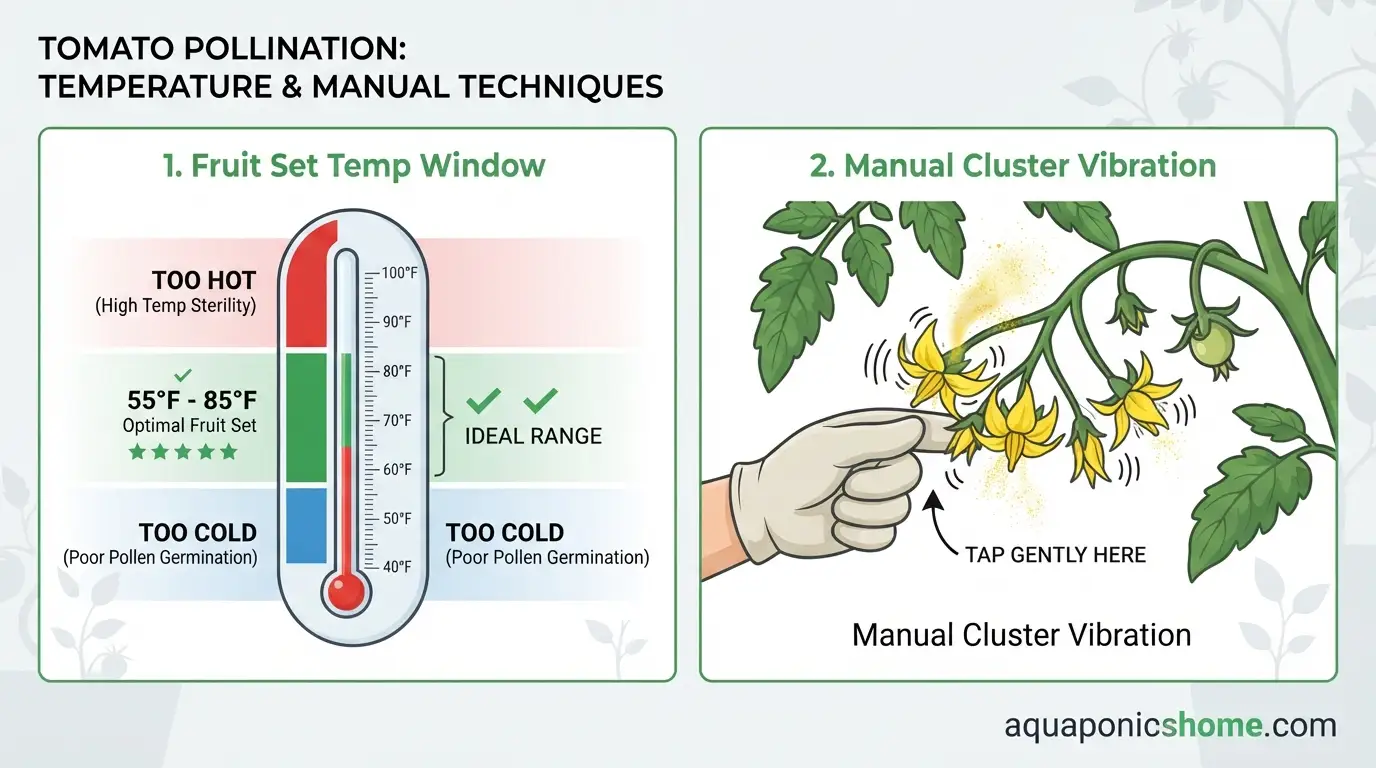
Temperature, more than any other single factor, decides whether a tomato flower turns into fruit. According to the Alabama Cooperative Extension System (reviewed 2026-09-23), tomato flowers often abort when daytime temperatures climb above roughly 85°F and nighttime temperatures stay above about 72°F, and for some varieties elevated night temperature alone is enough to cause the flowers to drop even if daytime temperatures stay lower.
The same extension guidance notes the opposite failure too: temperatures below about 55°F can also stop fruit set, and the longer a plant sits at either extreme, the more flowers it loses.
For a small indoor or balcony system, this matters because you are usually fighting whichever extreme your climate leans toward. A system kept in a hot, poorly ventilated space loses fruit set from heat; one kept near a cold window or unheated room in winter loses it from cold.
There is no fixed nutrient fix for this. It is a climate-control problem, solved by shade, airflow, or supplemental heat, not by feeding the plant harder.
Pollination Is a Job Wind and Bees Do Outdoors
Tomato flowers are self-fertile, but the pollen still has to move from the flower’s own anthers to its stigma, and outdoors that movement comes from wind and visiting insects shaking the flower cluster. Indoors, in a grow tent, greenhouse, or spare room, that movement does not happen unless you make it happen.
The University of Alaska Fairbanks Cooperative Extension Service (reviewed 2026-09-23) addresses this directly for greenhouse tomatoes: a simple tapping or vibrating of the flower cluster, done by hand or with a small battery-powered vibrator, is generally sufficient to pollinate a limited number of plants.
The same guidance cautions that shaking the support strings or blowing air across the whole plant is a poor substitute; if a fan or blower is used at all, it needs to be aimed directly at individual flower clusters to come close to matching the effect of direct vibration.
For a home aquaponics grower, the practical version of this is simple: a few seconds of gentle tapping on each open flower cluster, most mornings, when the pollen is driest and most likely to release.
Peppers benefit from the same routine, though their flowers are somewhat less fussy about it than tomatoes.
Blossom End Rot Is a Calcium Delivery Problem, Not a Disease
The most common tomato failure that gets mistaken for a disease is blossom end rot: a flat, sunken, leathery patch on the bottom of an otherwise healthy-looking fruit.
University of Connecticut Extension describes it plainly as a physiological disorder caused by a localized calcium deficiency in the developing fruit, not an insect or pathogen problem, and notes that it is closely tied to how consistently water (and with it, calcium) reaches the fruit rather than to how much calcium is available overall.
That distinction matters in an aquaponics system specifically. The nutrient solution usually is not short on calcium in an absolute sense, but flood-and-drain timing, an inconsistent pump cycle, or long gaps between flood events can create the same uneven delivery that causes blossom end rot in soil when watering is erratic.
The fix extension sources point to for soil growers, consistent moisture rather than a calcium spray on the leaves, translates in aquaponics to a steady, predictable flood cycle rather than a supplement chase.
Reading the Symptoms Instead of Guessing at Them
| Symptom | Likely cause | What the research points to |
|---|---|---|
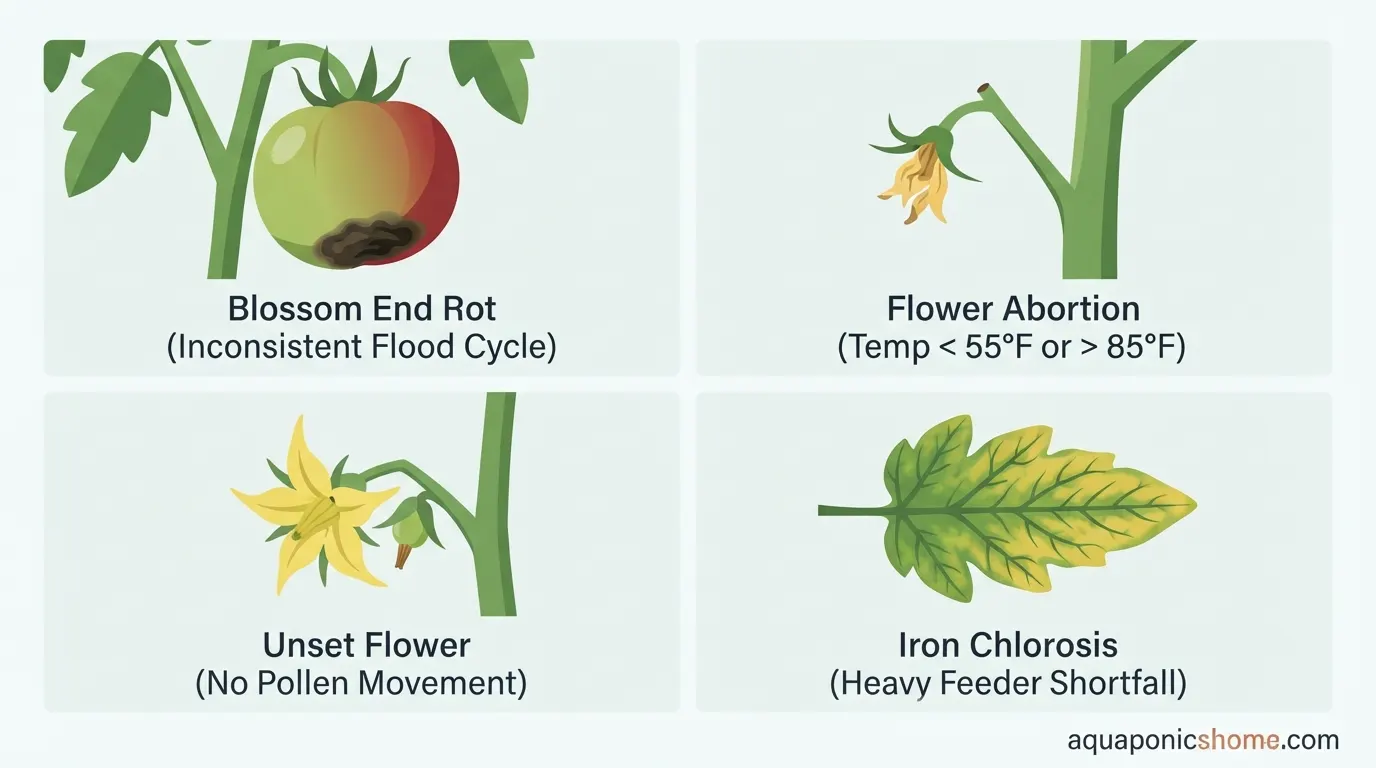
| Flowers open, then dry up and drop without fruit | Temperature outside the fruit-set window | Alabama Cooperative Extension System: above roughly 85°F day / 72°F night, or below about 55°F |
| Fruit has a flat, sunken, dark patch on the bottom | Uneven calcium delivery to the fruit, not a lack of calcium overall | University of Connecticut Extension: a physiological disorder tied to moisture consistency |
| Flowers open and look healthy but nothing ever sets | No pollen movement reaching the stigma | University of Alaska Fairbanks Cooperative Extension Service: hand tapping or vibrating the flower cluster |
| Leaves pale or yellowing between the veins on older growth | Micronutrient shortfall, commonly iron, in a heavy-feeding crop | Consistent with tomatoes’ higher nutrient draw as fruiting crops; confirm before treating rather than adding supplements on a guess |
Peppers: The More Forgiving Nightshade
Peppers are close cousins of tomatoes and share the same core requirements: a matured system, hand pollination indoors, and a warm, stable temperature. Where they differ is tolerance.
Pepper plants are generally smaller and less demanding on root space than an indeterminate tomato vine, and they tend to sulk rather than drop every flower when conditions are briefly off.
That makes them a reasonable second fruiting crop to try once a tomato plant (or a first attempt at one) has shown the system can support a heavy feeder at all.
Is It Worth Growing Tomatoes in a Small System At All
This is the honest question most guides skip. Tomatoes take up more grow bed space, more nitrate, and more attention than the leafy greens most small systems are built around, and a single tomato plant can end up competing with everything else you were hoping to grow.
If the goal is maximum food from a small footprint with the least fuss, greens and herbs still win on effort versus output. If the goal includes the specific satisfaction of a homegrown tomato, or you are past the beginner stage and have room in the system’s nitrate budget, it is a reasonable next step rather than a first one.
Whether a small system is worth the effort at all, tomatoes included, is a fair question to ask before committing more space to any one crop, and it is covered directly in is aquaponics worth it compared with buying vegetables.
FAQ
Can you grow tomatoes in aquaponics at all?
Yes. Tomatoes are grown successfully in aquaponic systems, including in university research settings, but they need a mature nitrogen cycle, consistent warmth, and hand pollination indoors, unlike lettuce or herbs.
Do aquaponics tomatoes need hand pollination?
Indoors, generally yes. Without wind or insect activity, tomato flowers often will not set fruit reliably. University of Alaska Fairbanks Cooperative Extension Service recommends gently tapping or vibrating each flower cluster by hand.
Why do the flowers drop off my aquaponics tomato plant without fruiting?
Temperature is the most common cause. Alabama Cooperative Extension System guidance points to daytime heat above roughly 85°F combined with warm nights, or cold below about 55°F, as the usual culprits.
Is blossom end rot caused by the fish water, or is it a plant problem?
It is a plant-side calcium delivery issue, not a sign the fish water is wrong. University of Connecticut Extension describes it as tied to moisture consistency reaching the fruit, which in aquaponics usually points back to an uneven flood cycle rather than the nutrient mix itself.
Are peppers easier than tomatoes in aquaponics?
Somewhat. Peppers share the same core needs but take up less root space and tend to tolerate brief lapses in temperature or pollination better than an indeterminate tomato vine.
Sources named in this article: Alabama Cooperative Extension System, tomato blossom drop guidance (reviewed 2026-09-23); University of Alaska Fairbanks Cooperative Extension Service, tomato pollination and fruit development guidance (reviewed 2026-09-23); University of Connecticut Extension, tomato blossom end rot guidance. No stocking density, yield or dosing figure appears in this article beyond what these named sources state.