
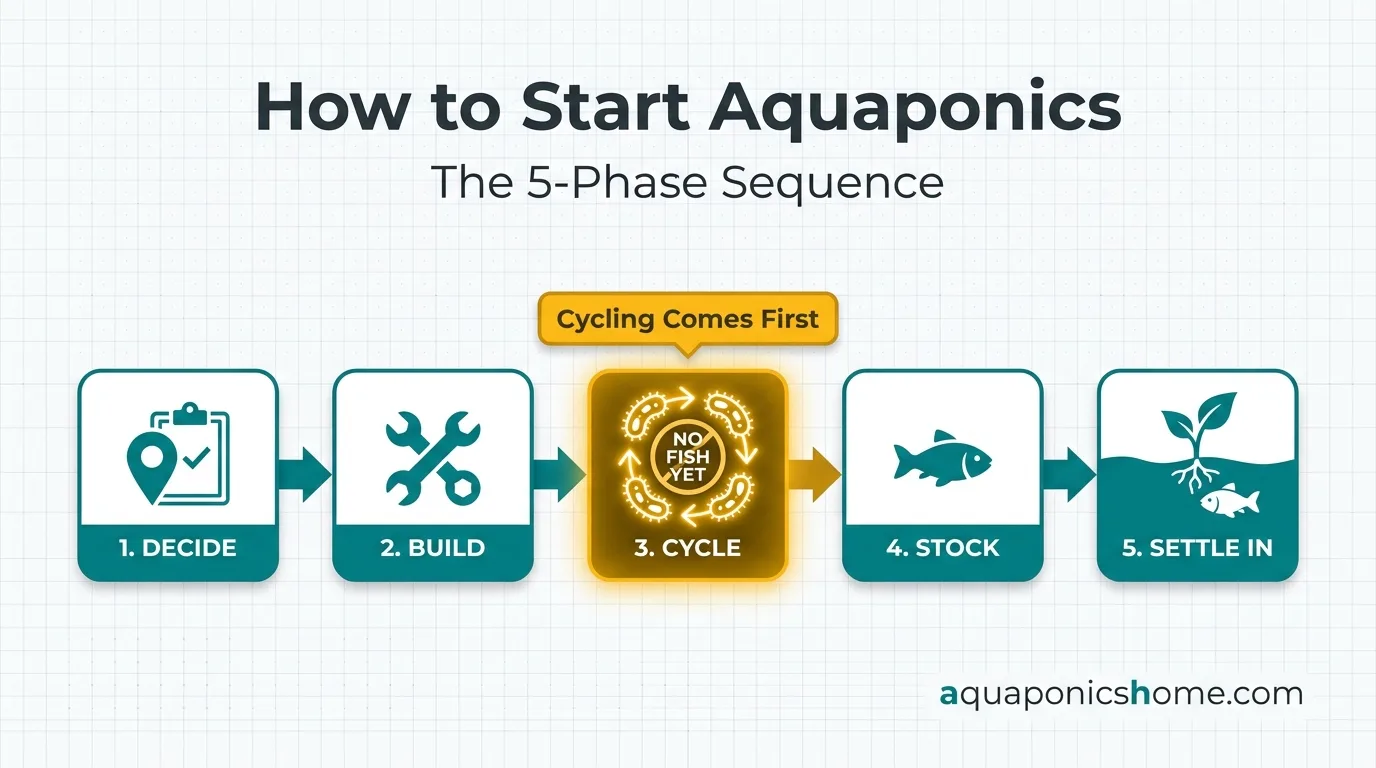
The order is: decide, build, cycle, stock, settle in. You decide what you are building and where it goes, you build and test it empty, you cycle it with no fish until the bacteria colony is established, you add fish gradually only after that, and then you settle into a weekly routine. The one rule that cannot move: cycling always comes before stocking, never the other way around.
I know that order looks obvious written down like that. It did not feel obvious the first time I tried it, on my own balcony, reading guide after guide that each assumed I already knew what “cycling” meant and none of which told me it had to finish before the fish arrived. My first batch of catfish did not survive the first month. I had built the thing, filled it with water, and added fish within days, because nothing I read said clearly enough that the middle step was not optional. This page exists so you do not have to find that out the way I did.
This is not a new deep dive into any one topic. Every phase below links to the page on this site that actually covers it, tank size, siting, media, cycling, equipment. This page’s only job is to put them in the right order.
Phase 1: Decide
Before you buy anything, settle four questions. Can you actually run a system where you live, on a balcony or in a rented flat? Read balcony aquaponics and, if renting applies to you, whether you need to tell your landlord before you start. Then work out roughly what a loaded system weighs, using the arithmetic of system weight, so the site question and the structural question are both open before you commit, not after. Decide where it will physically sit, since sun, shade, wind and drainage at that spot shape everything that follows; see where to put your system. Last, pick a rough design direction using the system types compared rather than copying whatever build you last watched on video. None of this needs to be perfect. It needs to be decided before phase two starts, because changing your mind after the tank is full is expensive and, worse, it is wet.
Phase 2: Build
This is where the tank, grow bed, media, plumbing and equipment come together. Work from the full equipment list so you are not discovering a missing part mid-build. Assemble everything, then run it with water only, no fish, no plants yet. Check every joint overnight before you trust it. Check that the drain empties the bed completely and that the air pump is actually running, not just plugged in. A system that leaks or fails to drain while empty will do the same thing later with fish inside it, except then it also floods your floor. Mine did, once, overnight, on a system I thought I had already tested. Test it again longer than feels necessary.
Phase 3: Cycle
This is the phase every ranking guide names as the one beginners skip, and it is the one this page exists to protect. Cycling is running the system with no fish while a colony of nitrifying bacteria establishes itself in the media and on every wet surface, so that fish waste has somewhere to go the moment it arrives. It takes real time, measured in weeks rather than days, and there is no shortcut that removes the waiting. The full explanation, including what fishless cycling actually looks like week to week, is in cycling without killing your fish. Read it now, not after you have already bought fish.
The order that matters most
Here is the part I will state as plainly as I can: skipping the cycling phase, or treating it as optional, is the single most common mistake a beginner makes, and it is the mistake I made. I built my first system, filled it, and added catfish within days because I did not understand that the bacteria colony had to be established first. I had no test kit either, so I could not have seen the problem coming even if I had known to look. The fish did not survive the first month. That failure is not a reason to be afraid of aquaponics. It is the reason this page puts cycling in its own phase, with its own gate, instead of folding it into “setting up the tank” the way several other guides do. Decide and build are yours to move through at your own pace. Cycle is not negotiable, and stocking before it is finished is the mistake that ends more first systems than any equipment failure does.
Phase by phase, at a glance
| Phase | What happens | What to check before moving on | Common mistake at this phase |
|---|---|---|---|
| 1. Decide | Confirm you can run a system where you live, choose a rough design, pick the spot | Landlord or building question settled; the weight question at least opened; sun, shade and wind at the spot noted | Picking a design because a build video looked good, without checking the site it has to sit on |
| 2. Build | Assemble tank, grow bed, media, plumbing and equipment; run it with water only | Every joint holds overnight with no leaks; the drain empties the bed completely; the air pump is actually running | Trusting a single overnight test, or skipping the empty-water test altogether |
| 3. Cycle | Run the system with no fish while the bacteria colony establishes | Ammonia and nitrite both read at the low end of your test kit’s scale, not just lower than the week before | Assuming the system is cycled because the water looks clear, or because “it has been a while” |
| 4. Stock | Add a small number of fish, not a full load | You have a source you trust, and you are prepared to test daily for the stretch right after stocking | Buying fish on the same trip as the tank, before cycling has even started |
| 5. Settle in | Add plants, start the weekly routine, let the system find its balance | You are testing on a schedule, not only when something already looks wrong | Relaxing the testing the moment things look fine |
Phase 4: Stock
Once your test kit shows the system has cycled, add fish gradually rather than all at once. A system that has only just finished cycling can process some ammonia, not an unlimited amount, so a small group first gives the bacteria colony room to catch up before you add more. Keep testing daily through this stretch. This is also the phase where it is worth having already worked out, back in phase one, whether you plan to eat what you grow, since that decision shapes tank size and species choice long before this point, not after.
Phase 5: Settle in
Add your plants once the system is running and stocked. From here it is a weekly routine of testing, feeding and watching, not a series of one-off tasks. Before anything from the system reaches a plate, read is aquaponics food safe, since food safety in a home system is its own set of habits, separate from whether the fish and plants are simply alive. This is also the point where the system stops being a project you are building and starts being something you maintain, which is a different rhythm and, honestly, an easier one.
FAQ
Can bottled bacteria let me skip cycling?
No. Products sold for this can shorten the wait, but they do not remove the need to test and confirm the colony is established before fish go in. Treat any such product as a way to speed up phase 3, not a way to skip it.
I already have fish and I have not cycled yet. What now?
Start testing immediately and reduce your fish load if you can, since an established colony is what protects them from here. The detail on managing this situation without more losses is in cycling without killing your fish.
Do I need every part built before I start cycling?
Yes. Cycling establishes bacteria across the whole wet surface of the system, media, plumbing and grow bed included, so it needs to run in the actual configuration the fish will live in, not a partial version of it.
How do I know which phase I am actually in?
If you have not decided on a design or a spot, you are in phase 1. If parts are assembled but no water has run through it unattended overnight, you are in phase 2. If water is running with no fish and no reliable test-kit readings yet, you are in phase 3. Everything before a confirmed cycle is one of the first three phases, regardless of how long you have been working on it.
Is it normal to feel like every guide contradicts the last one?
Very. Most guides cover the same ground at different depths, in a different order, and that is exactly what makes the sequence hard to piece together on your own. This page will not tell you anything new about any single topic. It only tells you what order to read the rest of this site in.