
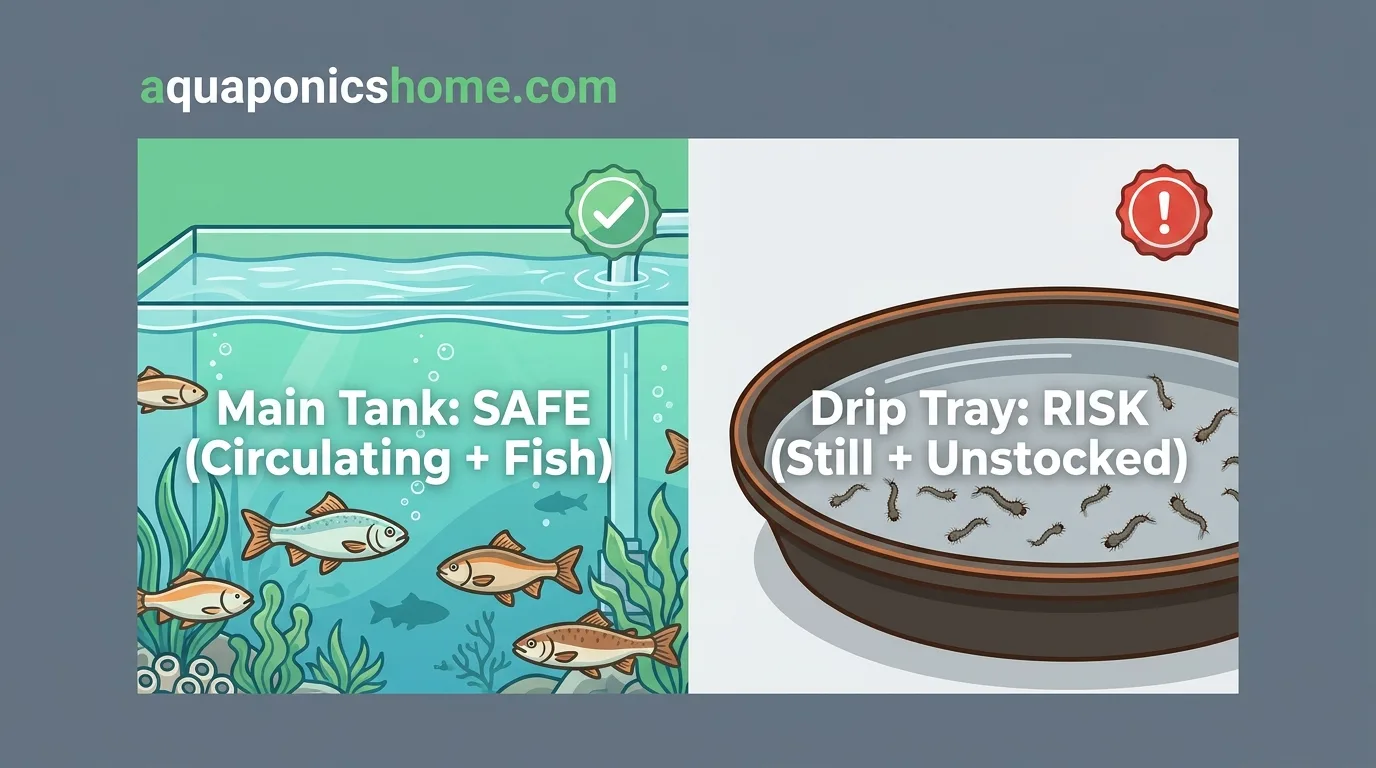
Short answer: if you have found mosquito larvae in a water tank garden, the tank is usually not the problem. A stocked, circulating aquaponics system is a hostile place for larvae, because the surface is moving and there are fish eating anything small that wriggles. Mosquitoes breed in the other water around it: the drip tray under the system, the saucer under a pot, the spare tote, the bucket you rinse media in, the sump your fish cannot reach, and the still corner of the grow bed. Find the container, empty it or move its water, and you have solved the problem at the source. Do not pour insecticide into a system that contains fish.
Mosquitoes are a public health matter, not only an annoyance. In places where dengue, chikungunya, Zika or malaria circulate, the container of water on your balcony is part of a bigger picture, and it is worth doing this audit properly rather than quickly.
Why the fish tank is usually innocent
Mosquito larvae need three things, and a running aquaponics system denies them all.
A still surface. Female mosquitoes lay on the surface film of undisturbed water. Moving water, ripples and turbulence break up that surface, and larvae themselves have to hang at the surface to breathe through a siphon tube. Circulation interferes with both stages.
No predators. Larvae are exactly the size and shape of food. Almost any fish you would keep in a small home system will eat them enthusiastically, and in a stocked tank they simply do not last.
Time. The larval and pupal stages take days, not hours. Any water that is disturbed, drained, refilled or eaten out of on a daily cycle rarely gives them a full run.
So when someone finds wrigglers, the useful question is not “how do I treat my tank” but “which water in my setup is still, unstocked and undisturbed.” That is nearly always somewhere else.
The audit: every container around your system
Do this with a flashlight, and look at the surface rather than the bottom. Larvae hang just under the surface and dart down when disturbed, so movement when the light hits is the giveaway.
| Where to look | Why it breeds | The fix |
|---|---|---|
| The drip tray or containment tray under the system | It exists specifically to hold water, and if it has caught a few days of drips it is a perfect breeding container. The safety measure becomes the habitat | Keep it dry between failures, or drill it to drain. Never leave it holding standing water |
| Saucers under pots and seedling trays | Small, still, in shade, refilled by every watering | Empty after watering, or remove the saucers entirely |
| The sump or reservoir, if fish cannot reach it | Still water with no predators is the one place inside your own system that qualifies | Screen it, or ensure surface movement reaches it |
| Still corners and dead zones in the grow bed | Water pooling where flow does not reach, especially in a constant-flood design | Improve flow or raise the bed’s turnover so nothing sits |
| Spare totes, barrels, buckets and the media rinse bucket | Filled once, forgotten, left in shade | Store them upside down. This is the single most effective habit change |
| Balcony drains, gutters and blocked outlets | Slow drainage leaves a permanent shallow puddle | Clear them. This is also the outlet your leak plan depends on |
| Plant pot rims, tarpaulin folds, upturned lids, old tires | Astonishingly small volumes are enough | Tip, remove, or turn over |
| Rainwater collection | Deliberately still, deliberately covered | Fit a fine mesh over the inlet and keep it sealed |
The World Health Organization’s dengue guidance is clear that Aedes aegypti, the primary dengue vector, lives in urban habitats and breeds mainly in man-made water-holding containers. The California Department of Public Health’s fact sheet on the same species lists dishes under potted plants, bird baths and discarded containers among the typical sites, and notes that this species bites during the day, with peaks in the morning and before dusk. Read that list again with your own balcony in mind. It describes a small-space garden almost exactly.
That is the honest and slightly uncomfortable point: the aquaponics system is probably fine, but the collection of containers that comes with any container garden is not automatically fine, and it is your responsibility either way.
The tray you added for safety is the likeliest culprit
I want to give this its own heading because it is the finding nobody writes about, and it catches careful people rather than careless ones.
If you followed sensible advice and put a containment tray under your system to catch a leak, you have installed a wide, shallow, permanently shaded vessel whose entire purpose is to hold water. Small drips from a fitting keep it topped up. Nothing circulates it. No fish can reach it. It is, structurally, the best mosquito habitat on the balcony, and it was added by someone doing the right thing.
The fix is not to remove the tray. The tray is still correct, and the reasoning behind it is in leak and overflow protection. The fix is to keep it dry between real failures: wipe it out when you check the system, fix the drip that is feeding it, or give the tray a drain so it holds water only during an actual event. A dry tray still catches a flood. A wet tray breeds mosquitoes every week of the year.
Fixes, in the order that works
Work down this list. The earlier fixes are permanent and free; the later ones are maintenance you will have to keep doing.
- Remove the water. Empty and store containers upside down. Tip saucers. Clear the drain. Water that is not there cannot breed anything, and no other control is as reliable.
- Move the water. Where the water has to stay, keep the surface disturbed. An air stone, a return jet aimed to break the surface, or better circulation in a sump does the job. Surface agitation also raises dissolved oxygen, so it is a fix that pays twice.
- Screen the water. Fine mesh over any covered vessel, fitted so there are no gaps at the edges. Mesh is the answer for rain barrels and closed sumps where you cannot introduce fish or turbulence.
- Let the fish reach it. If a still zone can be made accessible to your existing fish, it stops being a nursery. This is a design change, not a treatment.
- Skim visible larvae and egg rafts. A fine net or a splatter screen removes what you can see immediately. It is a same-day measure, not a solution, because the source is still there.
Only after those five is there any reason to think about a product.
About larvicides, and the rule that matters
Do not put insecticide into a system containing fish. Not a spray, not an oil film, not a household bug product, not “just a little.” Products intended to kill insects are routinely toxic to fish and other aquatic life, and in an aquaponics system you also have a bacterial colony keeping your fish alive and vegetables you intend to eat. There is no version of this that is worth the risk.
The commonly cited fish-safe option for standing water is Bti, Bacillus thuringiensis israelensis, a naturally occurring bacterium sold in slow-release forms for mosquito control. The Washington State Department of Health describes Bti as the primary material used for mosquito larval control specifically because of its low toxicity to non-target species, and explains that larvae must eat it for it to work, which is why it acts on early larval stages rather than on eggs, pupae or adult mosquitoes.
If you consider using it, three conditions apply and none of them are optional:
- The product label governs everything. Where it may be used, at what rate, in what kind of water, and whether that particular formulation is approved for use in water containing fish or in water associated with food production is stated on the label, and the label is the legal instruction. I do not publish doses for anything that goes into a system with animals and food in it, and you should be wary of any site that does.
- Registration and permitted uses differ by country. What is sold for garden ponds in one place may not be approved for the same use in another. Check with your own national or local authority, not with a blog.
- It does not replace source removal. Bti treats a container. Emptying the container solves it. If you find yourself dosing the same tray every fortnight, the tray is the problem.
And do not introduce mosquitofish. This is the recommendation the search results are full of, and it is the one I would push back on hardest. Gambusia affinis is a well-known invasive species in many regions, and releasing or keeping non-native fish is regulated in a lot of places. Adding a species to your system for pest control, when you already have fish that eat larvae and a circulation system that prevents them, is solving a problem you can solve with a bucket and a flashlight by importing a bigger one. If you want a fish-based answer, the fish you already keep are the answer.
If people in your home are being bitten or are unwell
This is where a gardening article should stop and say so plainly.
Mosquito-borne illness is a medical matter. If anyone in your household develops a fever, severe headache, pain behind the eyes, joint or muscle pain, a rash, or any warning sign after being bitten, contact a doctor or your national health service promptly rather than looking for answers on a gardening site. Dengue in particular can become severe, and the World Health Organization’s dengue guidance is the appropriate starting point for what the disease is and what warning signs mean. I am a balcony gardener. I am not qualified to tell you what a symptom means, and I will not try.
For prevention around the home, follow your own national or municipal public health authority’s advice on personal protection and container control. In many countries there is a local mosquito control program that will advise, and in dengue-endemic areas there is usually a seasonal campaign with specific instructions for exactly the kind of containers listed above.
Preventing it next season
Mosquito pressure is seasonal in most climates, and the work is easier before it starts than during it.
- Make “turn containers over” part of packing up. Every bucket, tote and tray stored upside down.
- Check the tray and the drain weekly. Add it to the same walk-around where you check readings and fittings, alongside the rest of the routine troubleshooting order.
- Fix drips rather than catching them. A leak that keeps a tray wet is now two problems.
- Think about siting. Deep shade, poor drainage and no airflow favor mosquitoes, and they also make for a worse system. Where you put the system affects this more than any treatment.
- Keep the surface moving. If circulation stops when the pump stops, remember that an outage is also a mosquito window, not only an oxygen one.
FAQ
Can mosquitoes breed in an aquaponics system?
Rarely, if the system is stocked with fish and the water is circulating. Larvae need still surface water and no predators, and a running system offers neither. When larvae do appear inside a system it is almost always in a still zone the fish cannot reach, such as a separate sump, a dead corner of a grow bed, or the system during a prolonged pump outage.
Will my fish eat mosquito larvae?
Yes. Most fish kept in small home systems take mosquito larvae readily, which is why an accessible, stocked tank rarely produces adult mosquitoes. The limitation is geometric rather than biological: fish only control the water they can physically reach.
Is it safe to use mosquito dunks in an aquaponics system?
Products based on Bti are widely described by public health authorities as having low toxicity to non-target species including fish, but the product label is what governs whether a specific formulation may be used in water containing fish or associated with growing food, and approvals differ by country. Read the label, check with your local authority, and treat source removal as the real fix. Never use a general insecticide, oil film or household bug product in a system with fish.
How do I stop mosquitoes without chemicals?
Remove standing water first, then keep any water that must stay in motion with an air stone or a return jet that breaks the surface, then screen anything covered with fine mesh. Those three steps handle almost every case in a small garden. Skimming visible egg rafts and larvae with a fine net helps immediately while you deal with the source.
Should I add mosquitofish to control larvae?
No. Gambusia affinis is invasive in many regions and keeping or releasing non-native fish is regulated in a lot of places. If your system already holds fish, they perform the same job without the ecological and legal risk. Improving access and circulation is a better answer than adding a species.
I run small aquaponics systems on a rented balcony and this article is about finding and removing breeding sites, nothing more. It is not medical advice and not a pest control recommendation. At the time of writing, the World Health Organization’s dengue guidance describes Aedes aegypti as an urban, container-breeding vector; the California Department of Public Health publishes an Aedes aegypti fact sheet covering its daytime biting behavior and typical container habitats; and the Washington State Department of Health describes Bti as the primary mosquito larvicide used because of its low toxicity to non-target species. For symptoms after mosquito bites, contact a doctor or your national health service. For product use, follow the label and your local authority.