
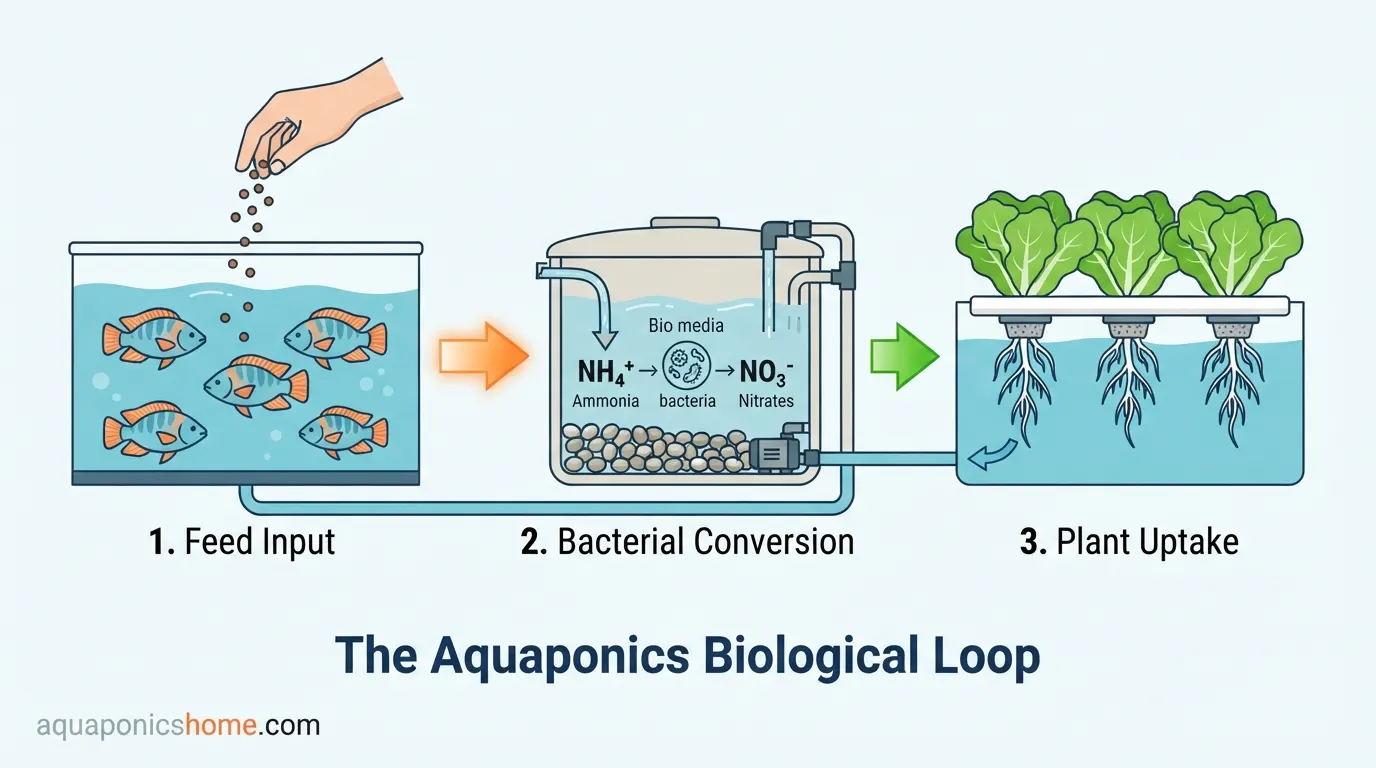
Aquaponics fish feeding works differently from feeding a pet fish: the amount is tied to how much plant area the feed has to nourish, not only to how many fish you keep.
For raft systems, the Southern Regional Aquaculture Center’s fact sheets cite a University of the Virgin Islands guideline of 2 to 4 ounces of feed per day for every 10 square feet of plants. Use a complete floating pellet made for your species, feed only what the fish clear, and remove leftovers, because uneaten feed rots into exactly the problems the system is built to prevent.
The rest of this page explains where that guideline comes from, why it changes for media beds and pipe systems, what the “overfeeding trap” actually is, and how feed choices end up in the vegetables you eat.
Why Feed Is the Engine of the Whole System
In a normal fish tank, feed is fish food. In aquaponics, feed is also plant fertilizer, delivered after passing through a fish and a colony of bacteria.
SRAC Publication No. 5007, Principles of Small-Scale Aquaponics (Mullins, Nerrie and Sink, Virginia State University Cooperative Extension and Texas A&M AgriLife Extension, 2015, read September 24, 2026) puts it in one line: nutrients are a function of the food fed to the fish.
That is why the design question in aquaponics is not “how much do my fish want?” but “how much feed goes in each day, compared with how much plant area has to use it?”
The longer fact sheet in the same series, SRAC Publication No. 454 (Rakocy, Masser and Losordo, 2006 revision, hosted by the University of Kentucky aquaculture program, read September 24, 2026), calls the ratio of daily feed input to plant growing area the key design ratio.
Too much feed for the plant area and nutrient salts build up quickly, possibly to levels that harm plants. Too little and plants develop deficiencies.
How Much: Aquaponics Fish Feeding Rate, Sized by Your Plants
The sourced numbers below all come from raft systems, where plants float on foam boards over deep channels of water. That detail matters, as the next section shows.
| Source | Guideline for raft systems | Notes from the same source |
|---|---|---|
| SRAC 454 (2006) | 60 to 100 grams of fish feed per square meter of plant growing area per day | Use the low end for small plants such as Bibb lettuce and the high end for larger plants such as romaine or Chinese cabbage |
| SRAC 5007 (2015), citing the University of the Virgin Islands | 2 to 4 ounces of feed per day to support 10 square feet of plants (the fact sheet converts this to 56 to 100 g per square meter per day) | Called a general guideline for small-scale systems |
Why the numbers shrink for media beds and pipe systems
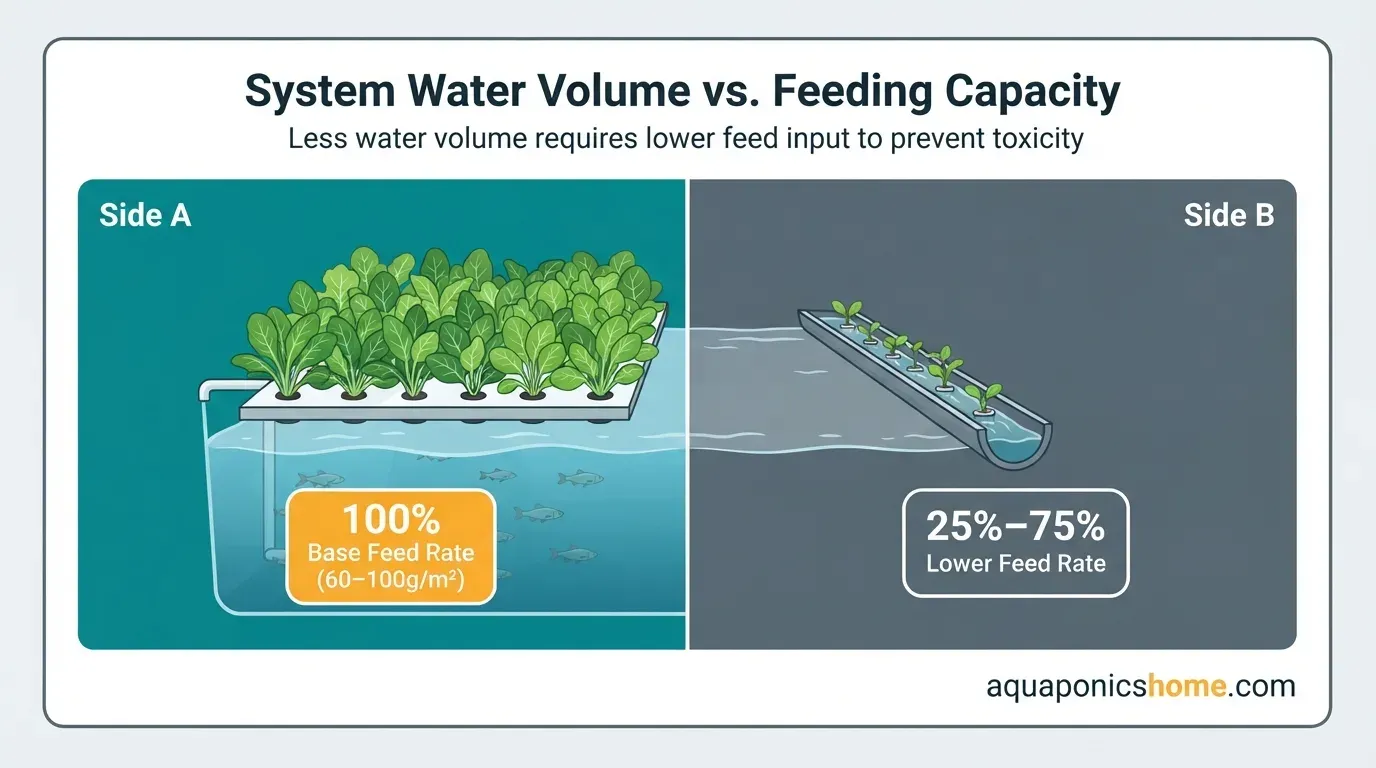
Raft beds hold most of a system’s water. SRAC 454 explains that in raft systems roughly 75 percent of the water sits in the plant beds, while gravel beds and NFT channels (the narrow pipes where a thin film of water runs past the roots) hold very little. Put the same feed into less water and the dissolved nutrients become far more concentrated.
Here the two fact sheets disagree, and it is worth seeing the disagreement rather than hiding it:
- SRAC 454 says gravel and NFT systems should run a feeding rate ratio of roughly 25 percent of the recommended raft ratio.
- SRAC 5007 says an NFT system would generally use only 25 to 75 percent of the raft feeding rate, depending on the plant species, the design and the growing area.
Both come from the same regional aquaculture center. For the flood-and-drain gravel beds many home systems use, SRAC 454 also offers a volume rule instead of a feed figure: 1 cubic foot of fish tank to 2 cubic feet of pea gravel, with the fish “fed appropriately.” The reading: if your system is not a raft, start well below the raft figure and let your plants and test readings tell you whether to move up.
Turning a ratio into a starting point
A ratio is only useful once you know your own plant area. Measure the growing surface in square feet, then weigh the feed you actually give for a week on a kitchen scale rather than guessing by the pinch.
As plain arithmetic on the raft guideline: a single 4-by-8-foot raft bed is 32 square feet, so 2 to 4 ounces per 10 square feet works out to roughly 6.4 to 12.8 ounces of feed per day. That number describes what a raft bed of that size can use. It does not mean your fish can or should eat it.
If your fish clear far less than the plants could use, the plants may run short; the answer is to adjust plant area or stocking gradually and within safe limits, never extra pellets sinking to the bottom.
What to Feed
Use a complete, commercially made pellet designed for your fish, not kitchen scraps or bread. SRAC 5007 recommends floating pellets containing 28 to 36 percent crude protein for tilapia, and notes that other species differ: koi may need as little as 22 percent protein, while hybrid striped bass may need 40 percent or more. Floating pellets have one practical advantage for beginners: you can see what is left.
Pellet size matters too. SRAC 5007 says pellets should be small enough for fish longer than 2 inches to eat, and that for smaller fish pellets can be mashed into a powder, though smaller fish often need a higher protein content. For the protein level and pellet size right for your species, ask a local extension aquaculture specialist or check the feed maker’s label for that species.
The Overfeeding Trap
You will often read that overfeeding is the biggest beginner mistake. It is really two different mistakes that look alike.
Trap one: feed the fish never eat
Pellets left in the tank do not disappear. SRAC 454 lists uneaten feed as a source of solid waste and explains that as this organic matter decays it lowers dissolved oxygen and produces carbon dioxide and ammonia.
If deep sludge builds up, it breaks down without oxygen and can produce methane and hydrogen sulfide, which the fact sheet describes as very toxic to fish. SRAC 5007 adds that fish waste and uneaten food can quickly lead to toxic conditions and clog a system.
If a test ever shows ammonia climbing after a stretch of heavy feeding, treat it as the emergency it is. Our guide to what to do when aquaponics ammonia is too high walks through the first hour.
Trap two: feed they eat, but more than the plants can use
The second trap is quieter. The fish eat everything, the water looks fine, and yet the system drifts out of balance because more nutrients go in each day than the plant area can take up.
SRAC 454 warns that a feed-to-plant ratio that is too high lets nutrient salts accumulate rapidly. SRAC 5007 adds a seasonal version: fish fed while plants are not actively growing, as in a cold winter, can be harmed by toxic nitrogen concentrations.
The opposite also happens. Feed too little for the plant area and plants run short, which is the situation described in aquaponics low nitrate.
Signs you are overfeeding
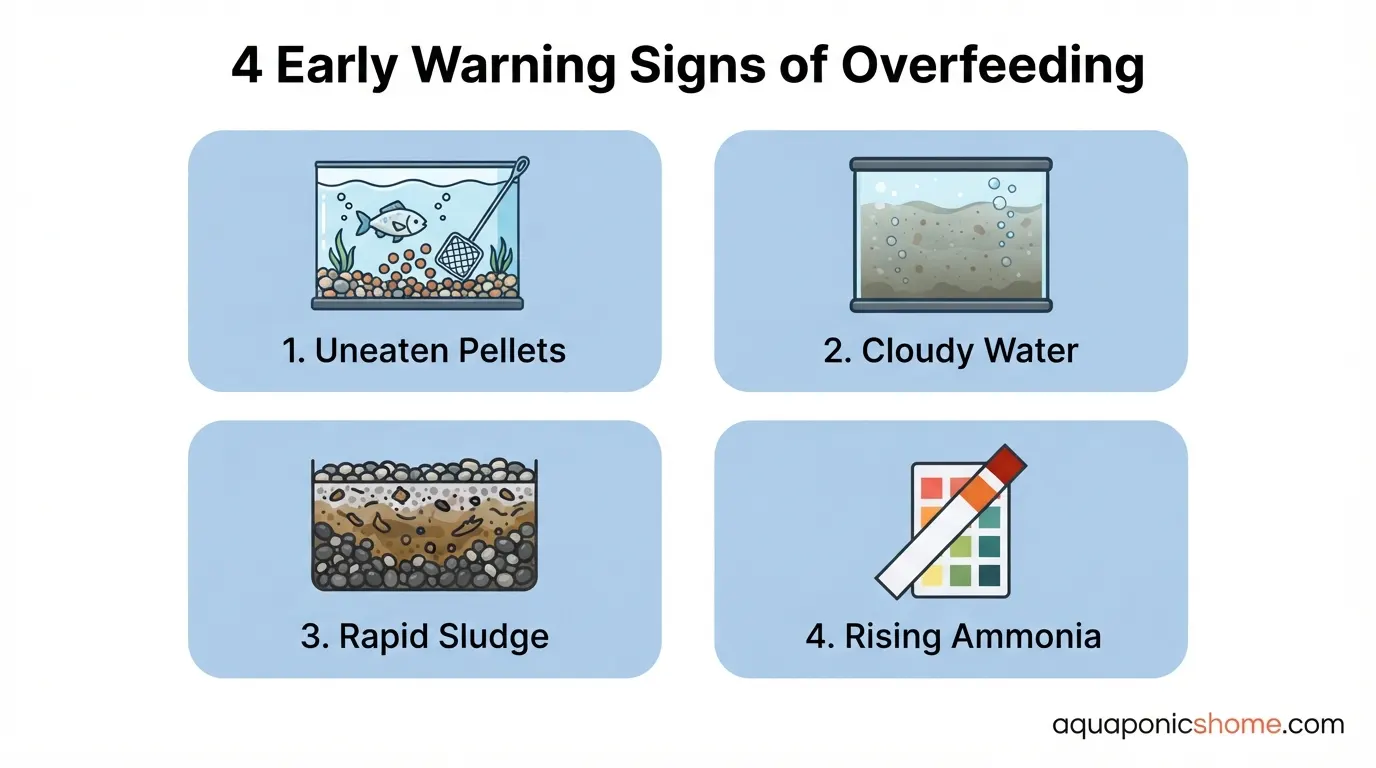
None of these needs a number to spot:
- Pellets still floating or sitting on the bottom after the fish lose interest
- Water turning cloudy or starting to smell
- Sludge building faster than usual in the tank or media bed
- Ammonia or nitrite readings rising when nothing else has changed
A Simple Daily Feeding Routine
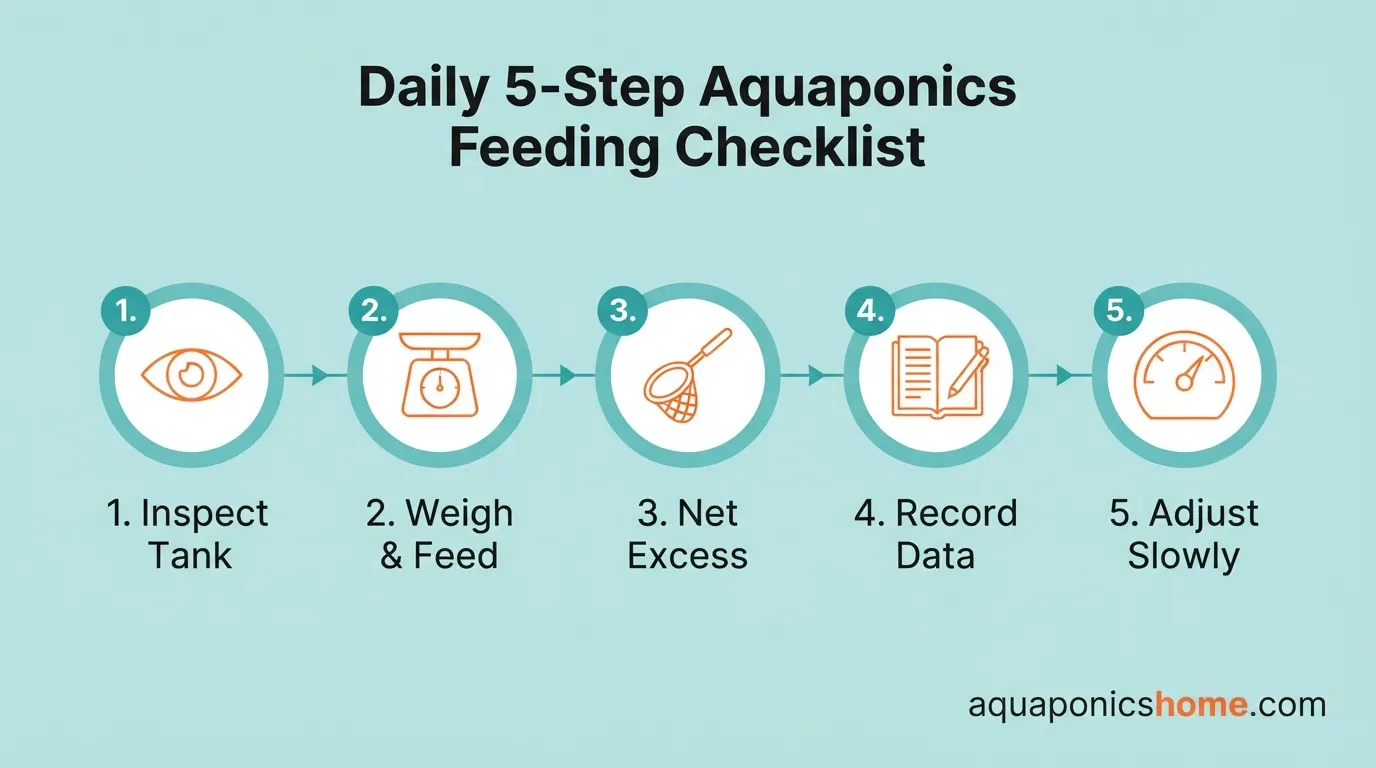
SRAC 5007 lists observation, feeding, siphoning off settled solids and recording data, including feeding activity and the quantity fed, among daily maintenance tasks. Turned into a routine:
- Look before you feed. Check that fish are swimming normally and that yesterday’s feed is gone.
- Feed a weighed amount and watch the fish eat.
- Remove what they leave. Net or siphon leftovers once the fish stop feeding.
- Write it down. Date, amount, how eagerly they ate, water temperature.
- Adjust slowly. Change the amount a little at a time and give the system days, not hours, to show the effect.
Appetite also moves with water temperature, stress and season. If your fish suddenly stop eating, the causes and the warning signs are covered in why aquaponics fish stop eating.
What Your Feed Means for What You Eat
In an edible system, the feed bag is the first ingredient in your salad. Three sourced points:
- Salt. SRAC 454 notes that salt is added to fish feed during manufacture, and that high sodium interferes with potassium and calcium uptake in plants, which in lettuce shows up as tip-burn. It adds that a producer ordering large quantities of feed could ask for it without added salt, if that does not affect fish health.
- Medication. SRAC 454 states that treatments for fish parasites and diseases should not be used in aquaponics because vegetables may absorb and concentrate them. Medicated feed is therefore a decision for an aquatic veterinarian, not a home fix, and this site does not publish treatments or doses.
- Storage. SRAC 5007 recommends storing feed in a cool, dry place, preferably in a sealed container that keeps out insects and rodents. Feed that has gotten wet or looks moldy does not belong in the tank.
For the wider question of eating food from a home system, start with whether food from a home aquaponics system is safe to eat.
What This Page Cannot Tell You
The sourced feeding ranges above describe plant capacity in raft systems. They are not a per-fish ration, and the fact sheets used here do not give a single daily amount per fish for every species and size.
For a ration suited to your species, water temperature and fish size, ask an extension aquaculture specialist. If your fish show signs of illness rather than a simple change in appetite, contact an aquatic veterinarian or your state’s extension aquaculture service. Do not add supplements or anything else to the water to force appetite back.
FAQ
How much should I feed fish in aquaponics?
For raft systems, SRAC 5007 cites a University of the Virgin Islands guideline of 2 to 4 ounces of feed per day per 10 square feet of plants, and SRAC 454 gives 60 to 100 grams per square meter per day. Gravel and NFT systems use less. Feed only what your fish actually eat.
How do I know if I am overfeeding my aquaponics fish?
Leftover pellets, cloudy or smelly water, fast sludge build-up and rising ammonia or nitrite readings are the common signs. Remove uneaten feed and reduce the amount gradually.
What protein level should aquaponics fish feed have?
It depends on the species. SRAC 5007 recommends 28 to 36 percent crude protein floating pellets for tilapia, notes koi may need as little as 22 percent, and says hybrid striped bass may need 40 percent or more.
Can I feed my aquaponics fish kitchen scraps?
Use a complete pellet made for your species as the diet. Scraps and bread are not balanced feed, and anything uneaten decays in the water.
Should I keep feeding in winter when plants are not growing?
Feed less and watch the water closely. SRAC 5007 warns that fish fed while plants are not actively growing can be harmed by toxic nitrogen concentrations.