
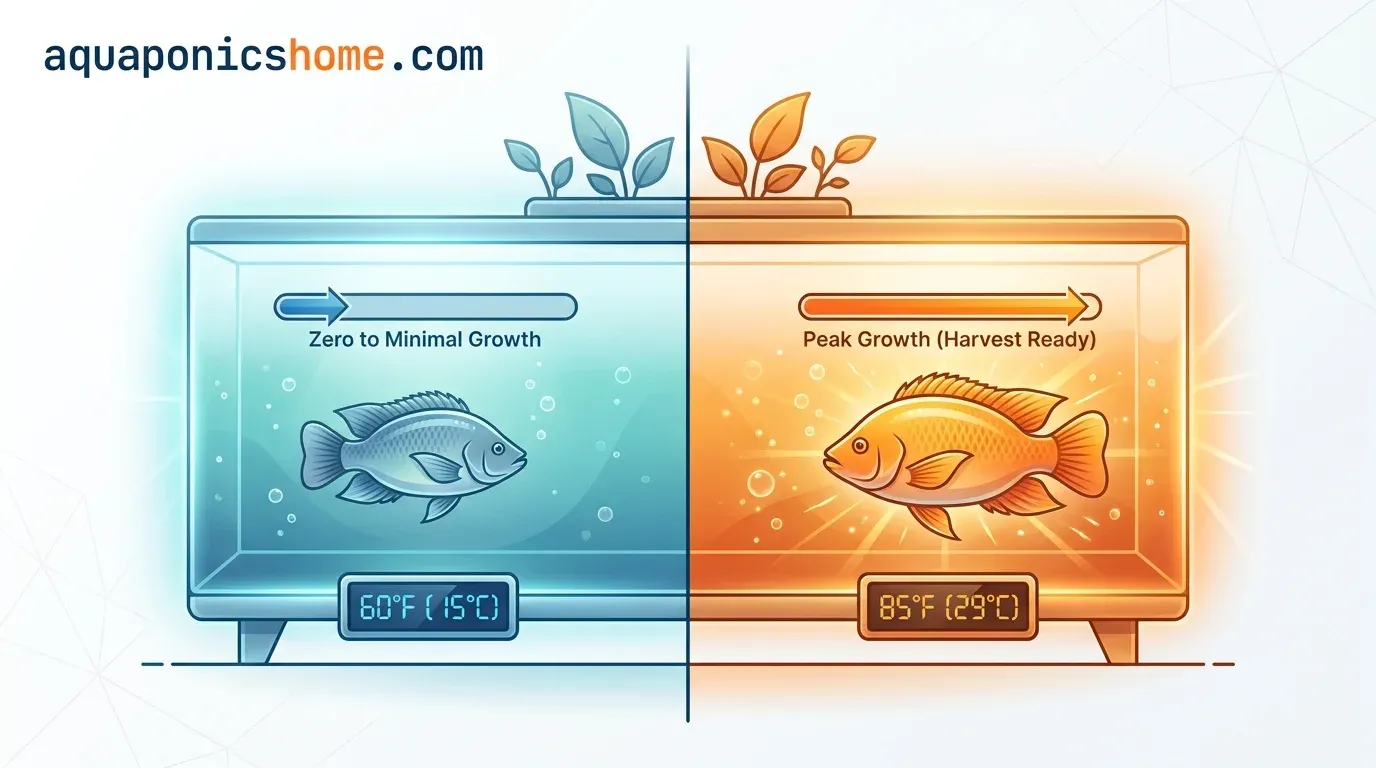
Aquaponics fish growth time is set mostly by water temperature, not by the system itself. The fastest published figure comes from the University of the Virgin Islands, where tilapia stocked at about 2 oz grow to about 2 lb in 24 weeks in a tropical commercial system.
Texas A&M AgriLife Extension puts market-size tilapia at seven to ten months when water quality and temperature are held in a favorable range, and Mississippi State University Extension says food-size channel catfish take 18 to 36 months from egg. In a home system in the US or Canada, count only the months your water actually sits in the fish’s growth range.
That last sentence is the whole article in small form. The rest explains where the headline numbers come from, why a home tank rarely matches them, what size counts as finished, and the situations where growing fish out to eating size is not worth attempting at all.
The Short Answer, Species by Species
Most guides give one month count per species with no conditions attached.
The table below keeps each figure next to the source that published it and the conditions it assumes, because a number without its water temperature is not much use to a home grower.
| Species | Temperature the source gives | What the source says about time | Source |
|---|---|---|---|
| Tilapia | Best growth about 85 to 88°F (29 to 31°C); feeding generally stops below 63°F (17°C) | 50 g (2 oz) fingerlings to about 900 g (2 lb) in 24 weeks, in a tropical commercial system | University of the Virgin Islands (time); Popma and Masser (temperature) |
| Tilapia | “Favorable” temperature and water quality, not specified further | Market-size fish in seven to ten months | Texas A&M AgriLife Extension |
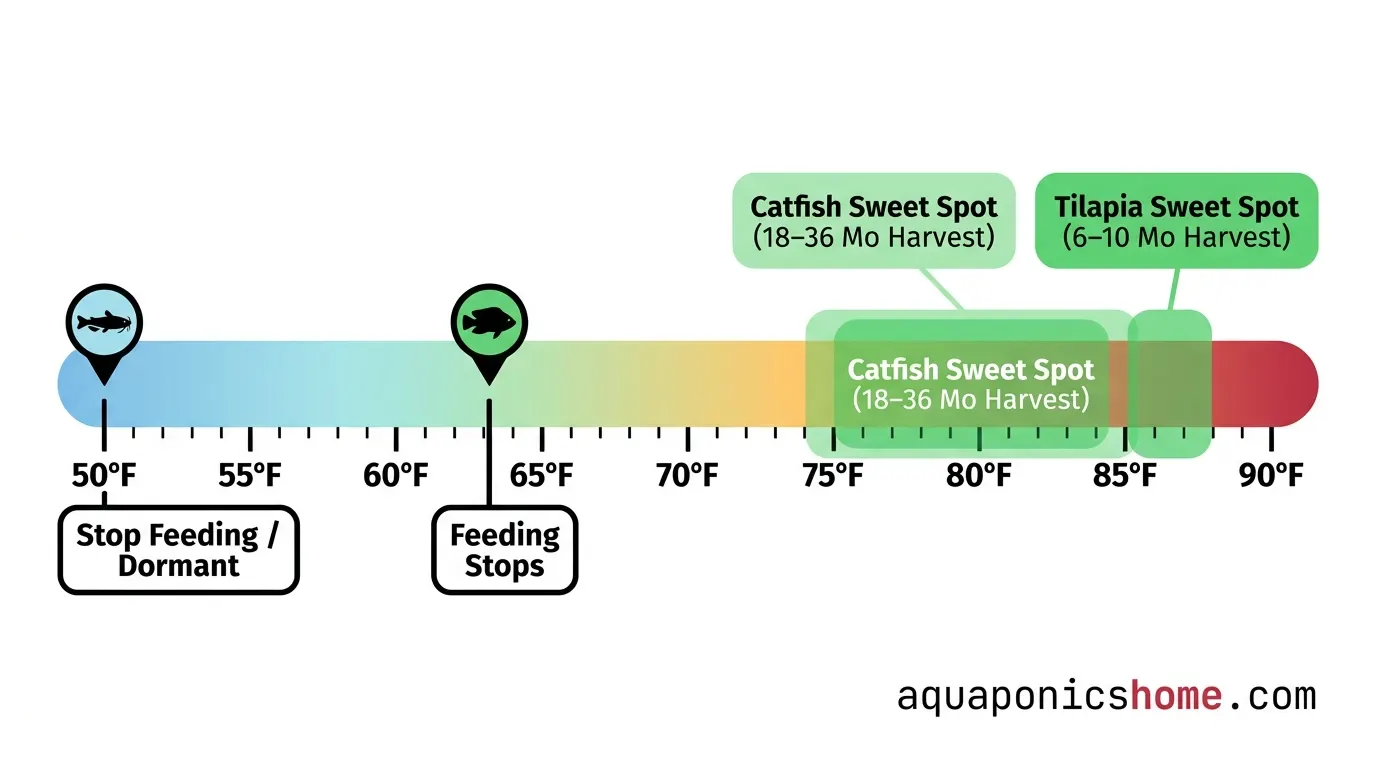
| Channel catfish | Best growth 75 to 85°F (24 to 29°C); slow below 65°F (18°C); feeding essentially stops below about 50°F (10°C) | 18 to 36 months from egg to food size, of which 5 to 10 months is spent reaching 3 to 8 inch fingerlings | Mississippi State University Extension |
This article sticks to the two species with extension-published grow-out figures. For trout, perch, bluegill or anything else, treat any single month count you read as a best case unless the page says what water temperature produced it.
Why Aquaponics Fish Growth Time Is Really a Temperature Question
Fish do not make their own body heat. Their appetite, digestion and growth follow the water they live in, so a cold month is not a slow month, it can be a month of almost no growth at all.
The numbers make this concrete. Thomas Popma of Auburn University and Michael Masser of Texas A&M University, in their tilapia life history and biology fact sheet (read September 24, 2026), state that tilapia generally stop feeding when the water falls below 63°F and that optimal growth happens at about 85 to 88°F.
Mississippi State University Extension’s catfish biology page (read September 24, 2026) gives channel catfish an optimum of 75 to 85°F, says growth is slow below 65°F, and says feeding essentially stops below about 50°F.
A fish that is not eating is not growing. If your fish have gone off their food as the weather cooled, the usual reasons aquaponics fish stop eating start with temperature for exactly this reason. Cold also slows the bacteria and the plants, which is covered in what water temperature does across the whole system.
Where the Fast Numbers Come From
The 24-week tilapia figure is real, and it is worth knowing what produced it. The University of the Virgin Islands Commercial Aquaponic System page (read September 24, 2026) describes fingerlings stocked at about 2 oz (50 g) and reared for 24 weeks to 2 lb (900 g).
Water is pumped continuously through each rearing tank at 25 gallons (100 liters) per minute, a full volume exchange every 1 hour 20 minutes, and the tanks are shaded to keep the water cool and reduce algae.
That is a Caribbean research station, running warm water all year, with staff and a commercial-scale plumbing design. It is the ceiling for what tilapia can do in aquaponics, not a forecast for a tank in a Chicago basement.
Popma and Masser give a similar picture from ponds. Under favorable conditions in all-male grow-out ponds with adequate temperature, they report males reaching about half a pound in 3 to 4 months, 1 pound in 5 to 6 months and 1.5 pounds in 8 to 9 months.
The same fact sheet notes that males grow about twice as fast as females, so a mixed-sex batch will not keep pace with those figures.
Count Growing Months, Not Calendar Months

Here is the practical method for turning a published figure into your own honest estimate. It uses no numbers you have to trust from us, only your own water and a named source.
- Find the growth range for your species from a university or extension source, as in the table above.
- Measure water temperature, not air temperature. A tank in a garage, a basement, a heated living room and a sunny patio will each track a different curve through the year.
- Mark each month as in range, partly in range, or below the feeding cutoff. A tilapia tank that spends a month below 63°F has, by Popma and Masser’s figure, spent that month mostly not eating.
- Compare your in-range months with what the source assumed. Published grow-out times assume nearly every month is a growing month. If yours are not, expect the calendar time to stretch well beyond the published figure.
This is also why an indoor tank at ordinary household room temperature can disappoint with tilapia. A comfortable living room sits well below the 85 to 88°F range Popma and Masser give as optimal, so fish survive and eat but do not grow at the pace the headline numbers suggest.
Temperature is not the only brake
Feeding, crowding and water quality also slow growth. Fish can only grow on what they eat, and poor water from too many fish or too much uneaten feed suppresses appetite.
On tilapia, the sex mix matters too, as noted above. Temperature is simply the brake a home grower most often cannot see, because the tank looks the same at 64°F as it does at 84°F.
What Size Counts as Done?
“Plate size” is a choice, not a biological finish line. Mississippi State University Extension says commercial channel catfish are harvested when they reach 1 to 2 pounds.
The University of the Virgin Islands system grows tilapia to 2 lb. Popma and Masser’s pond figures run from half a pound to 1.5 pounds depending on how long the fish are kept.
Smaller fish come out sooner and give less meat each. Larger fish take longer, eat more feed and take up more room as they grow, which means the total weight of fish in your tank climbs steadily toward harvest day. That final weight is the number your tank has to cope with, so decide your target size before you stock, not after.
This is where tank size stops being abstract. Before planning a harvest, read the honest limits of a small aquaponics tank, because a target weight that looks modest per fish can add up to more than a small tank should carry.
When Not to Bother Growing Fish Out
Growing fish to eating size is one reasonable goal among several. It is the wrong goal in some setups, and saying so plainly saves money and fish.
- Your water cannot stay in range through winter. Popma and Masser put the lower lethal temperature for most tilapia species at 50 to 52°F for a few days. An unheated tropical fish in a northern winter is not a slow-growth problem, it is a welfare problem. Choose a species that suits the water you actually have.
- The species may not be legal where you live. Texas A&M AgriLife Extension’s tilapia page (read September 24, 2026) notes that Texas Parks and Wildlife requires an exotic species permit to stock and transport tilapia. Rules differ by state and province, so check with your state fish and wildlife agency or provincial ministry before you buy fingerlings.
- You do not want to harvest. Keeping fish purely as the nutrient source for your vegetables is a legitimate way to run aquaponics. The plants become the harvest and the fish stay.
- You have not looked at the food-safety side. If the fish are for the table, read whether food from a home aquaponics system is safe to eat before harvest day, not after.
Staggered Stocking: How the Research System Gets a Steady Harvest
The University of the Virgin Islands system harvests one rearing tank every six weeks and staggers stocking “to achieve a fairly consistent input of feed.” That detail matters more to a home grower than the 24-week figure does.
In aquaponics, fish feed is the nutrient source for the plants. When a whole batch of fish comes out at once, the feed going into the system drops, and so does the nitrate the grow bed was living on.
A multi-tank rotation smooths that dip. A single-tank home system cannot copy it, but the principle still applies: plan what goes into the tank next before the last fish comes out, and time the harvest for a point when your plants can tolerate a lean spell.
If Your Fish Look Unwell
Slow growth is often a temperature or feeding story, but not always. This site does not diagnose fish disease or suggest medications, and in a system that grows food, any treatment is also a question about what ends up on your plate.
If fish look sick, stop guessing and contact an aquatic veterinarian or your state or provincial extension aquaculture specialist.
FAQ
How long do tilapia take to grow in aquaponics?
It depends on water temperature. The University of the Virgin Islands reports 50 g fingerlings reaching about 2 lb in 24 weeks in a warm commercial system, and Texas A&M AgriLife Extension says seven to ten months to market size under favorable conditions. A cooler home tank will usually take longer.
Do catfish grow slower than tilapia?
Published figures suggest a longer timeline. Mississippi State University Extension says food-size channel catfish take 18 to 36 months from egg, of which 5 to 10 months is the fingerling stage. If you buy fingerlings, part of that time has already passed.
Will my fish keep growing through the winter?
Only if the water stays warm enough. Popma and Masser state tilapia generally stop feeding below 63°F, and Mississippi State says catfish feeding essentially stops below about 50°F. A fish that is not eating is not growing.
What size should I harvest aquaponics fish?
There is no single right size. Commercial catfish are harvested at 1 to 2 pounds, per Mississippi State University Extension. Decide your target before stocking, because the final weight of all your fish together has to fit your tank.