
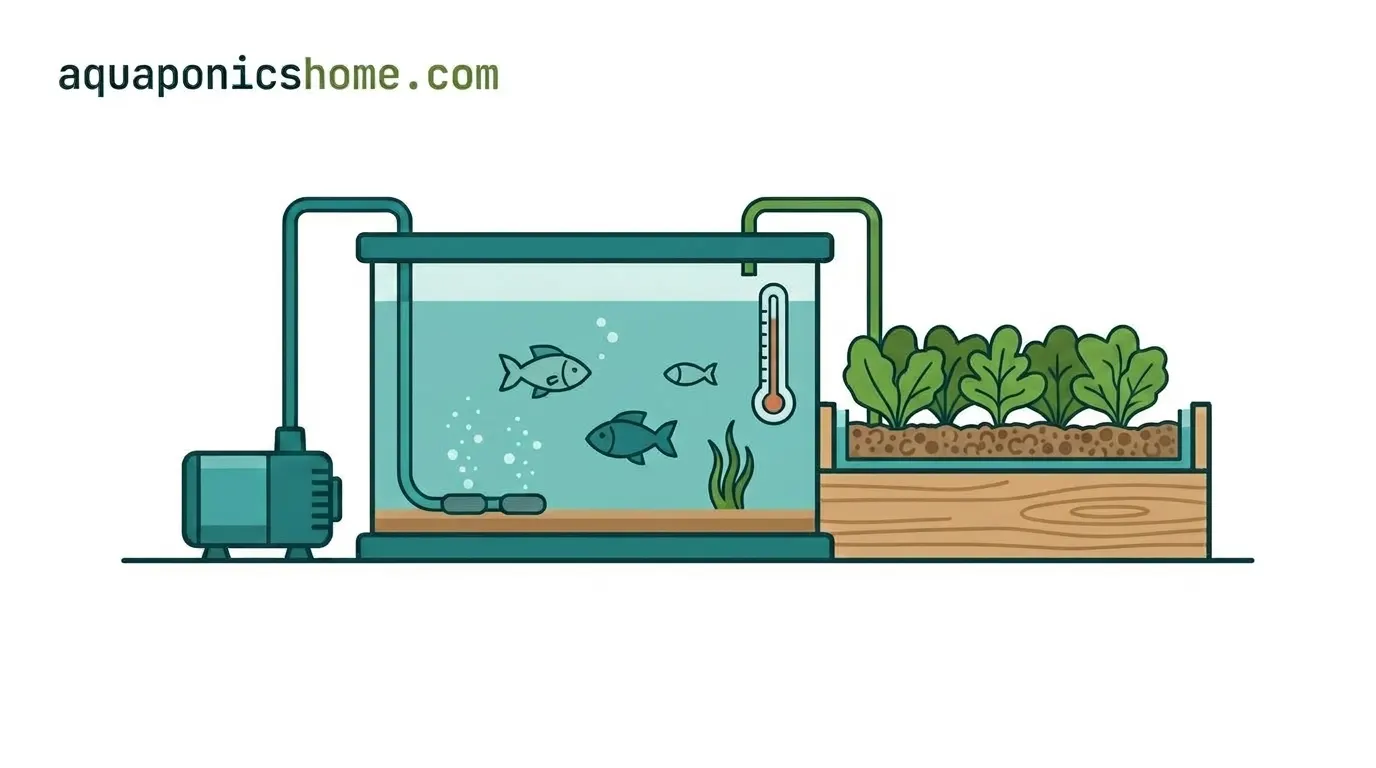
An aquaponics daily checklist comes down to five things you can check with your eyes and ears in about two minutes: the pumps are running, water is flowing into the grow bed, the water level has not dropped, the fish look and act normal, and nothing on the plants looks new and wrong.
Feeding is when you watch the fish most closely. Water testing is mostly a weekly job once a system is established, but a new system needs testing every day.
That short list is based on the daily routine the United Nations Food and Agriculture Organization (FAO) publishes for small aquaponic units, trimmed to what fits before you leave the house. Below is the list, what “normal” should look like, and what to do the moment a check fails.
Why a Daily Check Matters at All
An aquaponic system is a loop. The pump moves water from the fish tank to the plants, the plants and bacteria clean it, and it drains back. When one part stops, the rest keeps going for a while, and then everything fails together.
Most of the failures that harm fish are quiet. A pump clogs overnight. A fitting starts dripping. An air stone stops bubbling. None of these makes a loud noise, and all of them are obvious if you look for ten seconds.
The daily check is not about perfect water chemistry. It is about catching a stopped pump or a falling water level while it is still a small problem.
The FAO Daily Routine, in Full
FAO’s practice brief Management of the aquaponic systems (FAO, 2015, read 2026-09-27), drawn from its manual on small-scale aquaponic food production, lists these daily tasks:
- Check that the water and air pumps are working well, and clear their inlets of obstructions.
- Check that water is flowing.
- Check the water level and top up for evaporation as needed.
- Check for leaks.
- Check water temperature.
- Feed the fish, “two to three times a day if possible,” remove uneaten feed and adjust feeding rates.
- At each feeding, check the behavior and appearance of the fish.
- Check the plants for pests.
- Remove any dead fish and any sick plants or branches.
- Remove solids from the clarifier and rinse any filters.
That is the complete list. It is thorough, and on a busy morning it is more than most people will do. So it helps to split it into what you glance at and what you do when you have time.
The Two-Minute Version
This is the core. Do it every morning, in this order, and you will catch most problems early.
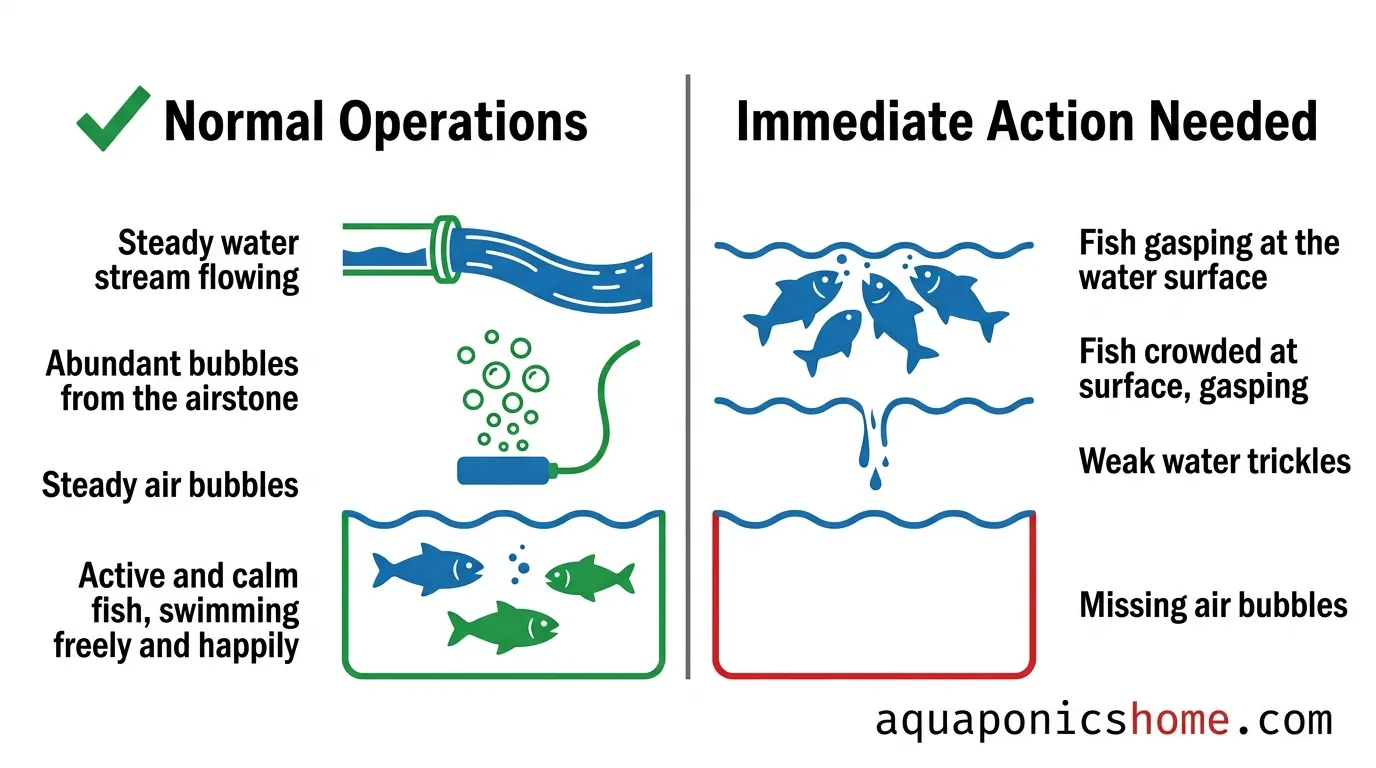
1. Listen, then look at the pump (15 seconds)
Before you look, listen. You get to know the normal hum of the water pump and the buzz of the air pump. Silence, a rattle or a change in pitch is your first warning.
Then look: is water coming out of the return pipe into the grow bed at its usual strength? A weaker stream than yesterday often means a clogged intake or a pump starting to fail. If nothing is coming out, go straight to what to do when your aquaponics pump is not working.
2. Check the air (10 seconds)
Look for bubbles from every air stone. A stone producing fewer bubbles than usual, or none, needs cleaning or replacing, and a stopped air pump is urgent because the fish depend on that oxygen.
3. Check the water level (15 seconds)
Look at the level in the fish tank against a fixed mark. A small daily drop is normal evaporation and plant uptake. A drop that is bigger than usual, or a damp floor, points to a leak or an overflow.
Mark the tank’s normal level with a strip of tape so you are not guessing. If you top up, topping up aquaponics water explains why top-up water needs the same care as any water you add.
4. Look at the fish (30 seconds)
You do not need to count them. You need to notice anything unusual:
- Fish gathered at the surface, gulping air.
- Fish lying on the bottom, hiding in unusual places, or swimming erratically.
- A fish missing from its usual spot, or a dead fish.
Fish gathered at the surface and gulping is a warning sign of low oxygen and should not wait until evening. See fish gasping at the surface for the first steps.
5. Glance at the plants (20 seconds)
You are looking for change, not perfection. Sudden wilting across many plants, new yellowing, or insects that were not there yesterday are all worth noting.
Wilting in several plants at once, while the water is flowing, can point back to a water or root problem rather than the plants themselves.
6. Check the thermometer (10 seconds)
If you have a thermometer in the fish tank, glance at it. Temperature is on FAO’s daily list because it swings with the weather, and warm water holds less oxygen. You are looking for a big change from normal, not a specific number.
That adds up to around two minutes once it becomes habit.
At Feeding Time: The Closer Look
Feeding is the best health check you have. FAO notes that “a major indicator of healthy fish is a good appetite, so it is important to observe their general feeding behaviour.”
When you feed:
- Watch how quickly they come up. Fish that normally rush to the food and now ignore it are telling you something has changed.
- Look at their appearance. FAO lists checking appearance at each feeding.
- Remove what they do not eat. FAO’s guidance is to “always remove any uneaten fish food after 30 minutes, and adjust the next feeding ration accordingly.” Uneaten food rots, adds ammonia and uses up oxygen.
A sudden loss of appetite is one of the earliest signs that something is wrong with the water or the fish. If they stop eating, hold back the next feeding and test the water before changing anything else.
Feeding amounts depend on the species, size and water temperature. Follow the guidance on your fish feed and from your fish supplier, and adjust based on what they actually eat.
When You Have More Time: The Rest of the Daily List
These are on FAO’s daily list but take longer than a glance. Do them in the evening or when you are home:
- Clean pump and air intakes if flow looked weaker in the morning.
- Remove solids from any settling tank or clarifier, and rinse mechanical filters.
- Remove sick plants or dead leaves before they rot in the grow bed.
- Check for pests on the underside of leaves. Be careful with any spray: whatever lands on the grow bed can reach the fish, so never use a product that is not stated as suitable for systems containing fish.
- Remove any dead fish immediately. A dead fish decays in the water and adds to the waste load the system has to handle.
Daily Testing: New Systems Versus Established Ones
People often ask whether water testing belongs on the daily list. The answer depends on the age of your system.
New Mexico State University’s Circular 680, Important Water Quality Parameters in Aquaponics Systems by Rossana Sallenave (revised June 2026, read 2026-09-27), puts it plainly: “Start-up systems should be tested daily so that adjustments can be made quickly when needed,” and “once nutrient cycles are balanced, weekly testing is usually sufficient.”
So:
- In the first weeks, while the bacteria are still establishing, daily testing of ammonia, nitrite and pH belongs on this checklist.
- Once the system is stable, move testing to a weekly slot. FAO’s weekly list includes testing pH, ammonia, nitrite and nitrate “before feeding the fish.”
- Any time a daily check fails, test straight away, whatever day it is.
Our 10-minute weekly water testing routine covers what to test and how to record it.
When a Check Fails: What to Do First
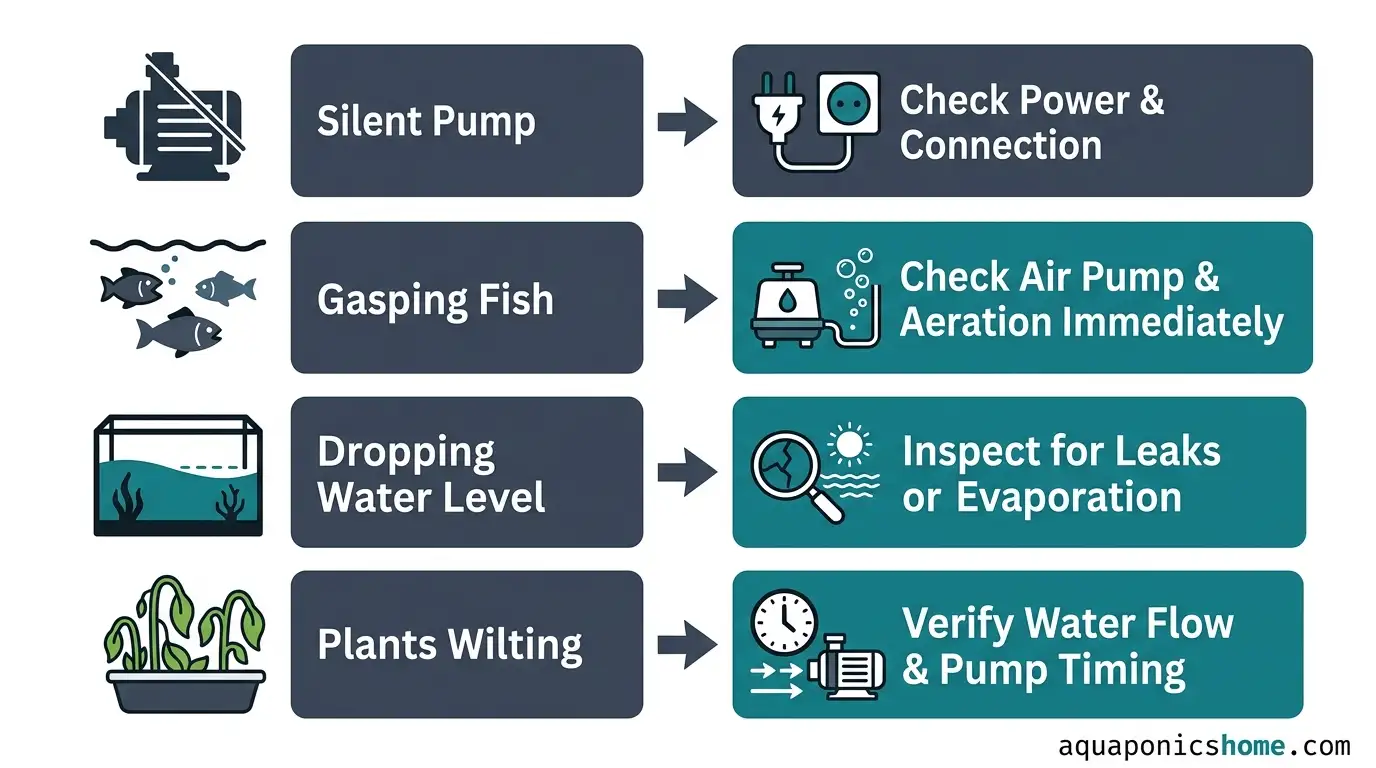
The value of a checklist is knowing the next step. Here is a quick guide:
| What you see | First thing to do |
|---|---|
| No water flow, pump silent | Check power and the intake; fix the pump before anything else |
| Weak flow | Clean the pump intake and check pipes for blockages |
| No bubbles from air stones | Check the air pump and tubing; clean or replace stones |
| Water level lower than usual | Look for leaks and overflows before topping up |
| Fish gasping at the surface | Restore aeration and water movement now, then test |
| Fish not eating | Hold back feeding, test ammonia, nitrite and temperature |
| Dead fish | Remove it, test the water, watch the others closely |
| Sudden wilting in many plants | Check flow and roots; a water problem is likely |
If fish are dying or visibly ill, treat it as an emergency: restore oxygen, test the water, and contact an aquatic veterinarian or your local extension aquaculture service for anything that looks like disease.
Do not add medications or chemicals to a system that grows food without professional advice.
Make the Checklist Stick
A checklist only works if you use it the same way every day. A few habits help:
- Tie it to something you already do, such as making tea or leaving for work.
- Keep a notebook or phone note next to the system. One line per day is enough: “Flow OK, level OK, fish fed well.” When something does go wrong, those notes show you when it started.
- Know your normal. The daily check works by noticing change, so spend the first few weeks learning what normal flow, normal behavior and normal level look like for your system.
- Plan for days away. If you travel, someone else needs this list and a phone number to call.
FAQ
What should I check every day in an aquaponics system?
Check that the water and air pumps are running, that water is flowing into the grow bed, that the water level has not dropped, that the fish look and behave normally, and that plants show no sudden change. FAO’s daily routine also includes checking temperature, feeding and removing uneaten food.
How long does a daily aquaponics check take?
The quick visual check of pumps, flow, level, fish and plants takes about two minutes once it is a habit. Feeding and the longer tasks such as clearing solids take extra time.
Do I need to test the water every day?
In a new system, yes. NMSU’s Circular 680 recommends daily testing for start-up systems and says weekly testing is usually enough once nutrient cycles are balanced. Test immediately whenever a daily check shows a problem.
How do I know if my fish are healthy from a quick look?
Appetite is the main indicator. FAO notes that a good appetite is a major sign of healthy fish. Fish that ignore food, gather at the surface gulping air, or hide in unusual places need a closer look and a water test.
What happens if I skip the daily check?
Often nothing, for a day. The risk is that a silent failure such as a stopped pump or a slow leak goes unnoticed long enough to harm the fish. The daily check exists to catch those failures while they are still easy to fix.