
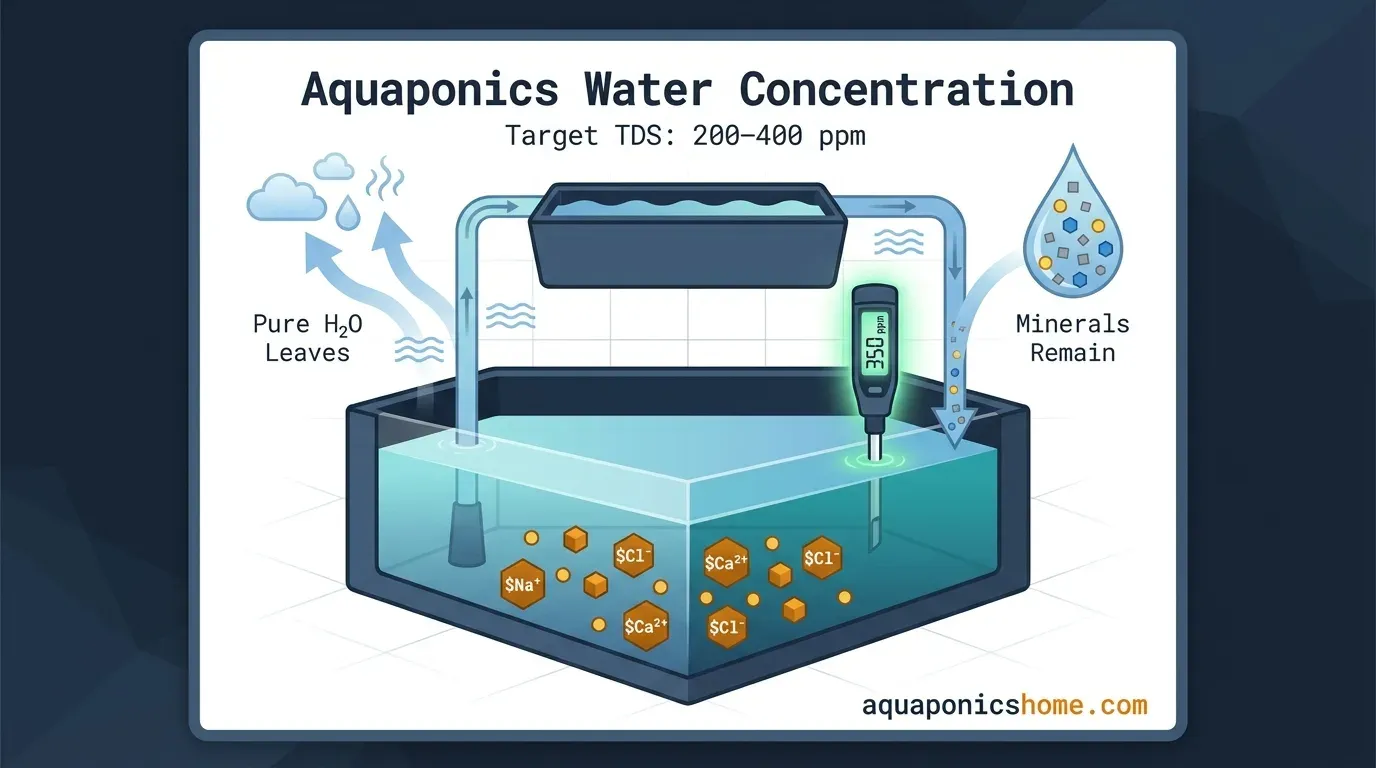
Short answer: topping up is normal and necessary, but it is not neutral. Water leaves an aquaponics system as vapor and through the plants, while the dissolved minerals and salts stay behind, and every refill adds whatever your source water carries. Over months the water slowly concentrates. That is why the University of the Virgin Islands authors of SRAC Publication No. 454 advise buying a conductivity meter and checking dissolved solids periodically, and why they treat unusually high water use as a sign of a leak. Adding water constantly is not a problem in itself. Not knowing what it is doing to the system is.
Where the water actually goes
SRAC Publication No. 454 (Rakocy, Masser and Losordo, 2006 revision, read September 11, 2026) lists the routes water leaves a system: “evaporation, transpiration, sludge removal and splashing.”
- Evaporation from every open water surface: the fish tank, the sump, and any grow bed that floods.
- Transpiration, the water your plants pull up through their roots and release through their leaves. A bigger, faster-growing crop drinks more.
- Sludge removal, whenever you drain solids out.
- Splashing from returns, siphons and waterfalls.
Of these, only evaporation and transpiration are pure water leaving. Sludge removal and splashing take dissolved material with them. That difference is the reason the system concentrates.
SRAC also makes a design point worth borrowing: the sump “should be the only tank in the system where the water level decreases as a result of overall water loss.” In a system without a sump, the fish tank is what drops, which means the fish’s own water is the part that shrinks between top-ups.
Why the water keeps concentrating
When water evaporates, the dissolved minerals and salts in it do not leave with the vapor. They stay in what remains. You then top up with source water that has minerals of its own. Round after round, the total dissolved load creeps upward unless something removes it.
Some of what builds up comes from inside the system. SRAC 454 notes that salt (sodium chloride) “is added to fish feed during manufacture,” so every day’s feeding adds a little sodium. Plants use nitrate, phosphate and many other nutrients, but sodium is not one they want.
SRAC gives the numbers that matter for plants:
| Measure | What SRAC 454 says |
|---|---|
| Total dissolved solids (TDS) in a working aquaponic system | 200 to 400 ppm, or EC of 0.3 to 0.6 mmho/cm, “will produce good results” |
| Phytotoxicity | Occurs at TDS above 2,000 ppm or EC above 3.5 mmho/cm |
| Sodium | Should not exceed 50 mg/L in hydroponic nutrient solutions; higher levels interfere with potassium and calcium uptake, which in lettuce shows as tip-burn. SRAC treats sodium above 50 mg/L with affected plants as a reason for a partial water exchange in aquaponics |
SRAC is candid that the exact level “is difficult to predict” because feeding, solids, water exchange, source water and plant uptake all vary. Its answer is measurement: “the culturist should purchase an inexpensive conductivity meter and periodically measure TDS or EC.”
Your top-up water is an ingredient
Most guides tell you to top up and stop there. The information they leave out is that the top-up water is a chemical input with its own character.
Hard, alkaline source water raises pH. New Mexico State University’s Circular 680 (Sallenave, revised June 2026, read September 11, 2026) notes that in the U.S. Southwest, where water is alkaline and high in calcium, “adding extra water rather than calcium hydroxide is often sufficient to raise the pH.” That is useful if your pH is falling. It is also why a system topped up heavily in summer can creep upward in pH and mineral content at the same time. If you have noticed pH moving after big top-ups, why aquaponics pH keeps changing covers the other half of that story.
Salty source water is a real limit. The UVI system uses rainwater “because the groundwater of semiarid islands generally contains too much salt for aquaponics,” according to SRAC 454. If your well or tap water is high in sodium, every top-up pushes you toward the plant limit above.
Municipal water must be treated first. NMSU states that municipal water is treated with chlorine and chloramines, “which must be removed before it can be used.” SRAC 454 agrees that municipal water “should not be used unless it is de-chlorinated.” Your utility’s disinfectant, and how to remove it, depends on your address.
Surface water is not a shortcut. SRAC warns that surface water “should not be used because it may contain disease organisms.”
Test your source water on its own once, for pH, hardness and, if you have a meter, TDS or EC. It tells you which direction your top-ups push the system.
Aquaponics topping up water: a routine that catches problems
A top-up routine does more than keep the level up. Done consistently, it gives you early warnings.
- Check the level at the same time each day. Mark a normal-level line on the sump or tank so a drop is obvious at a glance.
- Top up from treated water. Dechlorinated if it came from a municipal supply, and at the same temperature as the system. NMSU’s guidance for replacement water is that its temperature and pH should match the water already in the tank.
- Add slowly, near the pump intake or into the sump rather than straight onto the fish.
- Record how much you added. SRAC 454 recommends a water meter “to record additions,” and a jug count in a notebook does the same job at home.
- Check TDS or EC periodically, as SRAC advises, and watch the trend.
Step four is the one people skip, and it is the one that pays off. SRAC puts it plainly: “Unusually high water consumption indicates a leak.” A system that suddenly needs more water than last week, with no heat wave and no crop growth spurt to explain it, is telling you something. Start with finding the slow leak first.
When evaporation turns into an emergency
A low water level is not only a chemistry problem. When the level in the sump or tank drops far enough, the pump starts pulling air, runs dry and can fail. If the system goes quiet or the flow sputters after a hot day, check the water level before anything else, then work through what to do when the pump is not working.
Keep electrical safety in mind when you top up with a hose or bucket near pumps and heaters. The U.S. Consumer Product Safety Commission’s GFCI fact sheet (Pub. 099, read September 11, 2026) recommends ground fault protection where electrical equipment is near water.
Automatic top-up, done safely
SRAC 454 describes an electrical or mechanical valve that automatically adds replacement water “from a storage reservoir or well.” Two lessons for a home system:
- Feed the valve from treated water. A valve plumbed directly to a municipal tap bypasses dechlorination entirely.
- Plan for the valve failing open. A stuck float valve keeps adding water until something overflows. An overflow route and a backstop are covered in leak and overflow protection.
If your reservoir is an open barrel of stored rainwater, it can become a breeding site, so keep it covered and check it using the steps for mosquito larvae in a water tank.
Slowing the loss
You cannot stop evaporation, but you can reduce it. SRAC 454 notes that in raft systems the floating sheets shield water from direct sunlight and keep it several degrees cooler than open water, and that shading the fish tank and filters lowers water temperature in hot outdoor systems. Cooler, covered water loses less to the air. Covering open surfaces, shading the tank and keeping the system out of the hottest afternoon sun all reduce how much you need to add.
What concentrating does not mean
Rising dissolved solids are not automatically a crisis. Much of what builds up is plant food, and SRAC 454 notes that high nitrate concentrations promote the growth of leafy greens, while fruiting plants set less fruit and produce more leaves when nitrate is high. The concern is the upward trend, especially sodium, and a system heading toward the phytotoxic range. If readings keep climbing, SRAC’s longer-term fixes are to remove more solids or add more plant growing area, because diluting with more water or cutting back fish “are not good long-term solutions.”
FAQ
How often should I top up an aquaponics system?
As often as the level drops. Check it at the same time each day and top up with treated, temperature-matched water. SRAC Publication No. 454 recommends recording every addition, because unusually high water use is a sign of a leak.
Can I top up aquaponics with tap water?
Only after removing the disinfectant. NMSU Circular 680 states that municipal water is treated with chlorine and chloramines that must be removed before use, and SRAC 454 says municipal water should not be used unless it is dechlorinated.
Why does my pH change after topping up?
Because your top-up water has its own chemistry. NMSU notes that alkaline, calcium-rich source water can raise pH on its own. Test your source water separately so you know which way your top-ups push the system.
Does topping up replace the need to measure anything?
No. Evaporation leaves minerals and salts behind, so the water slowly concentrates. SRAC 454 advises checking TDS or EC periodically with a conductivity meter and notes phytotoxicity above 2,000 ppm TDS or 3.5 mmho/cm EC.
Sources
- Rakocy, J.E., Masser, M.P. and Losordo, T.M. Recirculating Aquaculture Tank Production Systems: Aquaponics, Integrating Fish and Plant Culture. SRAC Publication No. 454, November 2006 revision. (read September 11, 2026)
- Sallenave, R. Important Water Quality Parameters in Aquaponics Systems. New Mexico State University Cooperative Extension Service, Circular 680, revised June 2026. https://pubs.nmsu.edu/_circulars/CR680/ (read September 11, 2026)
- U.S. Consumer Product Safety Commission. What Is a GFCI? Fact Sheet Pub. 099. (read September 11, 2026)