
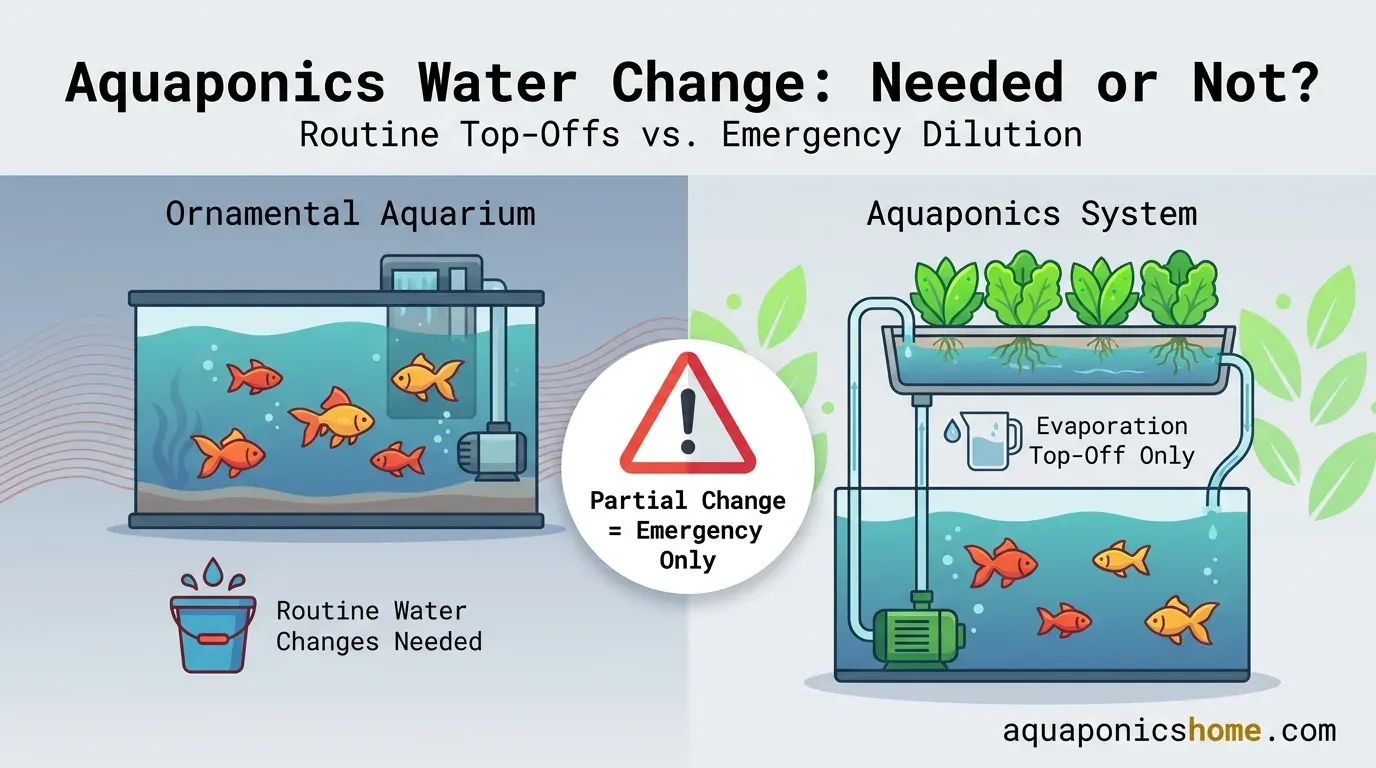
Short answer: routine water changes are not part of running a balanced aquaponics system. The plants take up the nitrate that an ornamental fish tank would have to dilute away, so ordinary water loss is handled by topping up. A partial water change is a tool for specific problems: extension guidance names nitrite that has risen, sodium building past what plants tolerate, and dissolved salts climbing toward levels that harm plants. SRAC Publication No. 454 describes closed aquaponic systems running with very little daily water exchange, and New Mexico State University’s aquaponics circular reserves the partial exchange for moments like a nitrite rise.
Why the aquarium habit does not carry over
In an ornamental aquarium, the weekly water change is a ritual for a good reason: nitrate builds up, nothing removes it, and diluting it is the keeper’s job. The goal of that tank is a healthy fish on display.
An aquaponics system has a different goal, which is a vegetable, and a different outlet for the nitrate. SRAC Publication No. 454, written by James Rakocy of the University of the Virgin Islands with Michael Masser and Thomas Losordo (2006 revision, read September 11, 2026), explains that nitrate “is relatively harmless and is the preferred form of nitrogen for growing higher plants,” and that by removing dissolved nutrients through plant uptake, “the water exchange rate can be reduced.” It describes closed systems with “very little daily water exchange (less than 2 percent)” in which nutrients accumulate to concentrations similar to hydroponic solutions.
So the question is not “how often do I change the water?” It is “is something happening that the plants and the biofilter cannot handle?” If you keep fish purely for display, the routine is genuinely different, and a state extension aquaculture specialist or an aquatic veterinarian is the right guide for that goal.
When a partial water change is the right tool
These are the situations the sources actually name. Each has its own page, and the links go to the full steps.
| Situation | What the source says | Where to go next |
|---|---|---|
| Nitrite has risen | NMSU Circular 680: if nitrite rises above 1 ppm, dilute by removing up to a third of the tank’s water and replacing it with fresh, dechlorinated water | Nitrite spike: what to do |
| Ammonia is climbing | Dilution is one of the physical actions that come before any chemistry | Ammonia too high: act now |
| Sodium is building up | SRAC 454: if sodium exceeds 50 mg/L and plants appear affected, “a partial water exchange (dilution) may be necessary” | Test sodium or conductivity, and check your source water |
| Dissolved solids approaching the plant limit | SRAC 454: as TDS approaches 2,000 ppm or EC 3.5 mmho/cm, increasing water exchange “will quickly reduce nutrient accumulation” | See the long-term fixes below |
| A dead fish was left in the system | SRAC 454: decaying organic matter depresses oxygen and produces carbon dioxide and ammonia | Dead fish: the first 10 minutes |
The nitrite figure deserves a clear label. NMSU’s 1 ppm is a trigger for action, not a line below which fish are safe. If nitrite is rising at all, the nitrite page explains why and what else to do.
How to do an aquaponics water change safely
When you do need one, the risks are in the new water, not the old.
- Treat the replacement water first. New Mexico State University’s Circular 680 (Sallenave, revised June 2026, read September 11, 2026) says municipal water is treated with chlorine and chloramines, “which must be removed before it can be used.” Find out which your utility uses, since they are removed differently.
- Match temperature and pH. NMSU tells growers to make sure “the temperature and pH of the replacement water are the same as the water remaining in the tank.”
- Unplug before your hands go in. Pumps and heaters sit in the water you are working in. The U.S. Consumer Product Safety Commission’s GFCI fact sheet (Pub. 099, read September 11, 2026) recommends ground fault protection where electrical equipment is near water.
- Keep the pump submerged. Lowering the water too far can leave the pump running dry. Refill before switching it back on if the level has dropped below it.
- Add the new water slowly. A gradual change is gentler on fish than a sudden one.
- Do not wash the grow media. SRAC 454 explains that nitrifying bacteria “grow as a film” on the surfaces of the media. A water change takes out water, not most of your bacteria. Scrubbing or rinsing the media under the tap is what strips the colony.
- Retest over the following days. Record what changed and whether the problem that prompted the change is actually going away.
Why water changes are not a long-term fix
This is the section most “do you need to change water” pages skip, and it is the useful one. If you find yourself changing water repeatedly, the system is telling you it is out of balance.
SRAC 454 is direct about it. Increasing water exchange or reducing fish stocking and feed “will quickly reduce nutrient accumulation,” but “because these methods either increase costs (i.e., more water consumed) or lower output (i.e., less fish produced), they are not good long-term solutions.” Its better fixes are to remove more solids, by upgrading solids removal, or to enlarge the plant growing area.
In home terms, the balance is between how much feed goes in and how much plant is there to use what the fish produce. SRAC calls the feed-to-plant-area ratio “the key” design criterion: when feeding is too high for the plants, nutrient salts accumulate and may reach phytotoxic levels. Routine water changes paper over that imbalance instead of correcting it.
It works in the other direction too. If your plants are already hungry, a water change dilutes the little nutrition they have. When nitrate is reading low, changing water makes the problem worse, and the real fix for low nitrate is usually about feeding and fish load, not water.
Nitrate is not the reason to change water here
Readers coming from fishkeeping often want to change water to “get nitrate down.” In aquaponics that is usually the opposite of the goal. SRAC 454 notes that high nitrate concentrations promote the growth of leafy greens, while fruiting plants such as tomatoes set less fruit and produce excess leafy growth when nitrate is high. For a system growing fruiting crops, the answer SRAC describes is managing solids and plant uptake, not routine dilution.
What not to add instead of changing water
When a system struggles, some growers reach for a product instead. Two are worth ruling out.
- Salt. SRAC 454 states that “the common practice of adding salt to treat fish diseases or reduce nitrite toxicity is detrimental to plant crops.”
- Fish medications. SRAC also says therapeutants for treating fish parasites and diseases “should not be used because vegetables may absorb and concentrate them.” In a system that grows food, a fish medicine is also a food-safety question, covered further in whether food from a home aquaponics system is safe to eat.
If fish look sick rather than stressed by water quality, diagnosis and treatment belong with a qualified aquatic veterinarian, who can advise with the edible crop in mind.
FAQ
How often should you change the water in aquaponics?
In a balanced system, not routinely. SRAC Publication No. 454 describes closed aquaponic systems running with very little daily water exchange because plants take up the nutrients that would otherwise build up. You top up what evaporates and use a partial exchange only when a specific problem calls for it.
Does a water change remove the beneficial bacteria?
Mostly no. SRAC 454 explains that nitrifying bacteria grow as a film on the surfaces of the media, not freely in the water. What damages the colony is washing the media, or adding untreated tap water whose chlorine or chloramine harms the bacteria.
How much water should I change in aquaponics?
Only as much as the problem requires. The one figure the sources give is NMSU Circular 680’s guidance for nitrite above 1 ppm: remove up to a third of the tank’s water and replace it with dechlorinated water matched for temperature and pH.
Should I change water to lower nitrate in aquaponics?
Usually not. Nitrate is what the plants use. SRAC 454 calls it the preferred form of nitrogen for plants and notes that high nitrate favors leafy greens. If readings keep climbing, SRAC recommends removing more solids or adding plant growing area rather than relying on water changes.
Sources
- Rakocy, J.E., Masser, M.P. and Losordo, T.M. Recirculating Aquaculture Tank Production Systems: Aquaponics, Integrating Fish and Plant Culture. SRAC Publication No. 454, November 2006 revision. (read September 11, 2026)
- Sallenave, R. Important Water Quality Parameters in Aquaponics Systems. New Mexico State University Cooperative Extension Service, Circular 680, revised June 2026. https://pubs.nmsu.edu/_circulars/CR680/ (read September 11, 2026)
- U.S. Consumer Product Safety Commission. What Is a GFCI? Fact Sheet Pub. 099. (read September 11, 2026)