
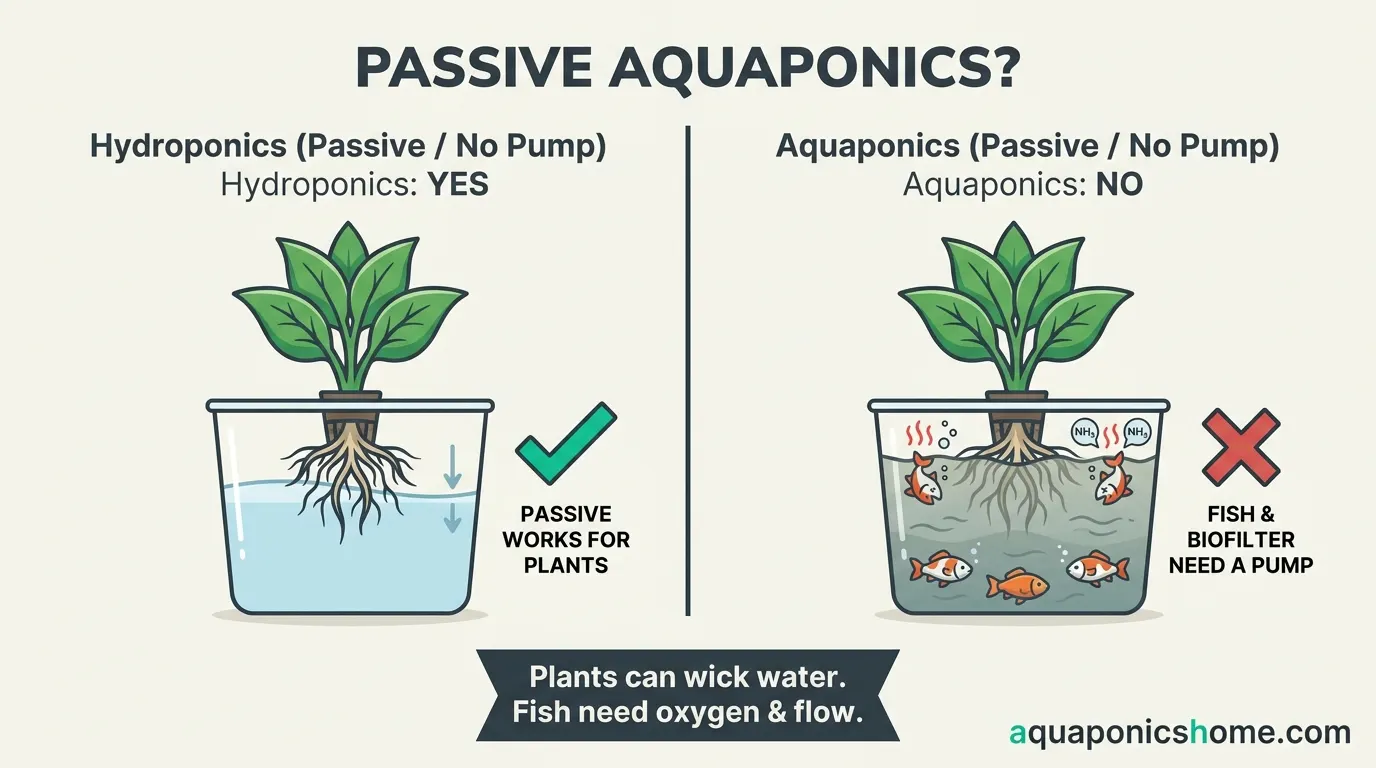
You can run the plant side of a growing system without a pump. You cannot make a system that contains fish truly passive. A pump-free approach moves water to plants by wicking, or by simply not moving it at all, but fish need oxygen and biological filtration around the clock, and neither of those arrives on its own. A no-pump aquaponics system is really a fish tank you have stopped aerating.
I would rather say that in the first paragraph than let you build something first. Nearly every page ranking for this question answers the plant-only version and loses the fish somewhere in the middle.
Where the “no pump” idea comes from
The passive method people usually mean is the non-circulating approach borrowed from plant-only growing: you fill a reservoir once, suspend the plants above it, and let the water level fall as the roots drink. Wicking beds are the other version, where a growing medium pulls water upward by capillary action instead of a pump pushing it.
Both are genuinely clever, and both are genuinely pump-free. Neither was designed with a fish in it.
That is as far as I will go on the method, because it belongs to plant-only growing, which is not this site’s subject and not something I have run. If you are still choosing between the two approaches, I laid out the trade-offs in aquaponics vs hydroponics: which one actually suits you.
Why the fish break the passive idea
Here is the part the pump-free articles skip. In an aquaponics system, the pump is not primarily a watering device. It does three jobs at once:
- Delivering nutrients. It carries fish waste water to the plant roots.
- Moving oxygen. Water in motion picks up oxygen at the surface, and that oxygen feeds your fish and the nitrifying bacteria doing your filtration.
- Carrying waste to the bacteria. Ammonia has to reach the bacteria colony to get converted. Still water does not deliver it.
A passive plant system only ever needed job one. Wicking replaces job one beautifully. It replaces nothing else.
There is also a naming trick worth catching. Plenty of builds described as “no pump” quietly kept an air pump running in the fish tank and only removed the water pump. That is not a no-pump system, and the difference matters, because the air pump is the one your fish care about most.
What the published sources actually say
I am a hobbyist, not a scientist, so on anything this consequential I would rather hand you the people who are.
Rutgers New Jersey Agricultural Experiment Station, in fact sheet FS1351 (Yergeau, Zemeckis and VanVranken, July 2025), puts it plainly: “The reliance of aquaponics on pumps to maintain flow and aeration to the system means that power supply outages can be catastrophic to the fish and/or plants.” That fact sheet treats backup power as extra equipment at extra operating cost, not as something the design lets you avoid.
Clemson University’s Land-Grant Press, in “Aquaponics: System Layout and Components” (Lance Beecher, October 25, 2021), states that “Aeration in aquaponics systems is critical for providing adequate dissolved oxygen for fish survival, beneficial bacteria in the filter unit, and proper levels for plant growth.” It also ties low dissolved oxygen to disrupted ammonia processing and to oxygen-starved zones inside a media bed. That is the quiet second failure: even if the fish hold on, your filtration may not.
The number I am not going to give you
Every version of this question eventually becomes: “so how long do my fish have when the power drops?”
I went looking for that number in the named sources and it is not there. They describe outages as catastrophic and aeration as critical, but neither publishes a universal survival window, because there is not one to publish. It moves with how heavily you have stocked the tank, how warm the water is (warm water holds less oxygen while fish use more of it), how big the fish are, how much total water volume you have, and how oxygenated the water was when the power went.
A lightly stocked tank in a cool basement in March and a full tank on a sunny deck in July are not the same problem, and one number cannot describe both. When a blog or a product page tells you confidently that your fish have some specific number of hours, that figure has almost always come from nowhere. I am not adding another one to the pile.
What I can give you is the sequence to run when it does go wrong, which is what to do when your fish start dying.
Pumped, low-power, or passive: what each one keeps alive
| Approach | How water and air move | What it keeps alive | What it cannot keep alive | Power dependence |
|---|---|---|---|---|
| Conventional pumped | Water pump running continuously, usually an air pump too | Fish, nitrifying bacteria and plants together | Nothing, but it stops the moment power does | Total and continuous |
| Low-power or backed up | Smaller or timer-cycled pump, air-lift design, or battery-backed air | The same, if the backup engages and outlasts the outage | Nothing in theory; in practice it rests on the backup holding | High, with a cushion you paid for |
| Fully passive, no pump | Capillary wicking, or a reservoir never circulated at all | Plants, for a limited crop cycle | Fish, and the bacteria colony that makes it aquaponics | None, which is exactly why fish cannot live in it |
Read the third row honestly. Losing the electricity bill is real, but what you give up is the fish and the biofilter, which is to say the aquaponics part.
What happens on my balcony when the power goes
I have run a small pump-dependent system on a rented balcony in Dhaka for about three years, and my grid drops out rather more often than yours probably does, so I have had more practice at outages than I wanted. I have never run a fully passive fish system, and I am not going to describe one as though I had.
What I do during an outage is unglamorous. I stop feeding, because uneaten food and fish digestion both consume oxygen I cannot replace. I get shade over the tank if it is hot, since warm water is the harder version of this problem. I disturb the surface by hand, pouring water back in from a height so it picks up air on the way down.
I cannot tell you that is enough. It is what a person with two hands and no electricity can do while waiting.
If your power is genuinely unreliable
Plenty of people reading this are not dealing with a rare inconvenience. Ice storms, hurricane season, wildfire-related shutoffs, a long rural line that drops in every strong wind, an off-grid cabin: all real reasons to treat power as something you cannot assume.
The honest options fall into a few categories, and I am deliberately keeping this at the level of categories.
- Battery-backed aeration. Small air pumps run from a battery, or units that switch over on their own when line power fails. That is a category, not a product recommendation.
- Generators and larger backup supplies. Real and widely used, and they add fuel, noise, cost and maintenance.
- Designing for a smaller crash. A modestly stocked system in a decent volume of water is less fragile than a crowded one, because a larger volume swings more slowly when the pump stops. That is one of the reasons tank size is a bigger decision than it looks, and I go through what the published guidance actually says about it in balcony aquaponics: running a system in a rented flat.
One firm line, and I am not softening it. Anything involving fixed wiring, transfer switches, or work on your mains supply is a licensed electrician’s job. This is standing water and electricity in the same small space. There are no wiring instructions in this article and there never will be. Whatever you choose, budget for it from the start, which I break down in what a small aquaponics system really costs.
When going pump-free is actually the right call
Sometimes the answer here is yes, just not the yes people were hoping for.
If what you really want is homegrown greens and the fish were only the interesting-sounding part, a passive plant setup is a reasonable choice. It is quiet, it costs nothing to run, and nothing dies when the power does. It is not aquaponics, but that does not make it the wrong decision for you.
If you want fish and your power is unreliable, the answer is not a passive build. It is a smaller, better-designed pumped system with a backup plan made before you need it. Which design suits your space is a separate question, and I compare the options in media bed, raft and NFT systems compared. You can read exactly what my experience is and is not on my about page.
FAQ
Is there any aquaponics system that needs no electricity at all?
Not one that reliably supports fish. Passive methods move water to plants without power, but nothing passive supplies continuous oxygen to a fish tank or to the bacteria handling filtration. Systems advertised as needing no electricity are usually plant-only, or they kept an air pump and stopped counting it.
Can I turn the pump off overnight to save power?
People do run pumps on timers, and some designs tolerate cycling better than others. But that depends on your stocking, volume and temperature, and no named source I found publishes a safe off-interval. If you experiment, do it while you are awake to watch the fish.
Do I need both a water pump and an air pump?
A water pump circulates and delivers nutrients; an air pump adds oxygen directly. Some designs get enough surface agitation from the water pump alone. Given that Clemson’s Land-Grant Press calls aeration critical for fish, bacteria and plants alike, treating dedicated aeration as optional is the riskier assumption.
How long can my fish survive without the pump?
There is no honest universal answer and I am not going to invent one. It depends on stocking density, water temperature, fish size, total water volume, and how oxygenated the water was when the power went. Any specific number quoted for this is almost certainly unsourced.
Would a solar panel solve the problem?
It is one backup category worth considering, especially for a small air pump. It is not automatically simpler, since you then depend on a battery, a controller and enough sun. Any part of an install touching your home’s fixed wiring goes to a licensed electrician.
Sources named above: Rutgers NJAES fact sheet FS1351 (July 2025) and Clemson Land-Grant Press, “Aquaponics: System Layout and Components” (Beecher, 2021). No fish survival window, dissolved oxygen figure, stocking density or temperature range is published here, because no named source provides a universal one.