
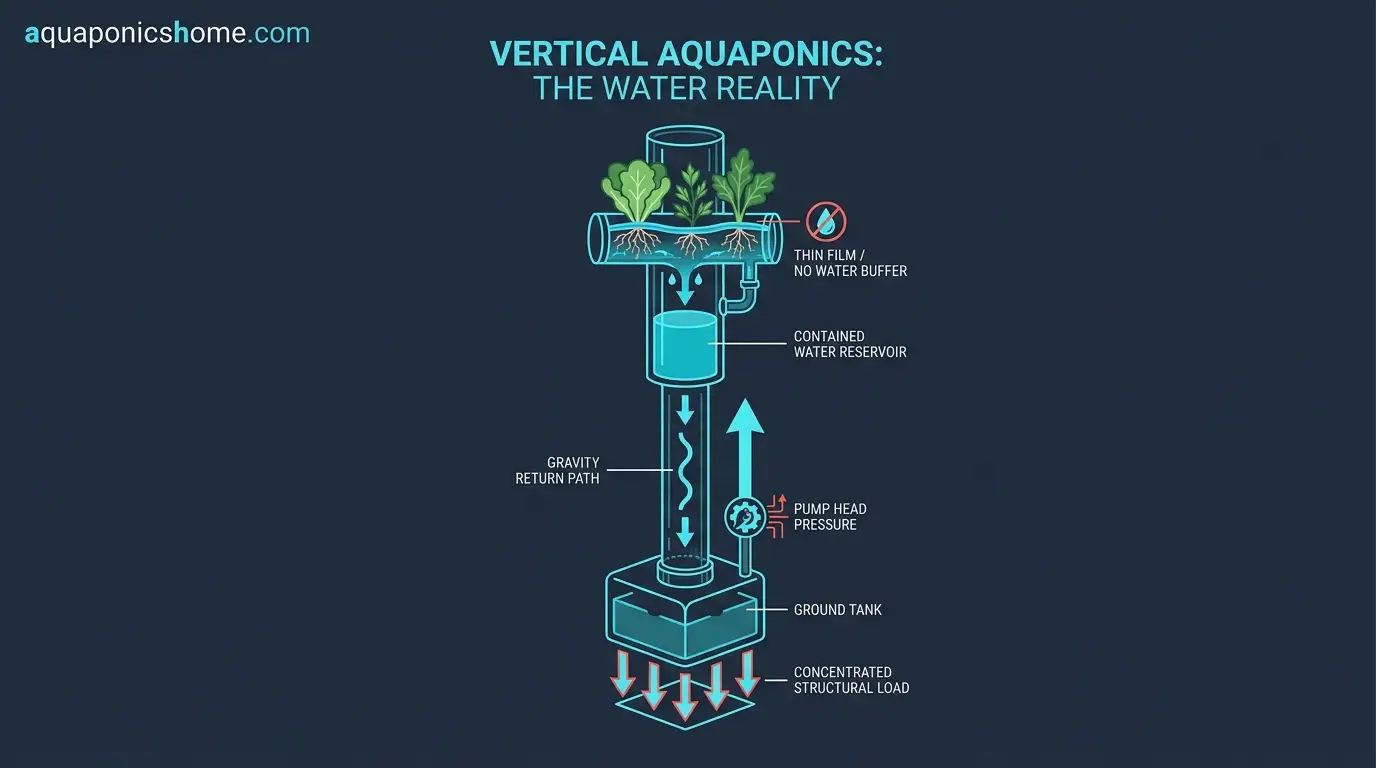
Yes, you can go up, and when floor area runs out, height is often the only real way to add growing space. But a vertical aquaponics system does not mainly change your plants. It changes your water. Height costs your pump real output, it removes the buffer that keeps roots wet when the power fails, and every drop you lift has to find a dependable path back down to the tank.
Honest part first: I have not run a vertical system. Three years on a rented flat’s balcony, two rebuilds, one media bed, greens and herbs, a first catfish batch that died inside a month, and one overnight flood I still think about. All of it at floor level. So this is not “look at my tower.” It is the water-side homework I did before deciding.
Second boundary: I am not going to tell you how to build the frame. Not the pipe, not the rack, not the mounting. That is construction. This site is about the water, and what happens to it once the frame exists.
What a vertical aquaponics system actually changes
A column of plants is not a new kind of aquaponics. It is the same loop, stretched upward: water leaves the tank, meets roots, and returns. What changes is that one leg now runs against gravity instead of along the floor.
That single change lands in four places. The pump works harder for the same flow. The roots sit in a thin film instead of a reservoir, so they hold nothing in reserve. The return trip becomes a fall rather than a slope, and the loaded mass concentrates onto a much smaller patch of floor.
Notice what is not on that list: the plants. Greens and herbs do not much care whether they sit at ankle height or shoulder height. Your water does. If you are still choosing, start with how the main aquaponics system types differ, then come back once you know height is your constraint.
The lift: head is the number the pump box does not tell you
“Head” is the resistance a pump fights: the vertical lift from the water surface to the release point, plus the drag of pipe, elbows and fittings. It matters because a pump’s advertised output is measured with nothing in its way. Add height and plumbing and real delivery falls off, sometimes steeply.
Here I disappoint you on purpose. I am not giving you a head figure, a flow rate, or a pump-sizing rule, because I could not find a government agency, a university extension publication or a peer-reviewed paper that publishes those numbers for home-scale vertical setups. Every specific figure I found traced back to pump retailers and forum threads, and this site does not treat those as sources.
Use the flow-versus-height curve the manufacturer publishes for that pump, read at your height, not at zero.
What you lose when the media bed goes away
This is the part the build guides skip. A media bed is not just somewhere to put plants. According to FAO Fisheries and Aquaculture Technical Paper 589 (Somerville and colleagues, 2014), media beds carry out mechanical filtration, biological filtration and mineralization in one component, which is why the FAO treats them as the simplest design and the one best suited to beginners.
Take the media away and those jobs go somewhere else. The same FAO manual reports that separate biofilters are needed for nutrient film technique and deep water culture units, alongside mechanical separation of solids, and it puts the combined volume of the mechanical separator and biofilter at 10 to 30 percent of total fish tank volume.
A column behaves like that thin-film family, not like a media bed. So going up usually means adding filter vessels you did not need before, and those vessels have volume, and volume needs floor. Some of the space you saved quietly comes back. Read what a media bed actually does for you and how thin-film systems behave in a small setup first.
Where the water has to land, and what happens when it stops
Water enters at the top and has to leave at the bottom, and gravity only finishes the trip if the path is clear, sloped and sized for the flow. Narrow emitters and tight bends are where solids collect, which is another reason the filtration above is not optional.
When a drain blocks at floor level, you get a wet floor. My flood was exactly that: a siphon failed overnight and I found it in the morning. When a blockage happens at height, the water leaves at height and lands on whatever is underneath, which on a balcony may include a neighbor. That failure mode is covered in what to do about leaks and overflows.
The other stoppage is the pump. FAO 589 notes that nutrient film designs carry a degree of risk, because pump failure can cause large crop loss if flow does not resume quickly, while deep water culture cushions the shock, since roots stay submerged. A column sits on the risky side of that line. Outages are a design input, not bad luck.
Weight does not spread out, it stacks up
The arithmetic is simple. Water weighs about 1 kg per liter, or about 8.34 lb per US gallon. Stacking removes none of that. It concentrates it: the tank, the water in transit, the wet medium and the plants all press down through a much smaller footprint than a spread-out bed would use.
That concentration is the safety question, and the one I am not qualified to answer. I will not give you a safe load figure, a capacity per square foot, or a code number. Whether your balcony or floor can carry a concentrated load is a question for a qualified structural engineer, your building management, or the original architectural drawings. The arithmetic itself is worked through in how much a small aquaponics system really weighs.
What height costs you, at a glance
| What height changes | Why it happens | What it means for you |
|---|---|---|
| Pump lift | The pump fights vertical distance plus pipe and fitting drag | Delivered flow is lower than the box says; read the pump’s curve at your height |
| Filtration | The media bed’s combined filtering and mineralization role is gone | Separate solids removal and biofilter, which the FAO sizes at 10 to 30 percent of fish tank volume |
| Drain path | The return is a fall, not a slope | A blockage releases water at height instead of at the floor |
| Failure margin | Roots sit in a thin film, not a reservoir | Pump or power loss becomes urgent within hours, not days |
| Weight | The same water on a smaller footprint | A concentrated load question for an engineer, not for a blog |
| Access | The top of the column is above eye level | Harvest, inspection and cleaning get harder with height |
What the published research actually found
Almost every page ranking for this topic sells the upside. Few mention that FAO’s own vertical design has been tested against its siblings and did not win.
Pérez-Urrestarazu, Lobillo-Eguíbar, Fernández-Cañero and Fernández-Cabanás published that comparison in Aquacultural Engineering volume 85 in 2019. They ran three FAO small-scale designs side by side (nutrient film technique, floating raft and a vertical felt subsystem), growing lettuce and goldfish over two production cycles. Their reported result: nutrient film technique performed best on both crop production and water consumption, while the floating raft and the vertical felt system produced poorly. Fish production was comparable across all three.
One study on one crop is not a verdict on every vertical design. But it is the best evidence I found, it points away from vertical for leafy greens, and none of the build guides mention it.
Would I go vertical on my balcony?
Not yet, and not for food. Height solves a floor-area problem by creating a pump problem, a filtration problem and a drainage problem, and I have already proven I can lose a system to a slow failure. I killed a tank once by over-cleaning it.
If I did go up, I would keep the tank and filtration at floor level where I can see them, keep the column short enough to reach the top without a stool, and inspect the drain path first every time. The layout questions underneath are the same ones in aquaponics on a rented balcony.
FAQ
Does a vertical aquaponics system need a bigger pump?
It needs a pump rated for your actual head, which is the vertical lift plus the drag of pipe and fittings. That is not the same as “bigger.” Compare pumps on the manufacturer’s flow-versus-height curve, and be skeptical of any figure quoted without a named source.
What happens in a power outage?
FAO 589 notes that thin-film designs risk large crop loss if flow does not resume quickly, whereas deep water culture cushions the shock because roots stay submerged. A column has no reservoir at the roots, so plan for outages before you build, not during one.
Is vertical better than a flat bed in a small space?
For growing area per square foot of floor, height wins. For simplicity, the FAO’s manual points to media beds, and the 2019 Aquacultural Engineering comparison found the vertical felt subsystem produced poorly against nutrient film technique. Choose deliberately, not by default.
Where do I learn to build the tower itself?
Not here. Frame design, materials, mounting and load rating are construction topics. This site stays on the water side: the pump, the filtration, the drain path and the fish. Take the load question to a qualified structural engineer.