
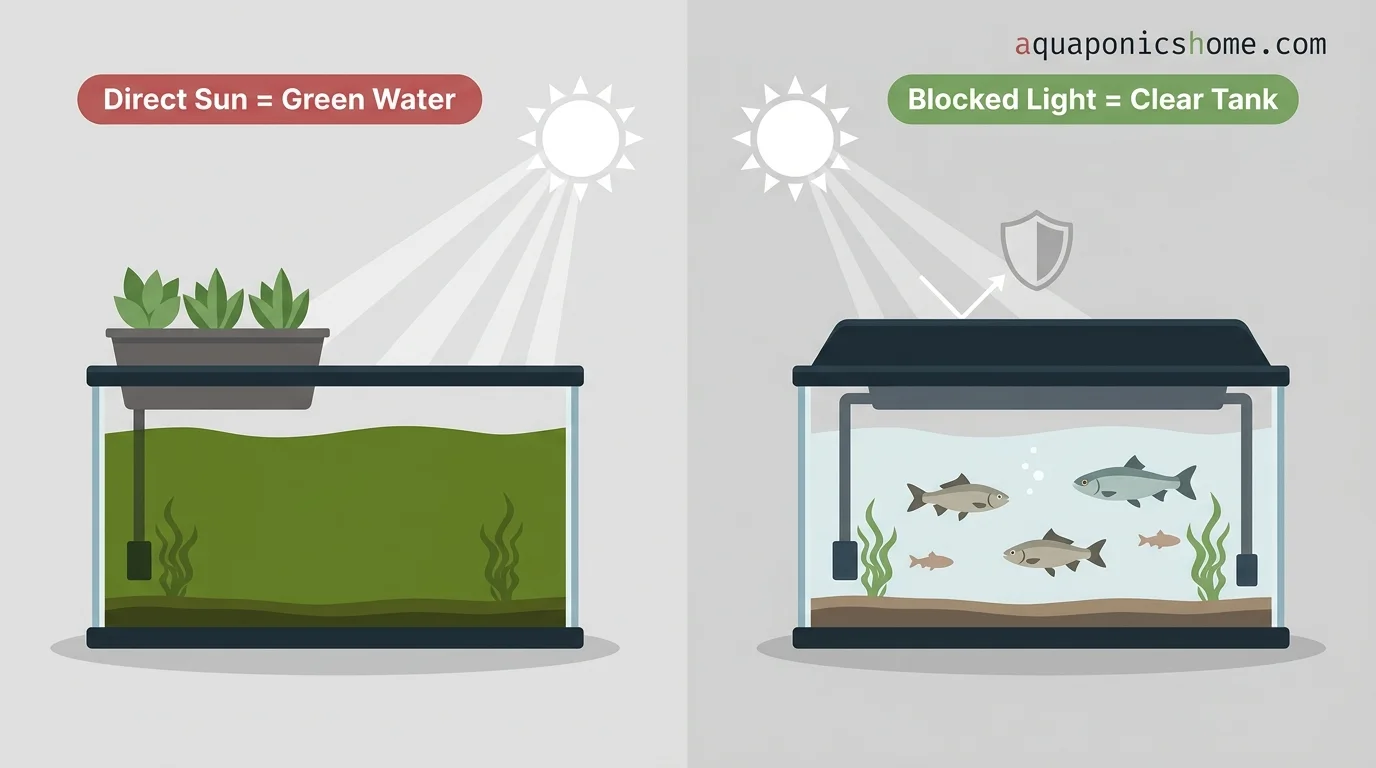
Green water in an aquaponics tank almost always comes down to one thing: sunlight hitting nutrient-rich water directly. An open tank, a clear tote, or a grow bed sitting in full sun gives algae everything it needs to bloom fast. The fix is not a chemical, it is blocking the light, covering the tank, shading the grow bed, and cutting off what the algae is actually feeding on.
I have had my own balcony tank turn pea soup green with no warning, and the first time it happened I genuinely thought something was wrong with the fish. It was not. It was sunlight.
Green water vs. string algae: same cause, different look
Both problems come from the same two ingredients, light and nutrients in the water, but they show up differently and get handled slightly differently on the ground.
| What you see | What it is | What to do |
|---|---|---|
| Water turns cloudy pea-soup green, uniform throughout | Free-floating algae, sometimes called a green water bloom | Block light from reaching the tank directly |
| Long green or brown strands on grow bed surfaces, pipes, or tank walls | String or hair algae growing on a surface | Reduce light on that surface, remove strands by hand as needed |
Green water is usually the more alarming one to look at because the whole tank changes color overnight. String algae is slower and more localized, and it shows up most often on the surfaces of a media bed or along tank walls, so most growers treat it as a cosmetic nuisance rather than a system problem. Neither one is a disease. Both are a light and nutrient story, not a fish-health story on their own.
Why light-blocking works
Algae needs light to photosynthesize, the same as any plant. Take that light away and the bloom cannot sustain itself, regardless of how many nutrients are floating around in the water. This is why the fix that actually works is structural: cover the tank so light cannot reach the water surface, and shade or wrap a clear grow bed so light cannot reach the root zone and any standing water inside it.
This matters because a lot of what you will read elsewhere reaches for a UV clarifier or an algaecide product first and mentions covering the tank as an afterthought. On a small system growing food you plan to eat, adding a product to the water is a bigger decision than it sounds, and it is not actually necessary. Blocking the light is a complete fix on its own, not a stopgap while you wait for something else to work.
How to cover a small tank without buying anything fancy
You do not need a specialized lid. A dark tarp, a piece of opaque plastic sheeting, plywood cut to size, or even a doubled-up dark bedsheet weighted at the edges will block light from an open tank. The goal is simple: no direct sun reaching the water surface.
For a grow bed that is a clear or light-colored container, wrap the outside in black plastic or paint it, since light can travel through the walls of a translucent container even if the top is shaded. I did this to a clear storage tote I was using as a grow bed and the string algae on the inside walls stopped spreading within days of it going dark.
If your whole setup gets more sun than shade for most of the day, it may be worth rethinking where the tank and grow bed actually sit. The siting guide for a small system is the piece I wish I had read before I put my first tank exactly where the afternoon sun hit it hardest.
Is green water dangerous to the fish?
On its own, a green water bloom is usually a nuisance rather than an emergency. Fish can often tolerate cloudy, algae-green water without obvious distress in the short term. The real risk is not the algae itself, it is what happens if a large bloom dies off all at once, whether from a sudden cover-up, a big water change, or a cold snap. A heavy die-off of algae can use up oxygen in the water faster than it can be replaced, which is a real strain on fish at exactly the moment you thought you had solved the problem.
The practical takeaway is not to panic about a green tank, but also not to change everything about the system in one go once you start fixing it. Block the light and let the bloom fade down gradually rather than trying to clear it instantly.
What not to do
I am not going to walk you through algaecide products, dosing, or UV clarifier setup here, and that is deliberate. This is a food-growing system with fish in it, and adding a chemical treatment is not something a blog post should be instructing you to do. If you are seeing algae alongside fish that look sick, not just stressed by cloudy water but showing sores, unusual spots, or behavior that goes beyond gasping or hiding, that is outside what covering a tank will fix, and it is worth contacting an aquatic veterinarian or your local extension aquaculture service rather than guessing at a treatment yourself.
If you are not sure whether what you are looking at is algae or something more serious with your water chemistry, the troubleshooting starting point is a better first stop than any product page.
My own algae bloom on the balcony
I have mentioned before, on my own page, that my setup has had its share of unexplained algae blooms over the three years I have been running it on my Dhaka balcony. The pattern, once I actually paid attention to it, was almost always the same: a stretch of stronger sun, a tank or grow bed that was not as covered as I thought it was, and a few days later, green water. Once I started treating covering the tank as a non-negotiable part of the setup rather than an optional extra, the blooms stopped being a mystery and started being something I could see coming.
None of this was scientific on my part. I am not an aquaponics scientist, I just noticed that the sunny stretches and the green water lined up every time, and blocking the light was the only change that actually made a difference.
FAQ
How long does it take for a covered tank to clear a green water bloom?
It varies by how heavy the bloom already is and how much light was reaching the water before you covered it, so I will not give you a fixed number of days. What I can tell you is that once light stops reaching the water, the bloom stops sustaining itself and fades rather than continuing to build.
Can I just do a big water change instead of covering the tank?
A water change can dilute the current bloom, but if the tank is still getting direct light afterward, the algae will likely come back. Covering the light source addresses the actual cause instead of resetting the symptom temporarily.
Will algae hurt my plants growing in the same system?
Algae competes with your plants for some of the same nutrients in the water, and a heavy bloom can shade root zones in a grow bed. It is more of a competition and clarity issue than a direct toxicity one, and blocking light handles both the algae and the shading problem at once.
Is string algae on my grow bed a sign something is wrong with my system?
Not on its own. String algae usually just means that surface is getting more light and nutrients than it should be. Shading that surface and removing visible strands by hand is generally enough, and it is not the same warning sign as, say, climbing ammonia would be.
Should I add algae-eating fish to control it?
That is a bigger decision than it sounds, since it changes your stocking, feeding, and space planning, and it is outside the scope of what this article set out to cover. Blocking the light is the fix that works regardless of what else is living in your tank, and it does not require adding another animal to a small system to get there.