
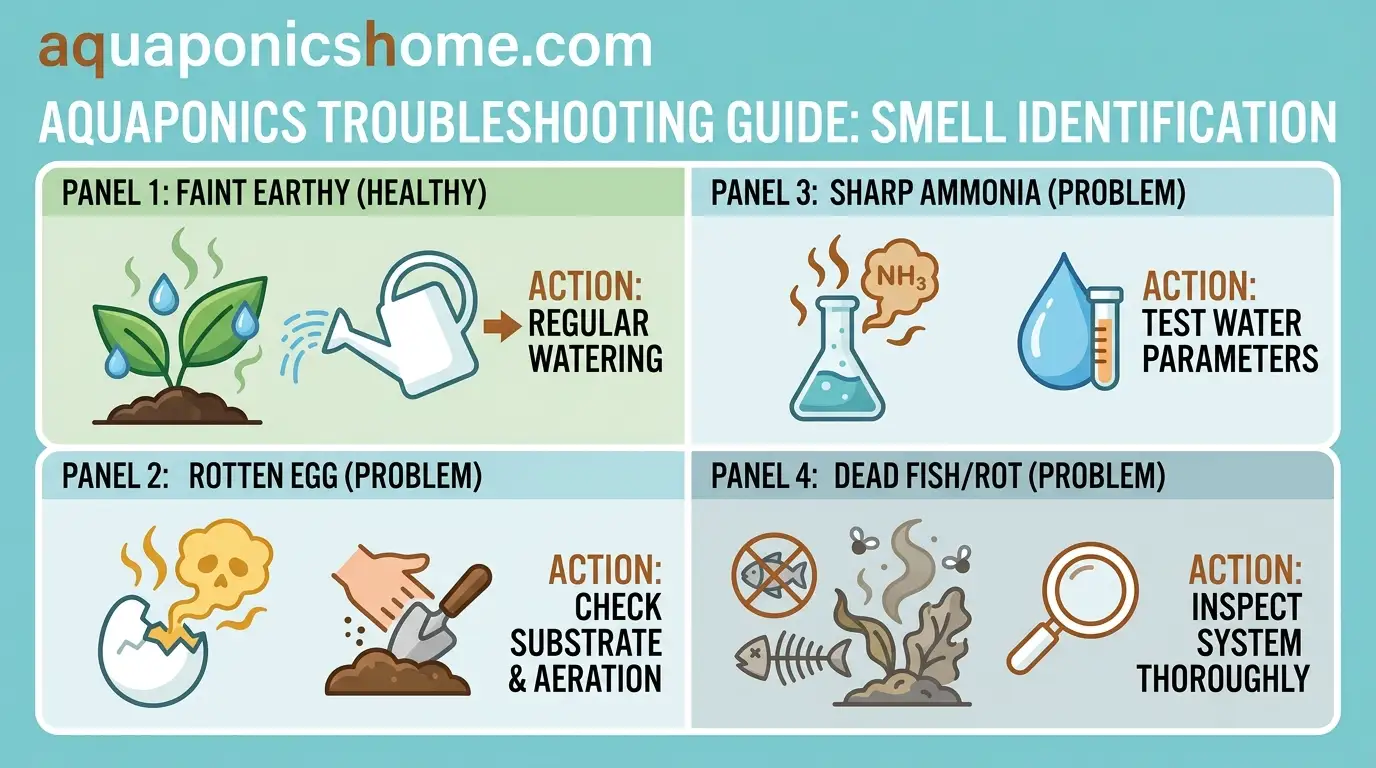
A healthy aquaponics system should smell faintly earthy, like fresh soil or a forest floor, from the biofilm quietly doing its job. It should never smell foul. A rotten egg smell points to an anaerobic dead zone somewhere in the media or the solids. A sharp, ammonia smell usually means overfeeding or an overloaded, undercycled system. A dead animal smell means something has died and you have not found it yet.
I have three years of running small systems on a rented balcony in Dhaka, and I check my nose before I check anything else now. It is not scientific, and it will not replace a test kit, but it is fast, and it usually points me in the right direction before I have even opened the test kit box.
What a healthy aquaponics system actually smells like
A working aquaponics system smells like damp earth, a little like the inside of a greenhouse or a forest floor after rain. That smell comes from the biofilm, the thin living layer of bacteria and microorganisms coating your media, your pipes, and any surface with steady water flow across it. It is not a bad smell. It is the smell of a system that is doing exactly what it should be doing.
That earthy note might get slightly stronger right after feeding, or on a warm day, and that alone is not a problem. What you are listening for with your nose is a change, not a total absence of any smell at all. A system that has gone from faintly earthy to sharply unpleasant is telling you something changed, even before your eyes or a test strip catch it.
Rotten egg smell: an anaerobic dead zone, not a mystery
A rotten egg smell is the most specific of the three, and it almost always means the same thing: a pocket somewhere in your system has gone anaerobic, meaning it has run out of oxygen. Bacteria that live without oxygen produce sulfur compounds as they break down organic matter, and that is what you are smelling. This usually happens in media that has clogged with solids and stopped draining properly, or in a low spot where waste has settled and never gets disturbed by flow.
Poor circulation and overfeeding both feed this problem, because both leave more solids sitting still for longer than they should. I have watched this happen on my own balcony during power cuts, when the pump stopped and the water sat without moving. Circulation is what keeps oxygen reaching every part of the system, and once it stops, dead zones start forming faster than you would expect. If your media has not been disturbed in a long time, or you have had a recent power outage, that is where to look first. The media bed guide covers how clogging actually happens and what a healthy bed looks like underneath the surface.
Sharp, ammonia-like smell: usually overfeeding or an overloaded system
A sharp smell, closer to a pungent, urine-like sting than an earthy note, usually points to ammonia building up faster than your system can process it. This is distinct from the visual ammonia test you might run with a liquid or strip kit. Your nose can pick up a change before or alongside that test, but it is not a substitute for one. If you smell this, test your water directly rather than guessing from the smell alone.
The two most common reasons this happens are overfeeding, where uneaten food breaks down into more ammonia than the system was built to absorb, and a system that is overloaded or not fully cycled yet, meaning the bacterial colony that converts ammonia has not caught up with how many fish and how much food you have. Both are workable problems once you know which one you are dealing with. The ammonia too high guide walks through what to do once you have confirmed it with an actual test, not just a smell.
Dead animal smell: something has died and you have not found it yet
This is the smell to take most seriously, and the one place on this page where a smell stops being a nuisance and starts being something you act on right away. A dead animal or rot smell, distinct from both the earthy baseline and the sharper ammonia note, usually means a decomposing fish, or occasionally dead plant matter, is sitting somewhere in the system out of sight.
In an edible system, a fish that has died and is decomposing is not only a fish-welfare problem. It is a food-safety event, because that decomposition is happening in the same water that reaches your plants. If you catch this smell, stop and search the system now: under media, behind pipework, in any corner of the tank you cannot normally see into. Do not wait for the smell to fade on its own, and do not assume it is nothing until you have actually looked. If you find a fish, or you cannot rule one out, is aquaponics food safe walks through what that means for anything you were planning to harvest soon.
Smell-to-cause-to-action table
Use this as a quick first read, then follow the linked article for the specific next step.
| Smell | Likely cause | What to do |
|---|---|---|
| Faintly earthy, like soil | Normal biofilm activity, a healthy system | Nothing needed. This is what a working system smells like |
| Rotten egg | An anaerobic dead zone in the media or settled solids, often from poor circulation or overfeeding | Check flow and aeration, inspect media for clogging, see the media bed guide |
| Sharp, ammonia-like | Overfeeding, or an overloaded/undercycled system | Test ammonia directly, then follow the ammonia too high guide |
| Dead animal or rot | A fish or dead plant matter decomposing somewhere unseen | Search the system now. Treat it as a food-safety event, see is aquaponics food safe |
Why your nose is a legitimate first check, and where it stops being enough
I am not an aquaponics scientist, and I am not going to pretend a smell test replaces a proper water test. What I will say, from three years of doing this on a small scale, is that your nose is often faster than any test kit at telling you something has changed. It cannot tell you a number, and it cannot tell you whether an ammonia reading is actually dangerous for your fish once you factor in pH and temperature. What it can do is tell you where to look first.
One distinction worth knowing: a rotten egg smell and a stripped biofilter are not the same failure, even though both involve the media. A biofilter that has been cleaned too hard tends to show up in your ammonia numbers before it ever shows up as a smell. If you recently did a thorough clean and now your water quality has soured without an obvious rotten egg or ammonia smell, I cleaned it and everything died covers that specific mechanism.
If you are not sure which of these you are actually dealing with, or the smell is only one of several things going wrong at once, start at the full troubleshooting checklist and work through it in order rather than chasing the smell alone.
FAQ
Does a healthy aquaponics system smell at all?
Yes, faintly. Expect a mild, earthy smell similar to damp soil or a forest floor, coming from the biofilm on your media and pipework. That smell is normal and is not something to try to eliminate.
Why does my aquaponics system suddenly smell like rotten eggs?
This almost always means a pocket of the system has gone anaerobic, usually clogged or settled media that stopped getting oxygen from flowing water. Poor circulation, a recent power outage, or overfeeding are the usual triggers. Check flow and inspect the media before assuming anything worse.
Is a sharp ammonia smell always an emergency?
Not automatically, but treat it as a signal to test, not to guess. A smell can tell you something changed before your eyes do, but only an actual water test tells you how serious it is. Overfeeding and an undercycled or overloaded system are the most common causes.
I can smell something bad but I can’t find where it’s coming from. What do I do?
Search the system directly rather than waiting it out: under and inside the media, along pipework, in corners of the tank that are hard to see into. If you cannot rule out a dead fish, treat any recent harvest as a food-safety question rather than assuming everything is fine.
Can I use a product to mask or fix the smell?
No. This site does not recommend any masking product, additive, or treatment for odor. A smell is a symptom pointing at a mechanical or feeding cause, and the fix is finding and addressing that cause, not covering it up.
I still check my systems by nose most mornings before I do anything else. It has never replaced a proper water test for me, but it has caught more than one problem before the numbers did.