
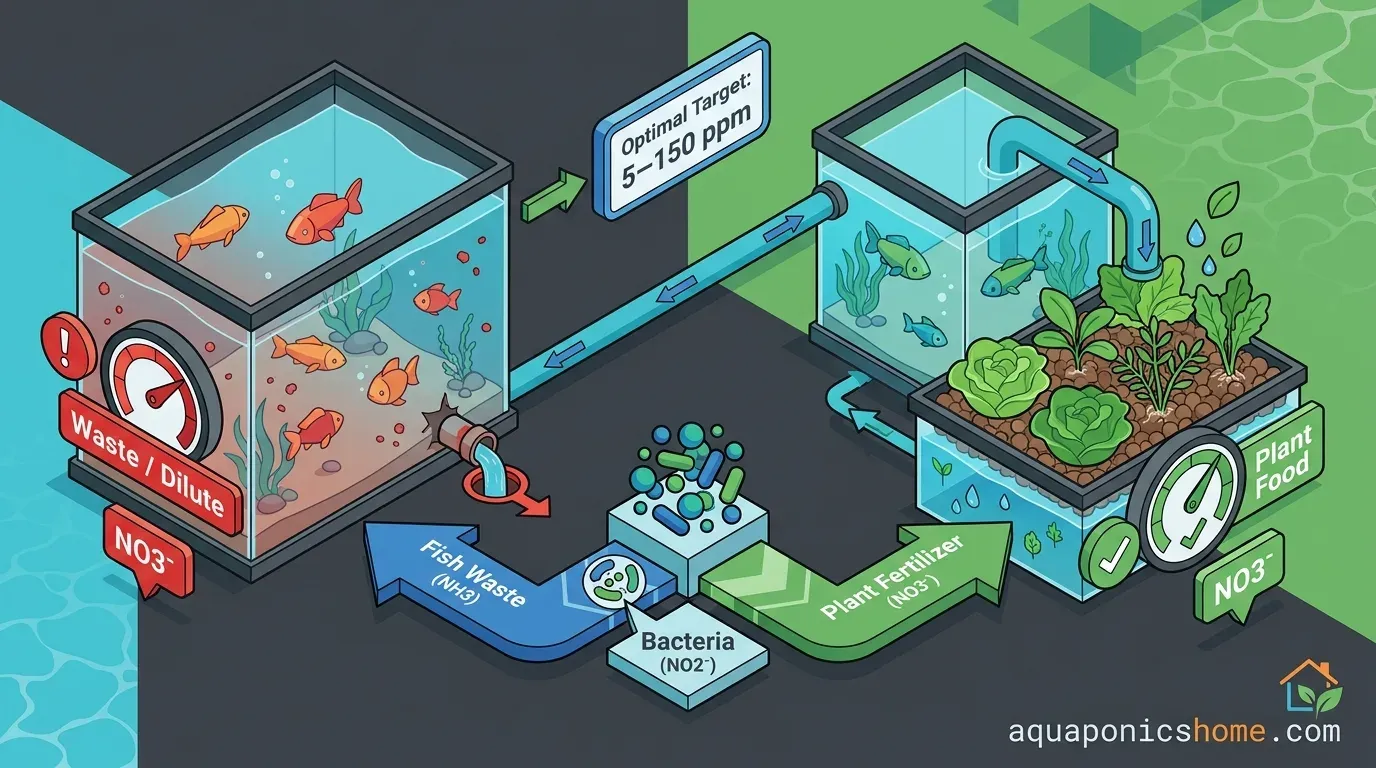
Short answer: nitrate is the end product of the nitrogen cycle and the form of nitrogen your plants actually eat. In an ornamental fish tank it is waste to be diluted away with water changes. In aquaponics it is the whole point, because the plants are the ones removing it, and a rising nitrate reading during cycling is the first proof that your system has become a food system rather than a fish tank. New Mexico State University Cooperative Extension’s aquaponics circular gives an optimal range of 5 to 150 ppm and treats levels above that as a sign the plants are not taking up what the fish are producing.
That inversion is the whole reason this reading confuses people. Almost every piece of advice you will find about nitrate was written for someone whose goal is a healthy fish and nothing else. Your goal includes a vegetable, and it changes the answer.
What nitrate is, and where it comes from
Nitrate, written NO3, is what your system makes out of fish waste after two bacterial handoffs.
- Fish excrete ammonia, mostly across the gills.
- Ammonia-oxidizing bacteria convert ammonia to nitrite.
- Nitrite-oxidizing bacteria convert nitrite to nitrate.
- Plant roots take the nitrate up as their nitrogen source.
Step four is what makes aquaponics different from an aquarium and different from a filter. In a display tank there is no step four, so nitrate accumulates until the keeper removes it by changing water. In your system, the crop is the removal mechanism. That is why the same reading tells two people opposite things, and why the honest answer to “should I be worried about nitrate?” is a question about what you are growing.
The chain only exists if the first two steps are working, so a nitrate reading is also indirect confirmation that your biofilter is alive. Watching nitrate appear for the first time is the single most satisfying moment in cycling a new system, because it is the reading that cannot be faked.
What the published ranges actually say
The internet will hand you a confident nitrate target. Several of them, all different, mostly with nothing attached.
Here is what a named source says instead. NMSU Cooperative Extension’s Circular 680 on water quality parameters in aquaponics systems (Sallenave) gives 5 to 150 ppm as the optimal nitrate range for productive aquaponics systems, and reads excessive levels above 150 ppm as an indication of insufficient plant uptake.
Notice how wide that is. A thirty-fold range is not vagueness; it reflects that the right figure depends on how much plant growing area you have, what you are growing, how heavily you stock and feed, water temperature and season. A system running lettuce in a small media bed and a system running a full grow wall are not aiming at the same number, and neither is the same system in July and in January.
So use the range as a sanity check rather than a target to chase:
| What you are seeing | What it usually means |
|---|---|
| Nitrate at or near zero in a system you believe is cycled | The chain is broken upstream, or the plants are outrunning the fish |
| Nitrate present and rising slowly | Normal. The fish are producing more than the plants are consuming, with headroom |
| Nitrate stable week after week | Production and uptake are roughly balanced. This is the state you want |
| Nitrate climbing steadily and high | The plants are not keeping up with the fish load |
The last row is the aquaponics answer to a problem an aquarist solves with a water change. Your first move is usually to add growing capacity or reduce feeding, not to dump and replace water, because the nitrate is fertilizer you paid for in fish feed.
If your reading is the first row and stays there, that is a different article with different causes, and it is nitrate that will not rise.
Reading the nitrate test without fooling yourself
The nitrate test is the fussiest of the three nitrogen tests in most liquid kits, and it is the one most often performed wrong.
- The second reagent bottle usually needs vigorous shaking, often for longer than feels reasonable, because a component settles out. Under-shaking it is the classic cause of a falsely low nitrate reading, and a falsely low reading sends people looking for a problem that does not exist.
- The color development takes time. Read it at the time the instructions state, not when you get back to it.
- The high end of a nitrate card is hard to read. The colors at the top of the scale are close together, so treat a high reading as “high” rather than as a precise figure.
- Nitrate moves slowly. Unlike ammonia, it does not swing in a morning. That makes it a poor emergency indicator and an excellent trend indicator, which is why it belongs in a weekly log rather than a daily panic.
There is one thing a nitrate reading does not do, and it is worth stating because a lot of disappointed growers learn it the hard way. Healthy nitrate does not mean complete plant nutrition. Nitrogen is one nutrient among several, and an aquaponic solution is genuinely weak in some of the others. Yellowing between the veins of a leaf on a plant sitting in plenty of nitrate is a different problem, and no amount of extra fish will solve it.
When high nitrate is telling you something else
High nitrate is a symptom of imbalance rather than a poison in its own right at the levels a home system reaches, and the imbalance usually has one of four shapes.
- Too few plants for the fish. The commonest one, and the most satisfying to fix, since the answer is more growing area rather than less food production. Grow bed capacity and how it relates to fish load is covered in media bed systems.
- A recent harvest. You just removed a large fraction of your uptake capacity. Nitrate will climb until the replanting catches up. This one is normal and temporary, and it is worth writing in the notebook so next season’s reading makes sense.
- Overfeeding. More feed in means more nitrogen in, whether or not the fish need it.
- Nutrient plus light equals algae. Nitrate is fertilizer, and it does not care whether the plant using it is your lettuce or a film of green in the tank. A system with high nitrate and sunlight on the water tends to grow algae and green water, which then competes with your crop for the same nitrogen.
Nitrate and what you are about to eat
This section exists because a food-growing site should raise it rather than leave it to the reader to find out later, and because almost no aquaponics page does.
Leafy vegetables accumulate nitrate, and food safety authorities have looked at this in detail. The European Food Safety Authority’s CONTAM Panel published a scientific opinion in 2010 on possible health risks for infants and young children from nitrates in leafy vegetables, concluding that levels in these vegetables are not of health concern for most children, while noting that children aged one to three consuming high amounts of high-nitrate spinach could at times reach an intake level at which a risk of methemoglobinemia, the same blood-oxygen condition nitrite causes in fish, cannot be excluded. In the European Union, maximum nitrate levels for certain leafy crops including spinach, lettuce and rocket, sold in North America as arugula, are set in law by Commission Regulation (EU) No 1258/2011.
Two honest caveats on that. Those are European instruments, so for a reader in the United States or Canada they are the best published reference rather than local law. And the studies behind them concern conventionally grown produce, not specifically aquaponic produce. What they establish is that this is a real, studied question with named authorities attached, not a reason to panic about a salad.
The rest of the produce-safety picture, which is mostly about water contact, harvest handling and what may be sprayed above an open tank, is covered in the site’s page on whether aquaponics produce is food safe. If you are growing for an infant or a young child specifically, take that question to a registered dietitian or your pediatric health service rather than to a gardening site, including this one.
Is nitrate ever an emergency?
Rarely on its own, at the concentrations a small home system produces, and this is where aquaponics genuinely is more relaxed than an ornamental tank. But two situations deserve a fast response.
A sudden large jump in nitrate usually means something changed sharply, most often a lot of decomposing material, and the thing that decomposed is often also producing ammonia. Test all three numbers, not just this one.
High nitrate alongside high ammonia or high nitrite is not a nitrate problem at all. It is a biofilter problem with a nitrate reading attached, and the acute risk to your fish is the ammonia and the nitrite. Work from the symptom rather than the number, using the troubleshooting routes, and if fish are visibly distressed, stop feeding, aerate, and do a partial water change with dechlorinated, temperature-matched water before you do anything chemical.
Do not use a page like this one, or any other, as the source of a dose for a water treatment product. The quantity depends on that product’s concentration and your real system volume, and it belongs on the label.
FAQ
What is the ideal nitrate level for aquaponics?
NMSU Cooperative Extension’s Circular 680 gives 5 to 150 ppm as the optimal range for productive aquaponics systems and treats readings above 150 ppm as a sign of insufficient plant uptake. The range is wide because the right figure for your system depends on your growing area, your crop, your stocking and feeding rate and the season, so it is better used as a sanity check than as a target.
Is high nitrate bad for my fish?
Nitrate is far less acutely toxic to fish than ammonia or nitrite, which is why aquaponic systems tolerate levels an ornamental keeper would remove. A high reading is mainly a message about balance: your plants are not consuming what your fish are producing. Species tolerances differ, so use your own extension aquaculture service’s figures for the species you keep rather than a general number.
Why is my nitrate zero after cycling?
Either the chain is broken upstream, meaning the ammonia or nitrite step is not completing, or your plants are taking up nitrate as fast as it is produced, which is common in a heavily planted system with a light fish load. Check ammonia and nitrite first: if either is detectable, the problem is the biofilter and not the plants.
Should I do a water change to lower nitrate?
That is the aquarium answer, and in aquaponics it is usually the wrong first move, because nitrate is the fertilizer your fish feed paid for. Adding growing capacity, replanting after a harvest or reducing feeding addresses the cause. Water changes remain a legitimate tool for other reasons, including diluting a genuine ammonia or nitrite problem.
Does nitrate in the water end up in my vegetables?
Leafy vegetables do accumulate nitrate, which is why the European Food Safety Authority has published an opinion on the subject and the EU sets maximum levels for certain leafy crops. Those instruments concern conventionally grown produce and are European rather than North American, so treat them as the best published reference rather than as local law, and take any question about feeding young children to a qualified health professional.
Sources
- Sallenave, R. Important Water Quality Parameters in Aquaponics Systems. New Mexico State University Cooperative Extension Service, Circular 680.
- EFSA Panel on Contaminants in the Food Chain (CONTAM) (2010). Scientific opinion on possible health risks for infants and young children from the presence of nitrates in leafy vegetables.
- Commission Regulation (EU) No 1258/2011 of 2 December 2011, amending Regulation (EC) No 1881/2006 as regards maximum levels for nitrates in foodstuffs.
I grow spinach, leafy greens and herbs on a rented balcony and my nitrate reading has spent most of three years telling me whether I had planted enough, not whether I had too many fish. No universal target figure is invented here: the published range above is attributed, wide on purpose, and depends on your growing area, your crop and your season. Use your test kit’s documentation and a named extension aquaculture service for the species you keep, take food-safety questions about feeding young children to a qualified health professional, and take anything concerning a sick fish to a qualified aquatic veterinarian.