
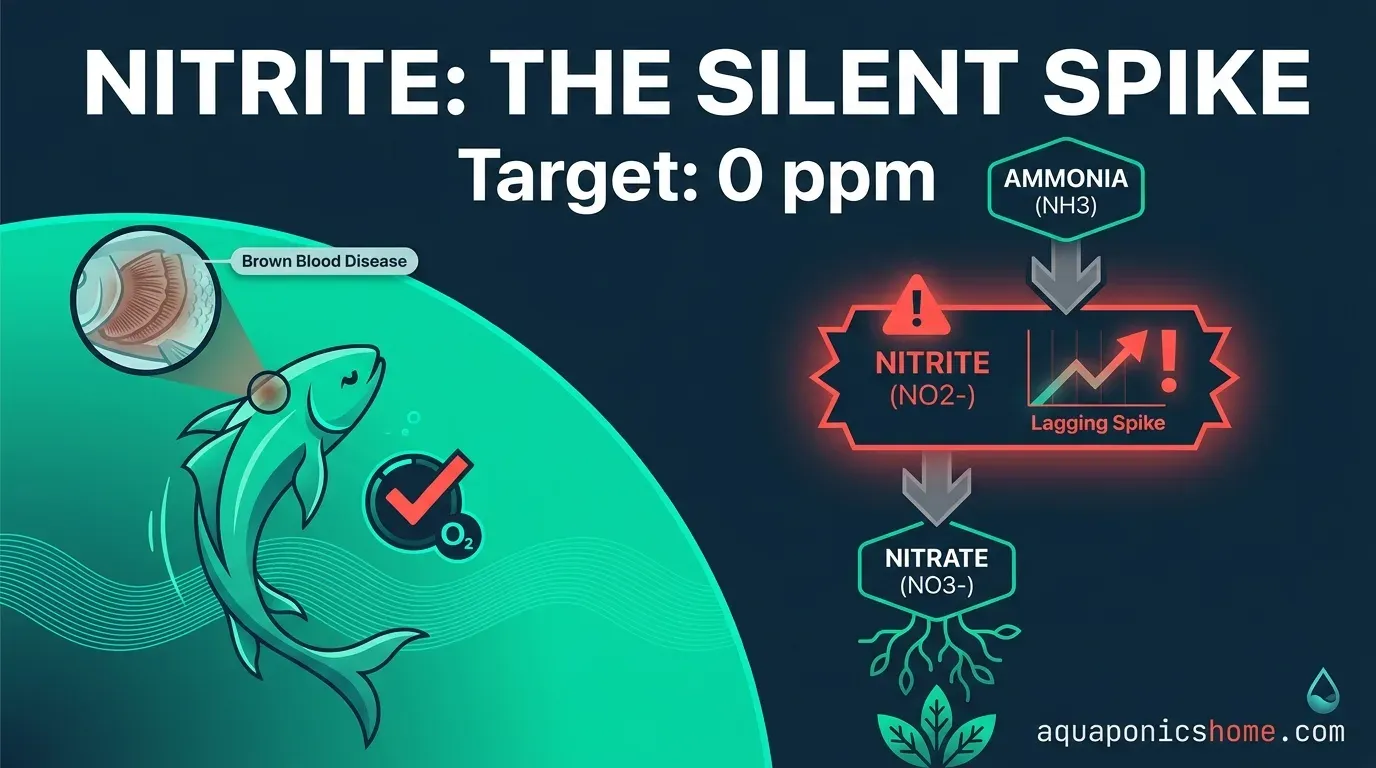
Short answer: nitrite is the middle step of the nitrogen cycle. One group of bacteria converts fish ammonia into nitrite, and a second, slower group converts nitrite into the nitrate your plants use. Nitrite matters because of what it does inside a fish: it enters the bloodstream through the gills and converts hemoglobin into methemoglobin, which cannot carry oxygen. The result, described by the Southern Regional Aquaculture Center’s fact sheet on nitrite in fish ponds (Durborow, Crosby and Brunson, SRAC Publication No. 462), is that affected fish can suffocate despite adequate oxygen in the water. That is why nitrite is the reading that kills after you think the crisis is over.
This is the explainer, not the emergency response. If your nitrite is high right now, the response is in what to do about a nitrite spike. This page is about what the number is, where it comes from and how to read it.
Why there is a second number at all
Beginners learn that ammonia is the dangerous one, and they are not wrong. What they are usually not told is that ammonia disappearing is not the same as ammonia being gone.
Nitrification is two separate jobs done by two separate groups of bacteria:
- Ammonia-oxidizing bacteria turn ammonia into nitrite.
- Nitrite-oxidizing bacteria turn nitrite into nitrate.
Those two groups do not establish at the same time or at the same speed. The first group gets going first, which is exactly why nitrite appears in a new system just as ammonia starts falling. It looks like a setback. It is actually proof that step one is working, and it is the point at which the second group is only just beginning.
So the sequence in a new system is: ammonia rises, ammonia peaks and falls while nitrite rises, nitrite peaks and falls while nitrate rises, then both toxic readings sit at zero with nitrate present. That last state is the finish line, and it is a two-zero finish line. A system where ammonia reads zero and nitrite reads anything at all is not cycled. Stocking at that moment is the single most common way a careful beginner kills fish, because it happens after the scary part appears to be over. The full procedure and the finish conditions are in the guide to cycling without killing your fish.
Where nitrite comes from
There is only one meaningful source, which makes this simpler than ammonia.
| Source | What it means for you |
|---|---|
| Bacterial conversion of ammonia | Effectively the only source. Nitrite is manufactured inside your system, not brought into it |
| Whatever raised ammonia in the first place | Overfeeding, a decomposing fish, new stock, a damaged biofilter. Nitrite follows the ammonia by days |
| A half-recovered biofilter | The group that makes nitrite has recovered and the group that consumes it has not |
That third row is the one worth internalizing. If your biofilter takes a hit, whether from over-cleaning, chlorinated top-up water or a long power cut, the two bacterial groups do not come back together. The faster group recovers first and starts producing nitrite into a system that cannot yet consume it. That is why a nitrite reading often follows a week or two behind a biofilter crash rather than arriving with it.
Practically: nitrite is a lagging indicator. It tells you about something that went wrong earlier, which is exactly why it catches people who have stopped worrying.
Brown blood: what nitrite actually does to a fish
This is the mechanism, and it is the one piece of chemistry on this page worth learning properly, because it changes what you do in an emergency.
SRAC Publication No. 462 describes it clearly. Nitrite enters the bloodstream across the gills and turns the blood a chocolate brown color. Hemoglobin, the molecule that transports oxygen, combines with nitrite to form methemoglobin, which is incapable of oxygen transport. Brown blood cannot carry sufficient oxygen, and affected fish can suffocate despite adequate oxygen concentration in the water. That, the fact sheet notes, accounts for the gasping behavior often observed in fish with brown blood disease even when oxygen levels are relatively high.
Read the last part again, because it is the practical consequence: turning up the air pump does not save a fish that is poisoned by nitrite. The oxygen is already in the water. The fish cannot pick it up. Aeration is still the right thing to do, because it costs nothing and helps a stressed fish in every other respect, but if you have concluded that gasping means the aeration is inadequate, you may be treating the wrong problem entirely. That overlap is why gasping at the surface always needs a test result behind it before you decide what it means.
Reading the test, and why one number is not enough
A nitrite test is mechanically simpler than an ammonia test. There is no ionized and un-ionized form to convert, and the color card is what it is.
The complication is in how much risk a given reading represents, and it is not the same across systems. SRAC 462 explains why: the chloride concentration in the water greatly affects the uptake of nitrite across the gills, because chloride ions carry the same charge and are similar in size to nitrite ions, so they compete at the gill. Two systems reading identical nitrite can therefore present genuinely different risk to the fish depending on the chloride already in their water. Species and fish size vary the picture further.
So this is what the sources actually say, and they do not fully agree.
- New Mexico State University Cooperative Extension, Circular 680 on aquaponics water quality (Sallenave), states nitrite is toxic to fish at levels of 5 ppm, and that for tilapia, nitrite should be maintained at or below 1 ppm. Note that the second figure is species-specific and much stricter than the first.
- FAO Technical Paper 589, Small-scale aquaponic food production (Somerville and colleagues, 2014), takes a system-function view: ammonia and nitrite should always be 0 to 1 mg per liter in a functioning and balanced aquaponic unit, and if either is detectable it indicates a problem with the nitrifying bacteria.
- SRAC 462 emphasizes the chloride relationship and species susceptibility rather than offering one universal cut-off.
That disagreement is not a flaw in the sources. It is the honest state of the question, and it is why this page does not average them into a single tidy figure to remember. Use the target range published by your own test kit or by a named extension aquaculture service for the species you keep, and treat any detectable nitrite in a system you believed was cycled as a signal to investigate rather than as a level to tolerate.
What nitrite means for the plants
Less than you might fear, and this is one of the few places aquaponics is more forgiving than a display tank. Nitrite is an intermediate; your plants are waiting for nitrate. A nitrite reading is a fish and bacteria problem rather than a crop problem, and the crop’s complaint, when it comes, arrives later as nitrate that never appeared.
There is one indirect effect worth knowing. If you are treating nitrite by any route that adds salt to the system, the plants become the limiting factor, because they tolerate far less salt than the fish do. That is a real constraint on a food-growing system and it is one of the reasons the response belongs on its own page with its own sourcing rather than as a paragraph here.
If your fish are in distress right now
Physical actions first. None of this is chemistry, and that is deliberate.
- Stop feeding. Feed becomes ammonia, and ammonia becomes more nitrite. This is the fastest lever you have.
- Increase aeration anyway. It will not reverse brown blood, but a stressed fish needs every advantage, and the biofilter needs dissolved oxygen to work at all.
- Do a partial water change with dechlorinated, temperature-matched water. Dilution is the one intervention that works on any dissolved problem. Treat the water before it goes in and match the temperature.
- Check the obvious physical causes while you are there: is the pump running, is the bed draining, is there a dead fish, did you recently clean anything.
- Retest and write it down.
Do not follow a dose figure from a blog for any salt, conditioner, binder or bacterial product, including any number you may find on a competing page. Doses depend on the concentration of the specific product and the true volume of your system, both of which only you can know, and both of which are on that product’s own label. An overdose in a small system is a second emergency on top of the first, and in a system growing food it is also a residue question.
If fish are already dying, work through the first-hour triage sequence. If you have both a high ammonia reading and a high nitrite reading, treat the ammonia side as the upstream cause, because reducing ammonia production is what eventually reduces nitrite production. Anything that looks like disease rather than water chemistry goes to a qualified aquatic veterinarian or an extension aquaculture specialist.
FAQ
What causes high nitrite in aquaponics?
Nitrite is produced inside the system by the bacteria that consume ammonia, so high nitrite means the group that converts nitrite to nitrate is not keeping up with the group that produces it. That happens in a new system that is mid-cycle, in a system whose biofilter was damaged and is recovering unevenly, or in a system whose ammonia load has increased through feeding, new fish or something decomposing.
Why is nitrite dangerous if my water is well aerated?
Because the problem is inside the fish, not in the water. SRAC Publication No. 462 describes nitrite combining with hemoglobin to form methemoglobin, which cannot transport oxygen, so affected fish can suffocate despite adequate oxygen concentration in the water. Adding air does not restore the blood’s ability to carry it.
My ammonia is zero. Do I still need to test nitrite?
Yes, and this is the single most useful habit in this article. Ammonia falling to zero is the halfway point of cycling, not the end of it, and a system reading zero ammonia with detectable nitrite is not cycled. Test both, every time, until both have read zero across several consecutive tests with nitrate present.
How long does a nitrite spike last?
There is no dependable figure, because it depends on water temperature, how large the surviving bacterial colony is, how much ammonia is still being produced and whether the underlying cause has been fixed. The nitrite-consuming group is the slower of the two to establish, so this phase routinely lasts longer than the ammonia phase before it, which is why so many people conclude their cycle has failed at exactly this point.
Does nitrite harm my vegetables?
Nitrite is an intermediate step and your plants are waiting on nitrate, so it is primarily a fish and bacteria problem. The crop-side consequence shows up later as nitrate that never arrives, and as the salt tolerance limit if the system is being treated with anything chloride-based.
Sources
- Durborow, R. M., Crosby, D. M. and Brunson, M. W. (1997). Nitrite in Fish Ponds. Southern Regional Aquaculture Center, SRAC Publication No. 462.
- Sallenave, R. Important Water Quality Parameters in Aquaponics Systems. New Mexico State University Cooperative Extension Service, Circular 680.
- Somerville, C., Cohen, M., Pantanella, E., Stankus, A. and Lovatelli, A. (2014). Small-scale aquaponic food production: integrated fish and plant farming. FAO Fisheries and Aquaculture Technical Paper No. 589.
I run small aquaponics systems on a rented balcony and I have watched the nitrite phase outlast the ammonia phase on two different builds. No treatment dose is published here on purpose: the amount of anything you add depends on that product’s concentration and your true system volume, and both belong on the label rather than in a blog post. Published nitrite thresholds disagree with one another, so use the target range from your own test kit or a named extension aquaculture service for the species you keep. Anything concerning a sick fish belongs with a qualified aquatic veterinarian.