
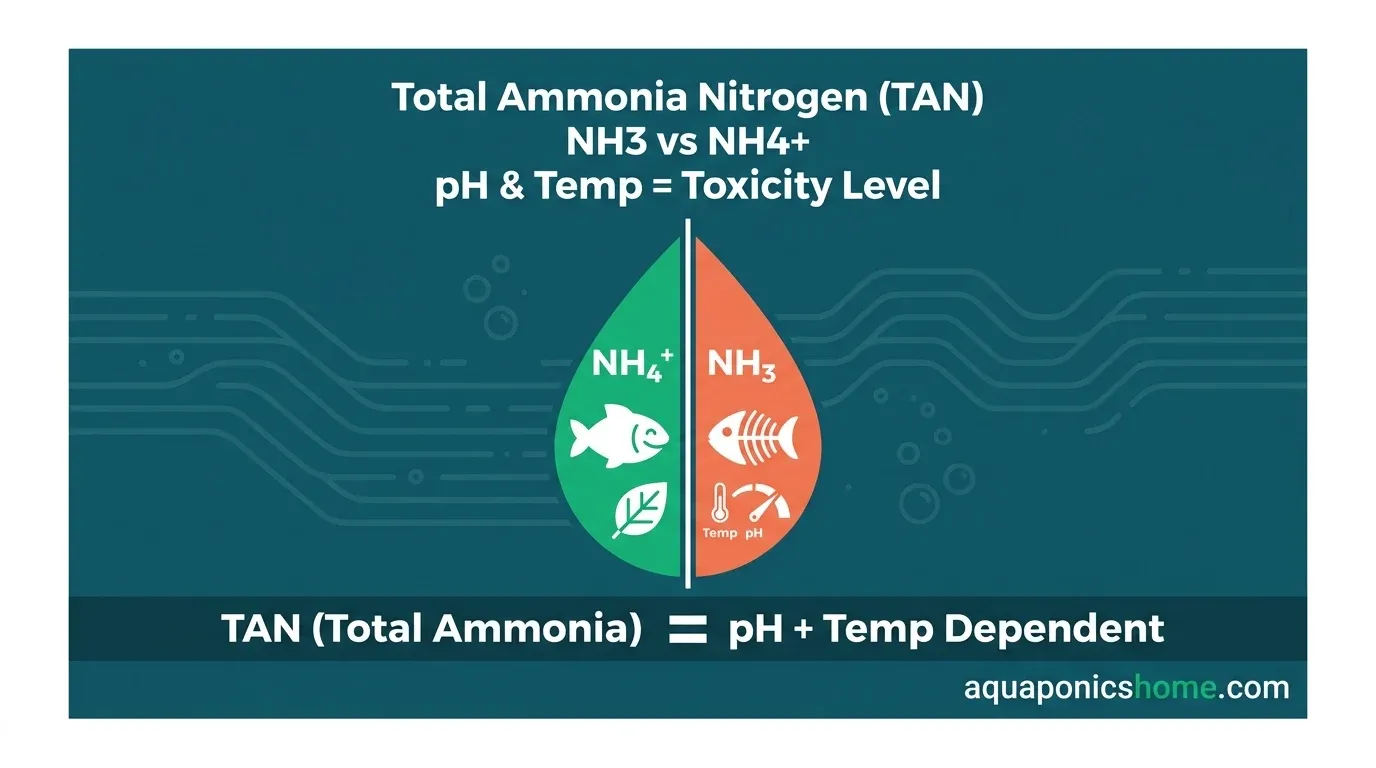
Short answer: ammonia is the nitrogen waste fish excrete, mostly through their gills, and it is the first link in the chain that ends up feeding your plants. In water it exists in two forms: un-ionized ammonia, which is the form that poisons fish, and ammonium, which is far less harmful. Your test kit does not tell them apart. It measures the two together as total ammonia nitrogen, and the split between them depends on your pH and your water temperature. That is why the same reading can be harmless in one system and lethal in another, and why an ammonia number without a pH and a temperature beside it cannot be interpreted.
This is the reference page, not the emergency page. If ammonia is high right now and you need to act, go to what to do when aquaponics ammonia is too high, which covers the response. This page covers what the number is and how to read it, which is what stops you needing that page again.
What ammonia actually is in an aquaponic system
Fish are the engine here, and ammonia is their exhaust. Unlike land animals, most fish excrete the majority of their nitrogen waste directly across the gills as ammonia rather than in solid waste, which is why ammonia appears in the water almost immediately after feeding rather than accumulating slowly in the bottom of the tank.
In water, that ammonia sits in equilibrium between two chemical forms:
- NH3, un-ionized ammonia. The toxic one. It crosses fish gill membranes easily.
- NH4+, ammonium. Far less harmful, and, usefully, still a nitrogen source plants can take up.
Both are counted together by a home test kit under the label total ammonia nitrogen, often shortened to TAN. This single fact is behind most of the confusion beginners have with ammonia, and it is why “is 1 ppm dangerous?” has no answer on its own.
Ammonia is also not the villain of the story. It is the input your whole system runs on. Nitrifying bacteria convert it to nitrite, then a second group converts nitrite to nitrate, and nitrate is what your lettuce eats. A system with no ammonia at all is a system with nothing to feed the plants. The problem is never ammonia existing; it is ammonia accumulating faster than the biofilter can process it.
Where it comes from, including the sources people miss
Five sources, and only the first is obvious.
| Source | How it shows up |
|---|---|
| Fish excretion | The main and continuous source. Scales with how much you feed and how much fish biomass you carry |
| Uneaten feed | Feed that is not eaten decomposes and releases ammonia. Overfeeding produces ammonia twice over |
| Decomposing solids | Settled waste and dying roots in the grow bed, especially where flow is poor and oxygen is low |
| A dead fish you have not found | A single decomposing fish is a large, concentrated ammonia source in a small system |
| Your source water | Chloramine is made by combining chlorine with ammonia, as the US EPA’s consumer guidance on chloramine describes, so chloraminated tap water brings ammonia into the system along with the disinfectant |
That last row surprises people, and it produces a specific confusing morning: you top up from the tap, test the next day, and find ammonia in a system that was reading clean. The disinfectant has also damaged the bacteria that would normally deal with it, so the reading climbs from both directions at once.
The fourth row is worth a hunt rather than a shrug. If ammonia rises with no change in feeding, count your fish. A missing fish behind the media or under the pump is a common and completely invisible cause, and it is one of the reasons a dead fish in an aquaponics system is an event to act on rather than just remove.
Reading the test: the part nobody explains properly
Here is the whole thing in one paragraph. Your kit gives you total ammonia nitrogen. Only the un-ionized part harms fish. The proportion that is un-ionized rises as pH rises and as temperature rises. So an identical TAN reading is a much bigger problem in warm, alkaline water than in cool, slightly acidic water.
New Mexico State University Cooperative Extension’s aquaponics water quality circular (Sallenave, Circular 680) states the ratio of NH3 to NH4+ at any given time depends on the pH of the water and the temperature, and that at pH 7.0 or below, most ammonia, more than 95 percent of it, is in the non-toxic ammonium form. The same circular publishes a table of toxic ammonia percentages across a pH range of 7.0 to 10.0 and a temperature range of 50 to 89.6 degrees Fahrenheit, which is the tool you actually want.
What to do with that, practically:
- Record pH and water temperature every single time you record ammonia. They are part of the reading, not context for it.
- To find out what your reading means for your fish, convert it. Use the conversion table or chart in your own test kit’s documentation, or the published table in NMSU Circular 680, matched to your pH and your temperature.
- Treat the converted un-ionized figure, not the raw TAN, as the number that describes risk to your fish.
I am not going to hand you a single safe ammonia level, and you should be suspicious of any page that does. The figure that matters is un-ionized ammonia, it varies with pH and temperature, tolerance differs by species and by fish size, and a confident universal number is how somebody at pH 8.3 concludes they are fine while their fish are already in trouble.
What I can give you is the reference for a working system, which is a different question from a toxicity threshold. FAO’s Small-scale aquaponic food production (Somerville and colleagues, Technical Paper 589, 2014) states that ammonia and nitrite should always be 0 to 1 mg per liter in a functioning and balanced aquaponic unit, and that if either is detectable it indicates a problem with the nitrifying bacteria. NMSU Circular 680 similarly gives a target of under 1 ppm total ammonia nitrogen. Read those as descriptions of a healthy biofilter, not as a line below which fish are guaranteed to be safe. Those are two different claims and the difference is the whole point of this page.
What a persistent ammonia reading is telling you
Ammonia is a symptom, and it is nearly always a symptom of one of four things.
- The system is not cycled yet. A new system has no established bacterial colony, so ammonia has nowhere to go. This is expected, it is temporary, and the process is cycling.
- The biofilter has been damaged. Over-cleaning, chlorinated or chloraminated top-up water, a long power cut, or a pH that fell out of the working range. My first catfish died this way: I cleaned the system thoroughly, washed the surfaces the bacteria lived on, and destroyed a colony I did not know was there. That failure has its own page because it is the most common own goal in small systems.
- The load has outgrown the colony. New fish added, fish that have grown, or feeding increased. The colony sizes itself to the ammonia it has been receiving and takes time to catch up.
- Something is decomposing. Uneaten feed, a dead fish, or a mass of dying roots.
Notice that the reading itself does not distinguish these. Your notebook does, because it holds what changed in the week before the number moved.
Why fish behavior is not a substitute for the test
A common piece of advice is to watch the fish instead of testing. It is not enough, for a reason worth understanding.
Ammonia poisoning damages gill tissue, and its visible signs, gasping at the surface, lethargy, loss of appetite, are the same visible signs produced by low dissolved oxygen, by nitrite poisoning and by a stopped pump. By the time the behavior is unmistakable, the water has usually been bad for a while. That overlap is exactly why gasping at the surface needs a test result to interpret it, rather than a guess about which cause it is.
The test is the early warning. The behavior is the late one.
If your fish are in distress right now
This is the emergency block. It is deliberately physical, not chemical, because chemistry takes time you do not have and a treatment applied to the wrong diagnosis makes things worse.
Do these now, in this order:
- Stop feeding. No feed until the readings recover. Fish are fine without food for far longer than they are fine in bad water.
- Aerate hard. Air stone, extra pump, anything that increases surface movement and gas exchange.
- Do a partial water change with dechlorinated, temperature-matched water. Treat the replacement water before it goes in, and match the temperature to the tank so you are not adding a second shock.
- Look for and remove anything decomposing. A dead fish, a mat of uneaten feed, a rotted root mass.
- Retest, and write down both readings.
Do not dose the tank with an ammonia binder, a pH adjuster or a bacterial supplement as a first move, and do not follow a dose figure from a blog post, including any that might otherwise appear on this site. Doses belong to the specific product’s own label, they depend on the concentration of that product and the true volume of your system, and an overdose is a second emergency layered on the first.
If fish are already dying, work through the first-hour triage sequence. If what you are seeing looks like disease rather than water chemistry, that is a question for a qualified aquatic veterinarian or your state extension aquaculture service, not for a water test.
FAQ
What is a safe ammonia level in aquaponics?
There is no single figure, and any page that gives you one has skipped the important part. The form that harms fish is un-ionized ammonia, and how much of your total ammonia reading is in that form depends on your pH and water temperature, with species and fish size affecting tolerance on top of that. Convert your reading using your test kit’s documentation or the published table in NMSU Circular 680, then judge the converted figure.
Why is my ammonia high when my system looks fine?
Most often because the biofilter is either not established yet or has been damaged, or because something is decomposing out of sight. Check whether you recently cleaned the system, topped up with untreated tap water, lost power to the pump, added or grew fish, or are missing a fish from the count.
Does ammonia hurt plants in aquaponics?
Plants can take up nitrogen as ammonium, so ammonia is not simply waste to them. The concern is the fish and the bacteria, not the crop. A high ammonia reading in a system growing well is still a signal that the biofilter is not keeping up.
Will more aeration reduce ammonia?
Not directly, but it helps in two real ways: nitrifying bacteria need dissolved oxygen to convert ammonia at all, with FAO 589 stating nitrification does not occur below 2 mg per liter, and better oxygenation supports fish that are already stressed by the ammonia. It is a supporting action, not a fix.
Can I test un-ionized ammonia directly?
Not with a standard home kit. Kits measure total ammonia nitrogen, both forms together. Getting to the toxic fraction means measuring pH and temperature at the same moment and using a conversion table, which is the reason this article keeps insisting on all three readings together.
Sources
- Sallenave, R. Important Water Quality Parameters in Aquaponics Systems. New Mexico State University Cooperative Extension Service, Circular 680.
- Somerville, C., Cohen, M., Pantanella, E., Stankus, A. and Lovatelli, A. (2014). Small-scale aquaponic food production: integrated fish and plant farming. FAO Fisheries and Aquaculture Technical Paper No. 589.
- US Environmental Protection Agency, information for consumers on chloramine in drinking water.
I run small aquaponics systems on a rented balcony and I killed my first batch of catfish by destroying the biofilter, which is where the cleaning warning comes from. No safe ammonia level and no treatment dose is published here on purpose: the toxic fraction depends on pH, temperature and species, and doses belong on the label of the specific product in your hand. Use your test kit’s conversion documentation and the named extension and FAO publications above for target values, and consult a qualified aquatic veterinarian for anything concerning live fish.