
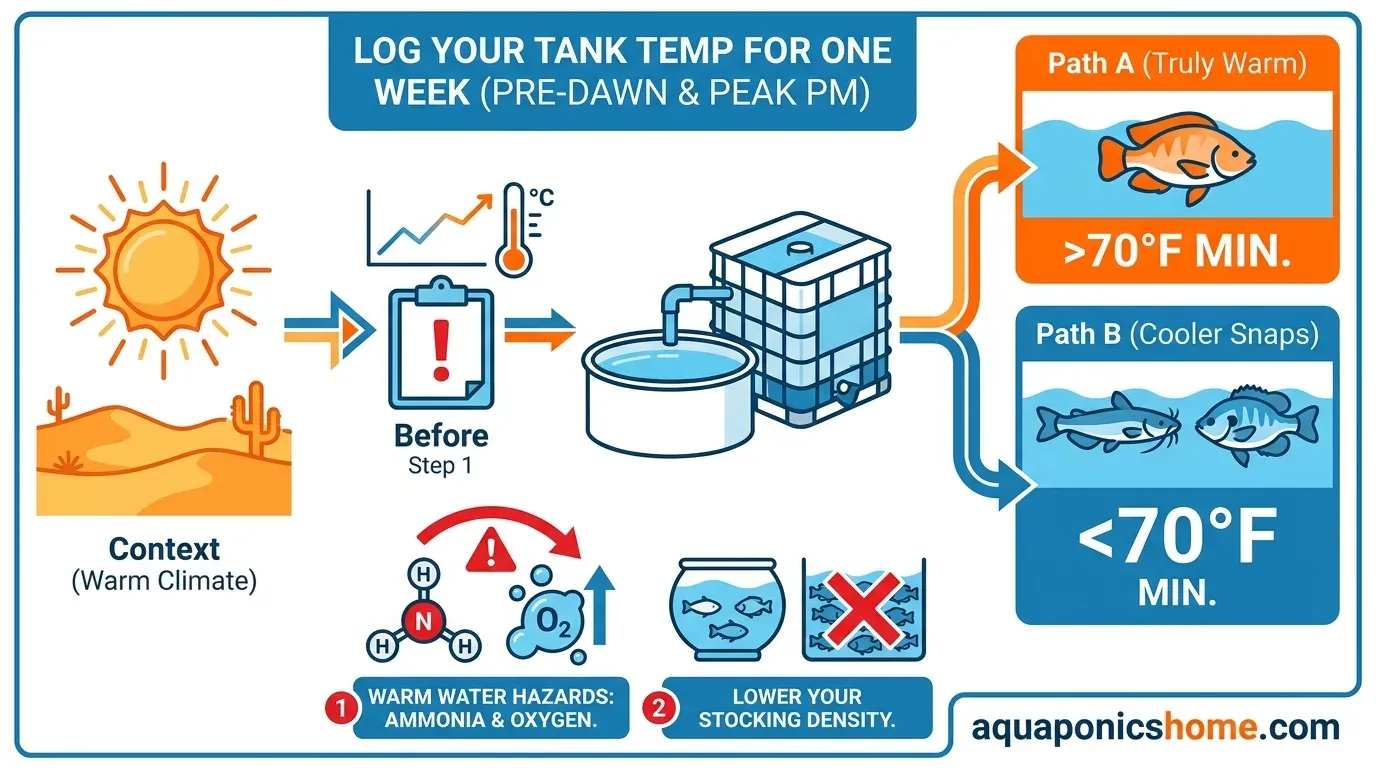
Running aquaponics fish no heater is realistic in a warm climate, but the fish choice depends on your actual water temperature range, not just the label “warm climate.”
Nile and blue tilapia are the standard pick because they grow well between roughly 82 and 86°F and only start struggling once water drops toward the high 60s.
Channel catfish and bluegill tolerate a wider swing and are the better call if your nights ever push water into the 60s. The species you can skip a heater for is the one whose temperature floor your tank never actually reaches, checked with a thermometer over a full week, not assumed from the weather app.
Aquaponics Fish No Heater Starts With Your Real Temperature Range
A region can be warm on average and still put an outdoor or garage tank through a 15 to 20 degree daily swing, especially in a metal stock tank or an above-ground tote that has no thermal mass. Air temperature and water temperature are different measurements, and only the water number decides whether a fish lives.
Before choosing a species, log your tank’s actual low and high for at least one full week, including the coldest pre-dawn hour and the hottest mid-afternoon hour. That single week of data does more for your stocking decision than any general climate map, because a “warm climate” city can still deliver a 58°F tank on a clear, windy night if the tank sits outside without insulation or shade.
Tilapia: The Default Aquaponics Fish for Truly Warm Water
Tilapia is the fish most aquaponics guides default to for unheated systems, and for a genuinely warm climate that default is earned. According to the Southern Regional Aquaculture Center’s Tank Culture of Tilapia publication (SRAC, read 2026-09-18), the species grows best between about 82 and 86°F, growth slows sharply below 68°F, and death occurs below 50°F, which is why the publication notes that only the southernmost parts of the United States can produce tilapia outdoors without supplemental heat.
Blue tilapia tolerate a somewhat lower range than Nile tilapia and are worth asking a supplier about specifically if your winters occasionally dip below what Nile tilapia can handle.
Either way, tilapia is not a fish you stock and forget: if your coldest recorded night is anywhere near 60°F, you are inside the stress zone the SRAC data describes, not comfortably above it.
Catfish and Bluegill: Options When Nights Cool Off
If your week of logged data shows occasional dips into the 60s, channel catfish and bluegill are the more forgiving choices, since both are native North American warmwater species built to handle a wider seasonal range than tropical tilapia. Neither needs tropical heat to feed and grow, and both pair with the same basic aquaponics setup.
This does not mean either fish is a cold-tolerant species. It means their stress threshold sits several degrees below tilapia’s, which matters if your “warm climate” still gets a handful of cool snaps a year.
Whatever species you land on, match the choice to your coldest logged night, not your average one, because a single bad night at the wrong temperature is what actually kills fish, not the seasonal average.
Why Skipping the Heater Still Changes Your Water Chemistry
Choosing a fish that survives your temperature range solves the obvious problem. However, a warm, unheated tank still runs a different water chemistry than a heated, climate-controlled one. And this is the part most “which fish needs no heater” articles skip.
Warmer water holds less dissolved oxygen than cooler water, so a tank sitting at 84°F year-round carries a thinner oxygen margin than the same tank at a cooler, heater-controlled setpoint, and that margin gets thinner still during a heat wave or a pump outage.
Ammonia toxicity moves the same direction: New Mexico State University Extension’s aquaponics water-quality circular (NMSU Extension, read 2026-09-18) explains that un-ionized ammonia, the toxic form, becomes a larger share of your total ammonia reading as both pH and temperature rise, and gives a concrete example at 82°F where the toxic fraction is about 2% of total ammonia at pH 7.5 but climbs to about 18% at pH 8.5.
In practice that means a warm-climate, no-heater system needs closer attention to pH and ammonia readings than a cooler system carrying the same fish load, because the same ammonia number is more dangerous to your fish on a hot day than on a mild one.
Space and Stocking: The Welfare Math Behind “How Many Fish”
Warm water raising your fish’s metabolic rate also raises how much waste they produce and how much oxygen they consume per pound of fish, which is why a warm-climate, unheated system needs a lower stocking density than the same tank volume would support at a cooler, controlled temperature. There is no single safe number that applies to every tank, because it depends on your tank’s surface area for gas exchange, your biofilter capacity, and your aeration.
What is not optional is checking, not guessing: a fish that looks fine at low stocking density can be pushed into chronic low-oxygen stress the moment you add “just a few more” without re-testing.
Run your water testing routine weekly, and treat any upward creep in ammonia or any afternoon lethargy as a sign to hold or reduce stocking before adding another fish, not after.
Cycle Before You Stock, Even in Warm Water
A common mistake is assuming that because a warm, unheated tank looks ready, the biofilter is ready too. Nitrifying bacteria still need an established colony to process fish waste, and that colony builds on the same nitrogen cycle timeline regardless of how warm your climate is outside.
Adding a full stock of tilapia or catfish to an uncycled tank in warm water is arguably riskier than in cool water, because the faster warm-water metabolism means ammonia and nitrite from an uncycled system climb faster too.
Confirm your tank has completed a full cycle, with ammonia and nitrite both reading zero and nitrate present, before you add fish at anything close to your target stocking density.
When to Worry: Signs of Heat and Water-Quality Stress
Fish gasping at the surface, clamped fins, sudden loss of appetite, or several fish showing the same unusual behavior at once are not “wait and see” situations, whether the cause turns out to be a heat spike, a crashed oxygen level, or disease.
A sourced description of the specific stressor, such as low dissolved oxygen or elevated un-ionized ammonia, tells you what to test for and fix immediately: add aeration, do a partial water change, and re-test.
If fish are dying and a water test does not explain why, treat it as a disease question, not a guessing game: contact a state Cooperative Extension aquaculture specialist or a land-grant fish disease diagnostic laboratory, such as the University of Florida’s Tropical Aquaculture Laboratory or Kentucky State University’s Fish Disease Diagnostic Laboratory, both of which accept samples and history from home producers.
Fish are not disposable stock to replace and move on from; a mass mortality event is a signal that something measurable went wrong, and it is worth identifying before restocking the same tank the same way.
FAQ
Can I really keep tilapia with zero heater in a warm climate?
Yes, if your tank’s logged low temperature stays above roughly 68°F year-round, since Southern Regional Aquaculture Center data puts tilapia growth decline below that point and death below 50°F (SRAC, read 2026-09-18). If your coldest night dips close to that line even occasionally, plan for a backup heater or a hardier species rather than assuming the average climate protects you.
Is catfish or bluegill actually easier than tilapia in a marginal climate?
Both tolerate a wider temperature swing than tilapia because they are native warmwater species rather than tropical ones, which makes them the safer default if your logged data shows occasional dips into the 60s. Neither is a cold-water fish, so the same rule applies: know your tank’s actual low before choosing.
Does a warm, unheated tank need more aeration than a heated one?
Often yes, because warmer water holds less dissolved oxygen to begin with, and warm-water fish also consume oxygen faster at higher metabolic rates. Treat aeration as a fixed cost of running warm rather than an optional upgrade, and verify it with a dissolved-oxygen test rather than assuming your air stone is enough.
What should I do if several fish die at once and the water tests look normal?
Stop stocking that tank further and contact a Cooperative Extension aquaculture specialist or a university fish disease diagnostic laboratory rather than guessing at a treatment. A clean water test does not rule out disease, and treating symptoms without a diagnosis risks losing the rest of the stock.
Do I still need to test ammonia and pH if my fish look healthy?
Yes. Un-ionized ammonia toxicity rises with both pH and temperature even when total ammonia looks low on a basic test, per NMSU Extension’s aquaponics water-quality guidance (read 2026-09-18), so a warm tank can cross into a dangerous range before fish show visible stress. Weekly testing catches that shift before it becomes a mortality event.