
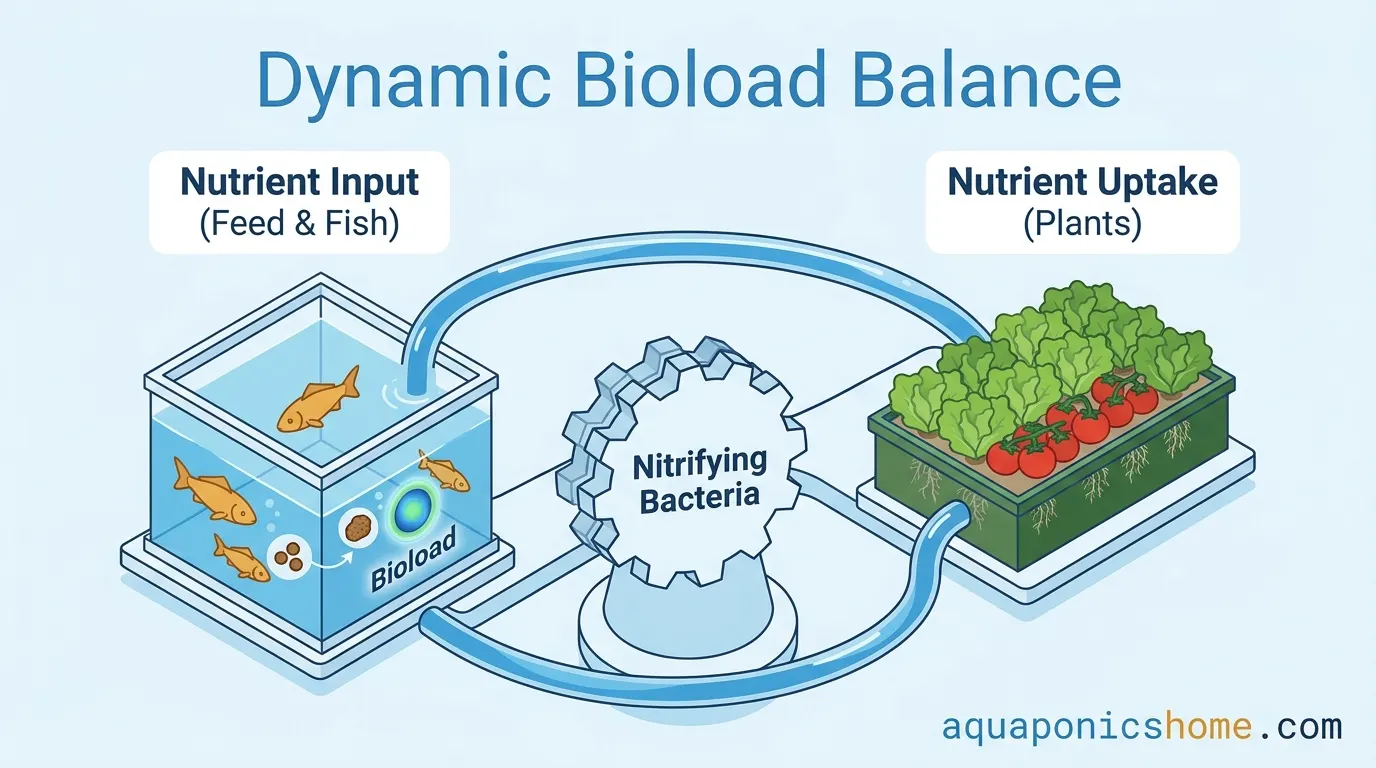
The short answer: there is no single aquaponics fish to plant ratio that works across systems, because the real limit is how much waste your fish produce and how much of that waste your bacteria and plants can process, not a fixed head count.
A media bed system, an NFT channel and a raft (DWC) bed each support a different number of plants from the same tank, and fish species, stocking density and feed input all shift the math further. What you need is not a ratio to copy, but the handful of numbers that decide it for your own setup.
Why the aquaponics fish to plant ratio is the wrong question
Most beginner searches want a clean answer like “one fish per two plants” or “ten fish per hundred plants.” Guides that give a flat number are simplifying past the part that matters.
Aquaponics works because fish waste (mostly ammonia) is converted by nitrifying bacteria into nitrate, and plants pull that nitrate out of the water as a nutrient.
The system balances when nitrate production roughly matches nitrate demand. A goldfish-sized bioload feeding lettuce needs a different plant area than the same tank stocked with tilapia and feeding tomatoes, because feed rate, fish size and plant appetite are all different variables hiding inside the word “ratio.”
The numbers that actually decide capacity
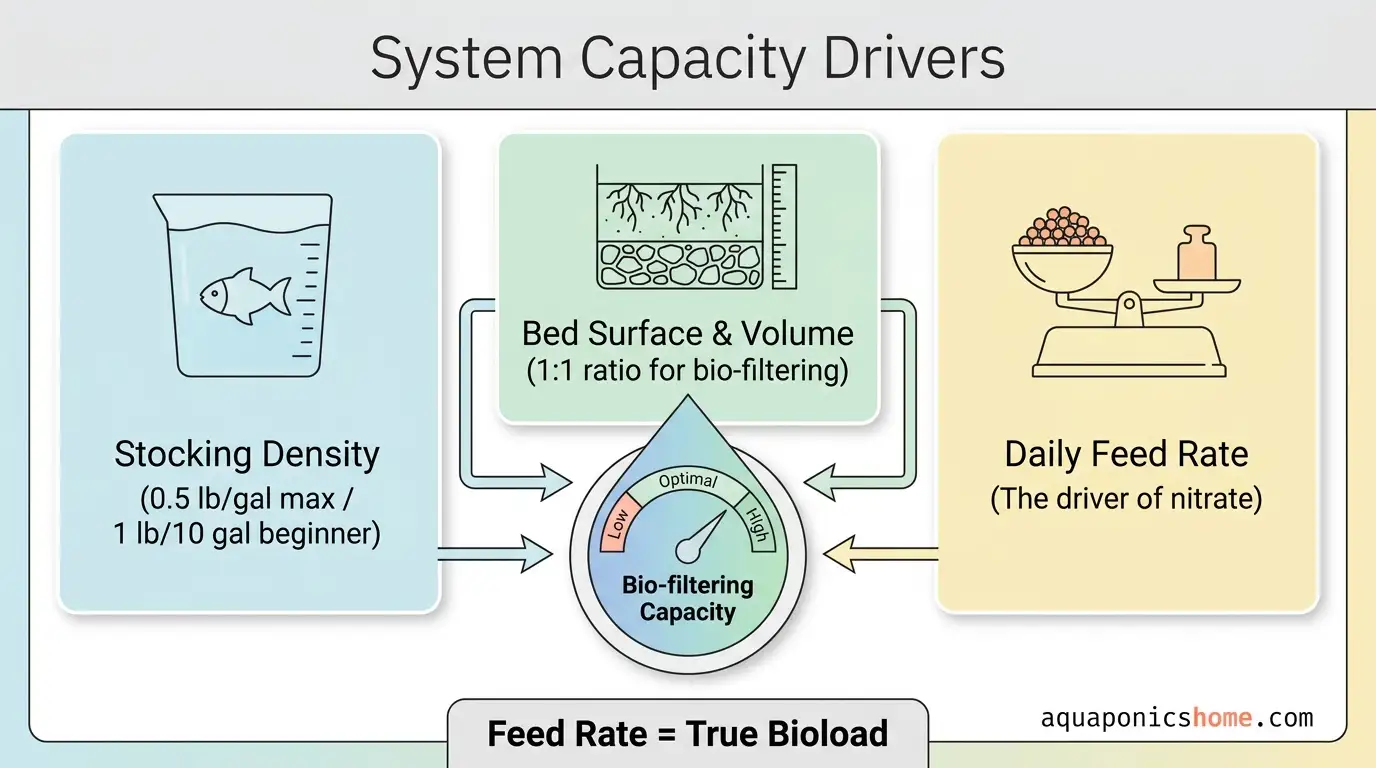
Three separate figures matter more than any single fish-to-plant count.
Fish stocking density
This is how much fish biomass your water can safely hold. Oklahoma State University Extension’s aquaponics guidance (read 2026-09-18) states that the critical standing crop in a small-scale system should not exceed about 0.5 pound of fish per gallon of water, and that a common target for a new or inexperienced grower’s final harvest density is closer to 1 pound of fish per 10 gallons, with the safe ceiling depending heavily on aeration, filtration and grower experience.
The Food and Agriculture Organization’s aquaponics guidance (read 2026-09-18) gives a comparable range for small aquaponic units, describing typical stocking density of roughly 10 to 20 kilograms of fish per 1,000 liters of water, with higher densities possible only when aeration and mechanical filtration are upgraded to match.
Neither source hands you a plant count. They cap how much fish your water can carry before the fish themselves suffer, which is the actual starting constraint.
Grow bed to fish tank volume
Once stocking density sets how much fish waste you are producing, grow bed volume decides how much filtering and root surface is available to process it.
A rough starting point used across small-scale designs is keeping grow bed volume close to fish tank volume, then adjusting up if plants are yellowing (nitrate is being outpaced) or down if nitrate keeps climbing with no plant uptake.
This is a starting point to test, not a number to trust blindly, because bed depth, media type and plant density inside the bed all change how much filtering capacity that volume actually delivers.
Feed rate, not fish count
The more useful number to track day to day is how much you feed, not how many fish you own. Two fish eating heavily can outpace six fish on a light ration.
Watching feed consumption and nitrate readings over the first few weeks tells you far more about whether your plant area is keeping up than counting fish ever will, and it is the number experienced growers actually adjust when they add plants or fish.
A worked example: the same tank, two different ceilings
A 50-gallon tank shows how much these guidelines can disagree with each other. Applying Oklahoma State University Extension’s conservative 0.5 pound per gallon standing-crop ceiling allows up to roughly 25 pounds of fish at full maturity.
Converting the Food and Agriculture Organization’s 10-to-20-kilogram-per-1,000-liter range to that same roughly 190-liter tank works out closer to 4 to 8 pounds, a much lower ceiling for an identical tank.
Neither figure is wrong. The higher OSU number describes a system with strong aeration and mechanical filtration already in place, while the FAO range is written as a starting point for growers who have not upgraded filtration yet. That gap alone is why turning any single stocking figure into a plant count is guesswork without knowing which assumptions the number already carries.
When in doubt, design toward the lower, more conservative figure and let your own water tests tell you when the system can safely carry more.
How system type changes the math
The same fish tank supports a different plant count depending on which of the aquaponics system types you build.
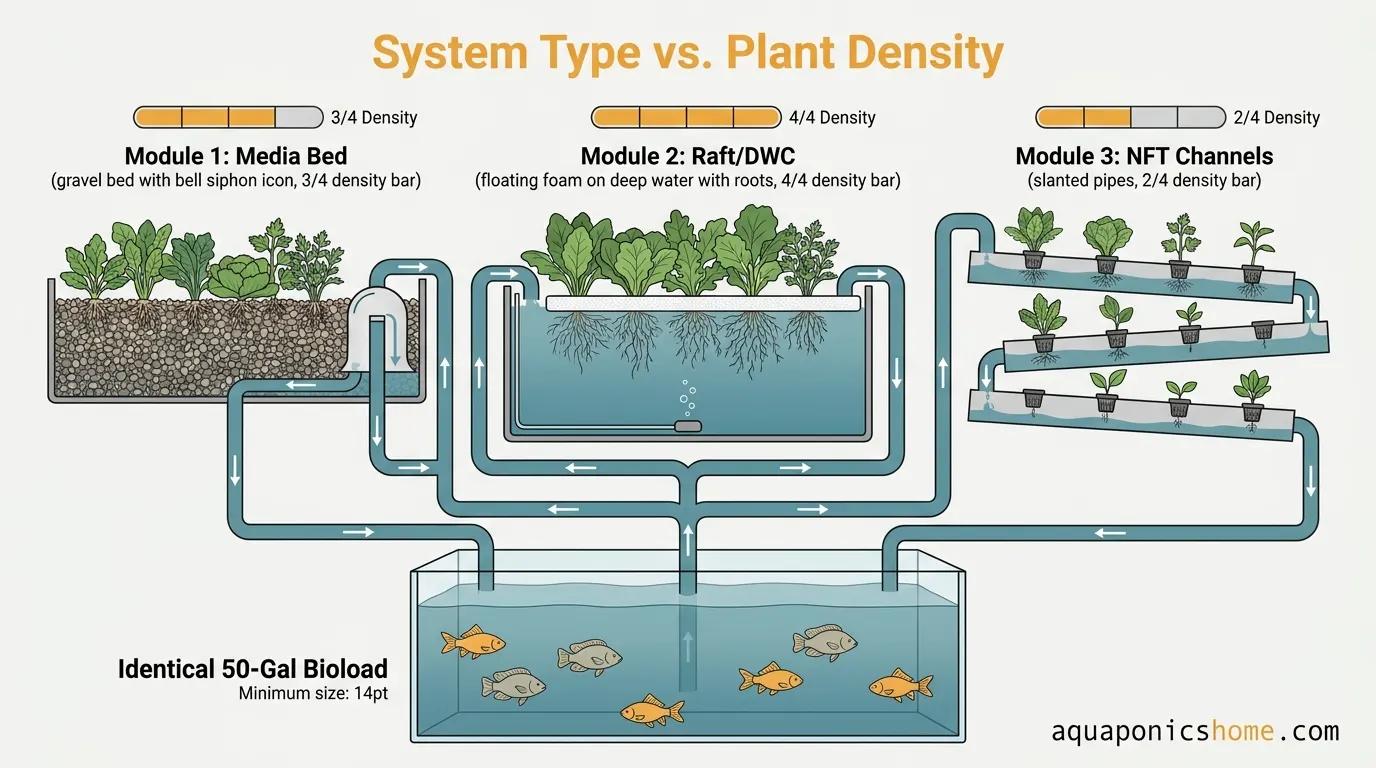
In a raft or deep water culture bed, the large floating surface gives bacteria more area to colonize and roots more room to spread, so it tends to carry more plants per gallon of fish water than a narrow channel design.
Media bed aquaponics sits in the middle: the gravel or expanded clay itself hosts a large bacterial population, which is a big part of why it is the default recommendation for a first system, but bed depth and how densely you plant into it still swing the real capacity.
Nutrient film technique (NFT) channels, with a thin film of water and less submerged surface area, generally support the fewest plants per gallon of fish tank volume of the three, which is why NFT is usually a second-system choice once a grower already understands their bioload.
A practical starting framework, not a formula
For a first small system, start conservative on fish and generous on plant area, then adjust based on water tests rather than a target you read online.
Pick your small aquaponics tank size first, since tank volume caps everything downstream: how much fish biomass you can safely carry, how much filtration you need, and how much grow bed the layout can physically support.
Stock lightly (well under the standing-crop ceilings the extension guidance above describes), plant generously, and use your first month of nitrate and ammonia readings to decide whether to add fish or add more growing area.
Adding plants is reversible in a weekend. Adding fish biomass beyond what your filtration can handle is a stress event for animals that are already confined, and it is the more common beginner mistake in either direction.
Why the nitrogen cycle is the real limiting factor

Every version of the “ratio” question is really a question about the aquaponics nitrogen cycle: how fast ammonia becomes nitrite, how fast nitrite becomes nitrate, and how fast plants remove that nitrate.
A system with an immature bacterial colony cannot support the fish-to-plant numbers that a well-established tank of the same size handles easily, which is why stocking heavily in week one, before the nitrogen cycle has established, causes more failed systems than an imperfect plant count ever does.
Test water before you trust any ratio, home-grown or published.
What this math cannot tell you
None of the numbers above predict your actual harvest. Plant growth still depends on light, temperature and the specific crop; a shaded grow bed of lettuce will underperform a well-lit one at an identical fish-to-plant ratio, and leafy greens pull nutrients differently than fruiting crops like tomatoes.
Fish growth rate varies by species and water temperature too. Anyone offering a single confident ratio for “how many plants per fish” is skipping the variables that determine whether that ratio actually holds in your kitchen, balcony or backyard.
Treat every published ratio, including the ranges above, as a starting point to test against your own water readings, not a guarantee.
It is also worth checking local rules before choosing a fish species: some fish sold for aquaponics require a permit or are restricted in certain states or countries, so confirming with your local extension office or state fish and wildlife agency before stocking is a step worth taking alongside the math, not instead of it.
Is chasing the exact ratio worth the effort?
For a hobby-scale system, the honest answer is no. The return on getting the ratio precisely right is small compared to the return on getting the nitrogen cycle right and keeping stocking density conservative.
If you are still weighing whether a system makes sense for your space and budget at all, Is aquaponics worth it compared to buying vegetables covers that decision separately from the stocking math.
FAQ
Is there a standard fish-to-plant ratio in aquaponics?
No single standard exists. Extension and FAO guidance sets safe fish stocking density ranges (fish per gallon or per liter of water), but how many plants that supports depends on system type, feed rate and how established your nitrogen cycle is.
How many plants can one fish support?
This depends far more on feed rate and system type than on the fish itself. A heavily fed fish in a raft bed with large bacterial surface area supports more plant area than a lightly fed fish in a narrow NFT channel.
What happens if I have too many fish for my plants?
Nitrate builds up faster than plants remove it, which can stress fish and foul water. Test ammonia and nitrate regularly during the first month and add plant area, or reduce feeding, rather than guessing.
What happens if I have too many plants for my fish?
Plants may show nutrient deficiency (often yellowing) because there is not enough fish waste to meet demand. This is the safer direction to err in as a beginner, since it risks a slower harvest rather than fish welfare.
Does fish species change the ratio?
Yes. Species differ in feed conversion, adult size, temperature needs and legal status by location, so a ratio built around one species does not transfer directly to another without checking those factors first.