
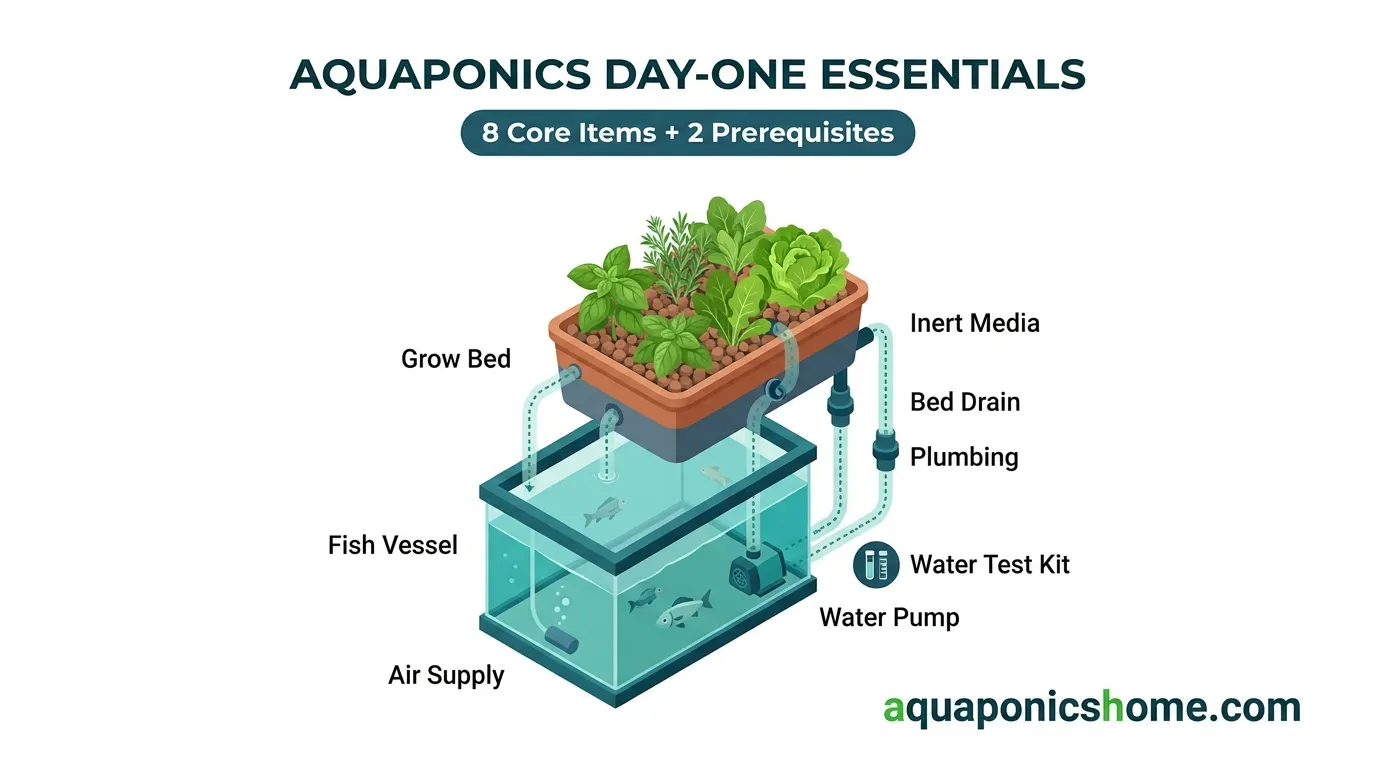
You cannot start without eight things: a watertight vessel for the fish, a grow bed, inert grow media, a water pump, an air pump with tubing and an air stone, plumbing to carry water up and back, a drain that empties the bed, and a water test kit. Two more depend on where you live. Everything else can wait until the thing is actually running.
That is the list. The rest of this page is what each item has to do, what decides its size, and what happens when you get it wrong.
The day-one aquaponics equipment list
I will not tell you what to buy. I do not know what your local shops stock, and this site sells nothing and takes no commission. What I can give you is the job each item does, so you can pick one up off an unfamiliar shelf and judge it yourself.
| Item | The job it has to do | What decides the size or spec | What goes wrong if you skip or undersize it |
|---|---|---|---|
| Fish vessel | Hold water and fish without leaking, and hold enough water that the chemistry moves slowly | What you intend to eat, and how much swing you can react to. As reported in the FAO’s small-scale aquaponics manual (Somerville and colleagues, 2014), raising fish for the table is not recommended below about 132 US gallons (500 liters). The full argument is in why the smallest system is the hardest | Ammonia climbs faster than you can test for, and the volume is too small to forgive one mistake |
| Grow bed | Hold media, plants and water, drain fully, and not sag when loaded | Root depth of what you plan to grow, and the bed’s footprint relative to the tank. A bed that cannot drain completely will not filter | Shallow roots, standing water in the base, and a smell you notice before you find the cause |
| Grow media | Support roots and give nitrifying bacteria surface to live on | Whether it is inert, meaning it will not push your pH around, and particle size, which trades drainage against root support. Compared in choosing grow media | A reactive medium quietly moves your water chemistry for months and you blame the fish |
| Water pump | Lift water from the tank to the bed | The vertical distance from the water surface to the point of delivery, plus how often you want the bed filled. Every pump ships with a head curve, and that curve is the only honest sizing guide | Water dribbles in instead of flooding the bed, so the bed never works as a filter |
| Air pump, tubing, air stone | Put oxygen in the water independently of the water pump | Water volume, how many fish, and temperature, since warmer water holds less dissolved oxygen | This is the one that kills fish overnight. It is also the cheapest item here |
| Plumbing | Move water up, let it fall back, and seal where it passes through the bed wall | The pump you actually bought. Outlet size, fitting type and bulkhead diameter all follow it, which is why you buy the pump first and the fittings second | You get home with parts that do not mate, or a bulkhead that weeps onto the floor |
| Bed drain (bell siphon or standpipe) | Empty the bed reliably, every cycle, with nobody watching | Bed depth and how fast the pump fills it. A siphon has to both start and break at the right water level | A siphon that will not break is a flood. Mine did that overnight once and I found out at 6am |
| Water test kit | Tell you what the water is doing before the fish do | That it reads ammonia, nitrite, nitrate and pH, and that you can read the result reliably in your own light | You are blind. This is the item I got wrong, and it is the next section |
| Depends where you live: a stand or base | Carry the loaded system without flexing | The loaded weight, which is arithmetic you can do: 8.34 lb per US gallon (about 1 kg per liter), plus media, plus the vessel. Worked through in how heavy a small system really is | A frame that racks under load, which is how a sealed joint starts to leak |
| Depends where you live: something for chlorinated tap water | Make top-up water safe for the bacteria and the fish | Whether your utility uses chlorine or chloramine, which the utility publishes and which changes what you need. Quantity goes by the product label, not by me | A large top-up with straight tap water knocks back the bacteria you spent weeks growing |
Why this list has no numbers on it
Every other beginner checklist gives you gallons, inches, gallons per hour and pounds of fish per gallon. I read several while writing this. None says where those numbers came from, and they disagree with each other, sometimes widely. So this site publishes a figure only when a named source published it first, and otherwise hands you the determinant instead of the digit. A gallons-per-hour number is useless the moment your bed sits at a different height than the writer’s did. Knowing that head height and fill frequency decide it means you can read any pump’s own chart, in any shop, forever. The reasoning behind the whole build is in the balcony aquaponics guide.
The test kit belongs near the top, not the bottom
On most checklists the test kit sits last, filed under “nice to have.” Mine belongs near the first line, because my first batch of catfish did not survive the first month.
I had no test kit. I was cleaning the system thoroughly and often, the way you do with a fish tank, and I was scrubbing away the bacteria colony that was supposed to be converting the fish waste. I could not see any of that. I saw dead fish, and I assumed the fish were weak.
A test kit would have shown ammonia climbing for days before anything died. It is the only item here that tells you what is happening inside the water, and the first month is when you are least able to guess. Buy it before you buy fish. What the readings mean is in cycling without killing your fish.
What people buy too early
None of these is a bad thing to own. They are bad things to own in week one, before you know how your system behaves.
- A heater. Depends on your climate and your species. Decide after you have measured your water temperature across a normal week.
- Grow lights. If your spot grows leafy greens already, you do not need them. Measure the spot first.
- pH up and pH down bottles. A new system moves around while it settles, and reaching for a bottle in week two usually makes it swing harder.
- Bottled bacteria. It can shorten cycling. It is not required, and it does not remove the need to test.
- Automatic dosers and monitors. You cannot automate a system whose normal behavior you have not learned.
- A sump tank, a second bed, a second tank. Additions to a working system, not parts of a first one.
- Expensive media. Get the properties right first, then buy whatever local material has them.
- The fish. Yes, really. Fish go in after the system has cycled.
One item moves up the list instead of down: a battery-backed air supply, if your power is unreliable. Aeration is the first thing you lose in an outage and the first thing fish miss.
The two things nobody puts on a shopping list
Electricity, beside standing water. Your water pump and your air pump are both mains devices sitting next to an open tank, and not one of the beginner lists I read mentions it. At a category level: leave a drip loop in the cord so water running down it drips off before reaching the socket, use a socket that is not underneath the tank, and use residual current protection, sold as an RCD or a GFCI depending on where you live. Anything involving fixed wiring is a licensed electrician’s job, and I will not explain it here.
The floor. You can calculate what the loaded system weighs. You cannot calculate what your floor is allowed to carry, and no website can do that for you, including this one. It goes to your building’s records or a qualified structural engineer. The arithmetic, and the point where I stop, are in how much a small system weighs.
Five questions to ask about anything on the shelf
Almost nothing in a general hardware or pet shop is labeled for aquaponics. That is fine. Ask:
- Is it inert? Will this material change the water chemistry, or just sit in it?
- Is it food safe? Anything holding water your vegetables drink counts, and the container’s previous contents count too.
- Does it publish a curve or a rating? A pump with no head chart is a pump you cannot size.
- Can I replace it locally? Pumps fail. A part you can rebuy this week beats a better part that ships for two.
- What happens when it stops? Ask it of every item. The answer for the air pump is why it matters most.
FAQ
Do I need a bell siphon, or will a timer do?
Both solve the same problem, which is emptying the bed. A siphon has no moving parts and no schedule, but it must be tuned to your bed and it can fail to break. A timer is easier to get running and depends on the timer working. Plenty of beginners start on a timer, then move to a siphon.
Can I use an aquarium I already own?
Often yes, and it saves the largest single purchase. The catch is volume. A display aquarium is sized for looking at fish, not for the water stability an edible system wants, so read what size tank you need before you commit to it permanently.
What do beginners cheap out on and regret?
The test kit and the air pump. Both are inexpensive next to everything else, and both are the difference between noticing a problem and finding out afterward. I regret the test kit specifically.
What will all of this cost?
I do not publish figures, because prices differ by country and shop and mine would be wrong for you the day I wrote them. What decides your total is how much you can repurpose, whether your media is local or shipped, and the pump, usually the largest single line. The categories are in what a small system costs.