
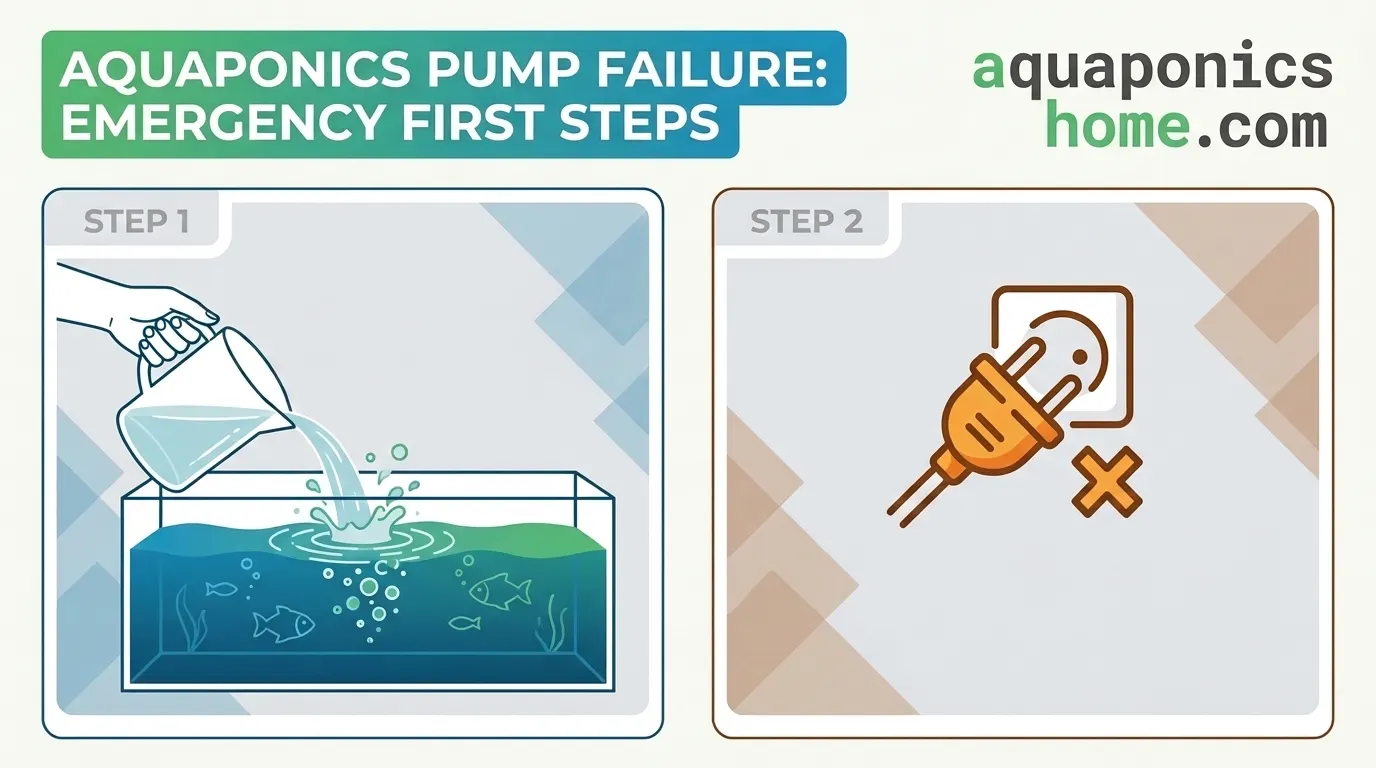
Short answer: the pump is your fish tank’s oxygen supply, so deal with air before you deal with the pump. In the first minutes: get aeration into the fish tank by any means you have, stop feeding immediately, and unplug the pump at the wall socket before your hands go anywhere near the water. Only then start diagnosing. Fish in a stopped, stocked, warm tank can be in serious trouble within hours, and the fix for that is air, not a working pump. A bucket and a steady arm will buy you time. A diagnosis will not.
If your fish are already at the surface gulping, go straight to the oxygen emergency guide and come back here afterward.
The first five minutes, in order
Do these in this order. The order is the point.
- Get air into the fish tank. A battery air pump if you own one. If not, pour water into the tank from a height with a jug or a cup, over and over. Falling water drags oxygen in at the surface. It is crude, it works, and it is the single most useful thing an unprepared person can do.
- Stop feeding. Not “feed less.” Stop. Uneaten food and the waste from a fed fish both become ammonia, and with no pump there is no water moving through the biofilter to process it. Fish handle a few days without food far better than they handle a few hours without oxygen.
- Unplug the pump at the socket. Not at the tank. Not by pulling on the cord. At the socket, with dry hands, before you touch anything wet.
- Look at the water level in the fish tank. If the system drains back when the pump stops, the tank may now be holding more water than usual, or a grow bed may be holding it instead. Check nothing is overflowing while you work. That is the same failure mode covered in leak and overflow protection.
- Now diagnose. Not before. Everything above takes about three minutes and buys you the time to think.
The electrical part nobody writes down
A submersible pump is mains-powered equipment sitting inside a body of water you are about to put your hands into. Almost every “aquaponics pump not working” guide online goes straight to “check if it is clogged” without mentioning this once. Treat it as the rule that outranks the rest.
Unplug at the socket before touching the pump, the tank, or anything connected to either. A pump that has failed may have failed by letting water into the motor housing. You cannot see that from outside, and the tank water is the return path.
Dry your hands, and stand on something dry. Wet skin and a wet floor are the difference between a shock you feel and one you do not survive.
If the pump tripped your RCD or GFCI, do not just push it back in. A residual current device trips because it has detected current leaking to earth. In a system that is mains equipment submerged in water, that is exactly the fault the device exists to catch. Electrical safety guidance is consistent on this point: repeatedly resetting a device that keeps tripping defeats the protection instead of fixing the problem, and a circuit that trips again after a reset needs a qualified electrician, not another reset. If your pump tripped the protection, that pump is out of service until an electrician or the manufacturer says otherwise. Do not re-energize it to “see if it does it again.”
Never reach into the tank with the pump plugged in, even if it is not running. “Not running” and “not energized” are different states.
I am not an electrician and this article is not electrical advice. If any part of your setup makes you unsure, stop and get someone qualified to look at it. Mains power and standing water is one of the few areas in this hobby where the cautious answer is the correct one every time.
Why oxygen is the clock, not water flow
Beginners assume a stopped pump is a plant problem. It is a fish problem first, and the reason is dissolved oxygen.
Oxygen enters water at the surface, where water meets air. A running system is constantly creating surface: water falling into the grow bed, draining back, breaking the surface of the tank. Stop the pump and all of that stops. The tank surface goes flat and still, and the only oxygen entering is what diffuses passively across an undisturbed surface, which is very little.
Meanwhile consumption does not stop. The fish keep breathing. The bacteria in the tank and on every surface keep respiring. Decomposing solids keep consuming oxygen. So the supply flatlines and the demand continues.
How fast that becomes lethal depends on things you can name honestly without inventing a number:
- Water temperature. Warm water holds less dissolved oxygen than cool water, and warm fish have a higher metabolic rate, so they consume it faster. A hot balcony in summer is the worst case on both counts at once.
- Stocking density. More fish, more demand, less time.
- How much waste is in the system. A tank with a heavy solids load has organisms consuming oxygen even where there are no fish.
- Tank shape. A wide, shallow tank has more surface area per gallon than a tall narrow one, and passive exchange happens at the surface.
Published estimates for how long fish survive an outage vary widely and every one of them carries the same disclaimer, that it depends on all of the above. So do not plan around a number. Plan around the principle: aeration is the intervention, it costs almost nothing to start, and there is no reason to wait and see.
The delayed cost: your biofilter is losing its oxygen too
This is the part I have not seen a single ranking page cover, and it is the reason a pump failure can kill fish two days after you fixed it.
The nitrifying bacteria that convert ammonia to nitrite to nitrate are aerobic. They need oxygen, and in a media bed they get it from water flowing over and past them and from air moving through the media between floods. When the pump stops, a media bed does one of two things, and both are bad for the colony. Either it drains and the media dries out, or it stays flooded and goes anaerobic as the trapped oxygen is consumed.
So a long pump outage does two kinds of damage. The visible one is the fish struggling for air. The invisible one is a weakened bacterial colony, and that one shows up later, as ammonia climbing in a system that was handling it perfectly a week ago. This is the same mechanism as a starved biofilter after over-cleaning, arriving by a different route.
What that means practically:
- After a long outage, test rather than assume. Ammonia and nitrite, for several days, not once.
- Restock the feeding slowly. Do not go straight back to a normal feed the moment flow returns. A reduced colony cannot process a full ammonia load, and the classic post-outage loss is caused by feeding, not by the outage.
- If ammonia does climb, you are in ammonia territory, and that is its own emergency with its own actions.
- Keep the media damp if you can. If the outage will be long and the bed has drained, hand-pouring system water over the media occasionally keeps the colony wetter than letting it bake.
That single insight, that the pump failure has a second bill arriving later, is worth more than any of the clog-checking below.
Now diagnose: why the pump stopped
With the pump unplugged and out of the water, work through these in order of likelihood.
| What to check | What you will find | What it means |
|---|---|---|
| Power at the socket | Nothing else on that outlet works either | Breaker, RCD or outage. See the electrical section above before resetting anything |
| Intake screen or sponge | Slime, roots, solids, a snail | The commonest cause by far. Rinse in system water, never under a chlorinated tap |
| Impeller | Grit, a root, hair, or a seized shaft | Open the housing, clear it, check the impeller spins freely by hand |
| Airlock in the pipework | Pump hums, no flow | Air trapped at a high point. Break the line and let it fill, or lower and re-prime |
| Motor | Hums and gets hot, or nothing at all, or trips the protection | End of life or water ingress. Replace, do not repair, and do not re-energize a pump that tripped the RCD |
| The pump is running but flow is weak | Everything spins, output is a dribble | Partial blockage, worn impeller, or the head height exceeded what the pump can lift |
Rinse anything you remove in system water or dechlorinated water. Rinsing a pump sponge under the tap sounds fastidious and is how people wipe out the bacteria living on it. That is a mistake I have made, and it is the same lesson the rest of this site keeps repeating.
The preparation that makes this a non-event
Everything above is easier if you did four things in advance, none of which is expensive.
- Own a battery-operated air pump and know where it is. This is the single best purchase in small aquaponics for the money. It does not care whether the mains is on.
- Own a spare water pump. Pumps are consumables. The spare turns a crisis into an errand you already ran.
- Know which socket kills the pump, in the dark, without thinking. Label it.
- Consider whether your design needs the pump at all. If your power is genuinely unreliable, a passive or low-pump design removes this entire failure category rather than mitigating it.
If you are not sure whether the pump is even the problem, work through the fifteen-minute troubleshooting order instead of guessing.
FAQ
How long can fish survive if the aquaponics pump stops?
It depends on water temperature, how heavily the tank is stocked, how much waste is in the water, and the tank’s surface area, so no single figure is honest. Treat it as hours rather than days, and shorter in warm water with a lot of fish. The safe response is not to estimate but to start aerating immediately, by battery air pump if you have one or by pouring water into the tank from a height if you do not.
Should I stop feeding when the pump fails?
Yes, immediately. With no flow there is no water passing through the biofilter, so ammonia from food and waste accumulates in a tank that is already short of oxygen. Fish tolerate short periods without food far better than they tolerate low oxygen or an ammonia spike. Resume feeding lightly once flow is restored and your test results are stable.
My pump tripped the GFCI. Can I just reset it?
No. A GFCI or RCD trips because it detected current leaking to earth, which for a submersible pump usually means water has reached somewhere electrical. General electrical safety guidance is that a device tripping repeatedly is a fault to investigate rather than a nuisance to reset. Take that pump out of service and have a qualified electrician check the circuit before you use it again.
Why is my aquaponics pump running but not moving water?
Most often a blocked intake screen, a clogged or jammed impeller, or an airlock in the pipework. Unplug at the socket first, then check them in that order. If everything is clear and flow is still weak, the pump may be worn or undersized for the height it has to lift the water.
Do I need to re-cycle the system after a long pump outage?
Usually not from scratch, but assume the bacterial colony took damage, because it is aerobic and it lost its oxygen supply along with the fish. Test ammonia and nitrite daily for several days after flow returns, feed lightly, and let the readings tell you when the system is processing normally again.
I run small aquaponics systems on a rented balcony and I have lost a pump overnight. Nothing in this article is electrical advice or veterinary advice. Mains equipment in or near water is a job for a licensed electrician if you are unsure, and sick or dying fish are a matter for a qualified aquatic veterinarian or your regional extension aquaculture service. At the time of writing, general electrical safety guidance from electrical trade and testing sources is consistent that a GFCI or RCD which keeps tripping indicates a fault requiring professional diagnosis rather than repeated resetting.