
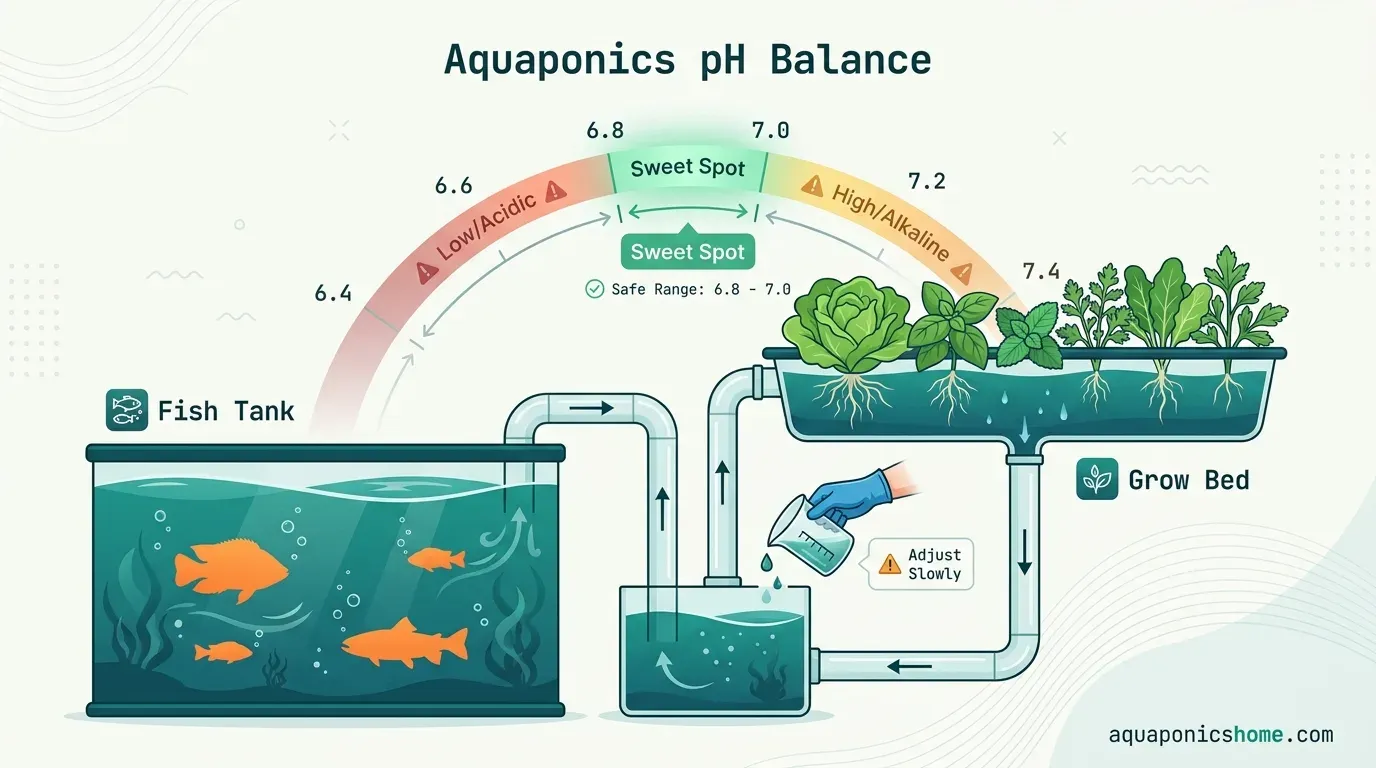
Short answer: adjust aquaponics pH slowly, in small steps, and only after testing tells you it has actually left the acceptable range. To raise pH, New Mexico State University’s aquaponics circular names calcium hydroxide or potassium hydroxide, alternated, and added very slowly over several days, because a large amount added at once can push ammonia into its toxic form and kill fish. Slow-dissolving carbonate materials are the gentler route. To lower pH, the usual answer is to stop adding whatever raised it and let the biofilter bring it down. This page gives no amount for any product. That figure belongs on the product label.
If you are not yet sure your pH needs moving at all, read why aquaponics pH keeps changing first. A slow downward drift is normal in a working system, and many “pH problems” are really a reader correcting a number that was doing exactly what it should.
Before you touch anything: two safety rules
Rule one protects you
The two bases the extension literature names for raising pH are caustic. The NIOSH Pocket Guide to Chemical Hazards entry for potassium hydroxide (read September 11, 2026) lists eye and skin burns among its symptoms, along with irritation of the respiratory system. Its first-aid lines are blunt: for the eyes, irrigate immediately; for the skin, flush with water immediately; if swallowed, get medical attention immediately. NIOSH also lists water among the substances it reacts with, which is one reason the mixing instructions on the label matter.
In practice that means:
- Wear eye protection and chemical-resistant gloves whenever you handle a hydroxide product.
- Dissolve it in a separate container of system water, following the label, never in your hand or in a cup you also drink from.
- Store it sealed, labeled and out of reach of children and pets.
- If any gets in an eye, flush immediately with running water and get medical help. Call a poison control center if anyone swallows it.
You will also have your hands near a pump and its power cord. The U.S. Consumer Product Safety Commission’s GFCI fact sheet (Pub. 099, read September 11, 2026) recommends ground fault protection for outlets where electrical equipment is near water, and notes that portable GFCIs exist where the outlet itself is not protected. Test it monthly, as the fact sheet advises.
Rule two protects the fish
NMSU’s Circular 680 (Sallenave, revised June 2026, read September 11, 2026) gives the reason slow matters: adding a large amount of base all at once will shift most of the total ammonia into the toxic un-ionized form, and “this could kill all the fish.” It tells growers to add base very slowly over several days.
The University of the Virgin Islands work written up in SRAC Publication No. 454 (Rakocy, Masser and Losordo, 2006 revision, read September 11, 2026) adds the physical detail. Soluble base such as potassium hydroxide “causes high and toxic pH levels in the sump,” and it only becomes acceptable after the water is diluted on its way to the fish. The UVI system goes further and dissolves its base in a separate, aerated tank that trickles into the sump. The home translation is simple: never pour a dissolved base straight into the fish tank. Add it where the water is diluted before it reaches the fish, which in a system with a sump means the sump.
Step one: confirm pH actually needs adjusting
Most harm done with pH products is done to systems that did not need them. Before reaching for anything:
- Test at the same time of day as your previous readings, and record water temperature alongside pH.
- Test alkalinity (KH) as well as pH. Alkalinity is the buffer. It tells you whether the pH is about to fall or has already lost its protection.
- Compare against a named range, not a feeling. NMSU Circular 680 describes 6.8 to 7.0 as the compromise optimal for fish, plants and nitrifying bacteria together, and says that between 6.4 and 7.4 the water “will be tolerable to all three components.” Its trigger for adding base is a pH that drops below 6.4.
Inside that tolerable band, the most useful thing you can do is usually nothing. A steady value at the edge of a range stresses fish less than a value being pushed back and forth.
How to adjust pH in aquaponics when it is too low
Low pH is the common direction, because nitrification produces acid every day. NMSU notes that pH “normally declines daily” for exactly that reason. The options, gentlest first:
| Option | How it acts | Main risk | Named source |
|---|---|---|---|
| Alkaline source water | Adding extra water carries buffer in with it | Only works if your source water is alkaline | NMSU Circular 680 |
| Carbonate materials such as dolomite, or carbonate-bearing gravel and shell | Dissolve slowly as the system’s acid reacts with them | Slow to take effect, and hard to remove later if you overshoot | SRAC 454 |
| Calcium hydroxide and potassium hydroxide, alternated | Neutralize acid quickly and add calcium and potassium for plants | Caustic to handle; a large addition spikes pH and ammonia toxicity | NMSU Circular 680, SRAC 454 |
Source water first. NMSU points out that in the U.S. Southwest, where water is alkaline and high in calcium, “adding extra water rather than calcium hydroxide is often sufficient to raise the pH.” Whether that works for you depends entirely on what comes out of your tap or well, so test your source water on its own before assuming either way.
Slow carbonates second. SRAC 454 describes gravel that, depending on its composition, releases calcium slowly “as the gravel reacts with acid produced during nitrification,” and notes that magnesium can be supplied by using dolomite as the base. Material like this works by slow reaction rather than a sudden jump, which is why it is the lower-drama choice for a home system. The trade-off is control: once limestone or shell is in a grow bed, it keeps working whether you want it to or not. That is a decision best made when you are choosing grow media, not after.
Hydroxides third, and carefully. Both SRAC 454 and NMSU describe alternating calcium hydroxide and potassium hydroxide. SRAC explains the reason: potassium and calcium are generally insufficient in aquaponic water, so adding them as bases “serves the dual purpose of supplementing essential nutrients and neutralizing acid.” It also warns that too much calcium can cause phosphorus to precipitate out of the water, which is another argument for alternating rather than using one product only.
The household product you should not use
Baking soda looks like the obvious cheap fix, and it is a common suggestion. SRAC 454 says plainly that sodium bicarbonate “should never be added to an aquaponic system for pH control,” because a high sodium level in the presence of chloride is toxic to plants. It adds that sodium above 50 mg/L interferes with the uptake of potassium and calcium, and in lettuce that shows up as tip-burn. In a fish-only tank that trade-off might not matter. In a system whose whole purpose is the vegetable, it does.
When pH is too high
A running system rarely stays high for long on its own, because the biofilter keeps producing acid. When pH sits high, the usual causes are alkaline source water or carbonate material in the system. Work through them in this order:
- Stop adding base. If you have been correcting upward, pause and let a few days of readings show where the system settles.
- Find the carbonate. Limestone gravel, shell or coral in a bed will hold pH up continuously.
- Dilute rather than dose, where possible. Replacing a portion of water with dechlorinated, temperature-matched water of lower pH moves the number without adding a chemical.
- Treat acid products like the hydroxides. Products sold to lower pH are acids. Handle them with the same eye and skin protection, follow the label and its safety data sheet, and add them slowly and away from the fish.
High pH deserves more urgency when ammonia is present. NMSU Circular 680 states that at pH 7.0 or below, more than 95 percent of ammonia is in the non-toxic ammonium form, and that warmer water holds more of the toxic form at any given pH. The same ammonia reading is therefore more dangerous in alkaline, warm water. If your ammonia test is positive, deal with that first, using the steps for ammonia that is too high, and do not raise pH during an ammonia problem.
The one-change rule
This is the habit that separates a system that stabilizes from one that is chased in circles.
- Make one change. One product, one addition, following the label.
- Write it down. Date, time, product, the amount the label directed for your volume, pH and KH before, and temperature.
- Wait and retest. Give the change time to show its effect before deciding anything else. NMSU’s “very slowly over several days” is the pace to think in.
- Never make two corrections in one day. A second correction on top of one that has not finished working is how a swing becomes a crash.
The log matters more than it looks. After a few weeks it tells you how fast your system spends its buffer, which is the real number you are managing.
What this page will not tell you
No dose, and no product quantity. Not for a hydroxide, a carbonate, an acid, or a household ingredient. The right amount depends on the concentration of the product in your hand, your true system volume and how strongly your water is buffered, and none of those can be known from a web page. Read the label, and if you want help interpreting your numbers for your water, your state’s Cooperative Extension aquaculture specialist is the right person to ask.
If something has already gone wrong
If fish are gasping, lying on the bottom or dying after a pH correction, stop adding anything. Aerate hard. If you need to move the water quality, dilute with dechlorinated, temperature-matched water added slowly. Then work through the emergency triage checklist for dying fish in order. Anything that looks like disease rather than water chemistry is a question for a qualified aquatic veterinarian.
FAQ
What is the safest way to raise pH in aquaponics?
Start with the least aggressive option that works for your water: alkaline source water if you have it, then slow-dissolving carbonate material such as the dolomite SRAC 454 names. If you use calcium hydroxide or potassium hydroxide, NMSU Circular 680 says to alternate them and add them very slowly over several days, and both are caustic, so wear eye and skin protection.
Can I use baking soda to raise pH in aquaponics?
No. SRAC Publication No. 454 states that sodium bicarbonate should never be added to an aquaponic system for pH control, because sodium in the presence of chloride is toxic to plants and interferes with their uptake of potassium and calcium.
How fast can I change pH in an aquaponics system?
Slowly. NMSU Circular 680 warns that a large amount of base added at once can shift most of the ammonia into its toxic form and kill the fish, and advises adding base very slowly over several days.
Should I lower pH to help my plants?
Be careful. NMSU notes that plants grow best below pH 6.5 while nitrifying bacteria perform best above 7.5, and it recommends 6.8 to 7.0 as the compromise for all three. Pushing pH down for the plants trades away biofilter performance, which is what keeps ammonia under control.
Sources
- Sallenave, R. Important Water Quality Parameters in Aquaponics Systems. New Mexico State University Cooperative Extension Service, Circular 680, revised June 2026. https://pubs.nmsu.edu/_circulars/CR680/ (read September 11, 2026)
- Rakocy, J.E., Masser, M.P. and Losordo, T.M. Recirculating Aquaculture Tank Production Systems: Aquaponics, Integrating Fish and Plant Culture. SRAC Publication No. 454, November 2006 revision. (read September 11, 2026)
- NIOSH Pocket Guide to Chemical Hazards: Potassium hydroxide. https://www.cdc.gov/niosh/npg/npgd0523.html (read September 11, 2026)
- U.S. Consumer Product Safety Commission. What Is a GFCI? Fact Sheet Pub. 099. (read September 11, 2026)