
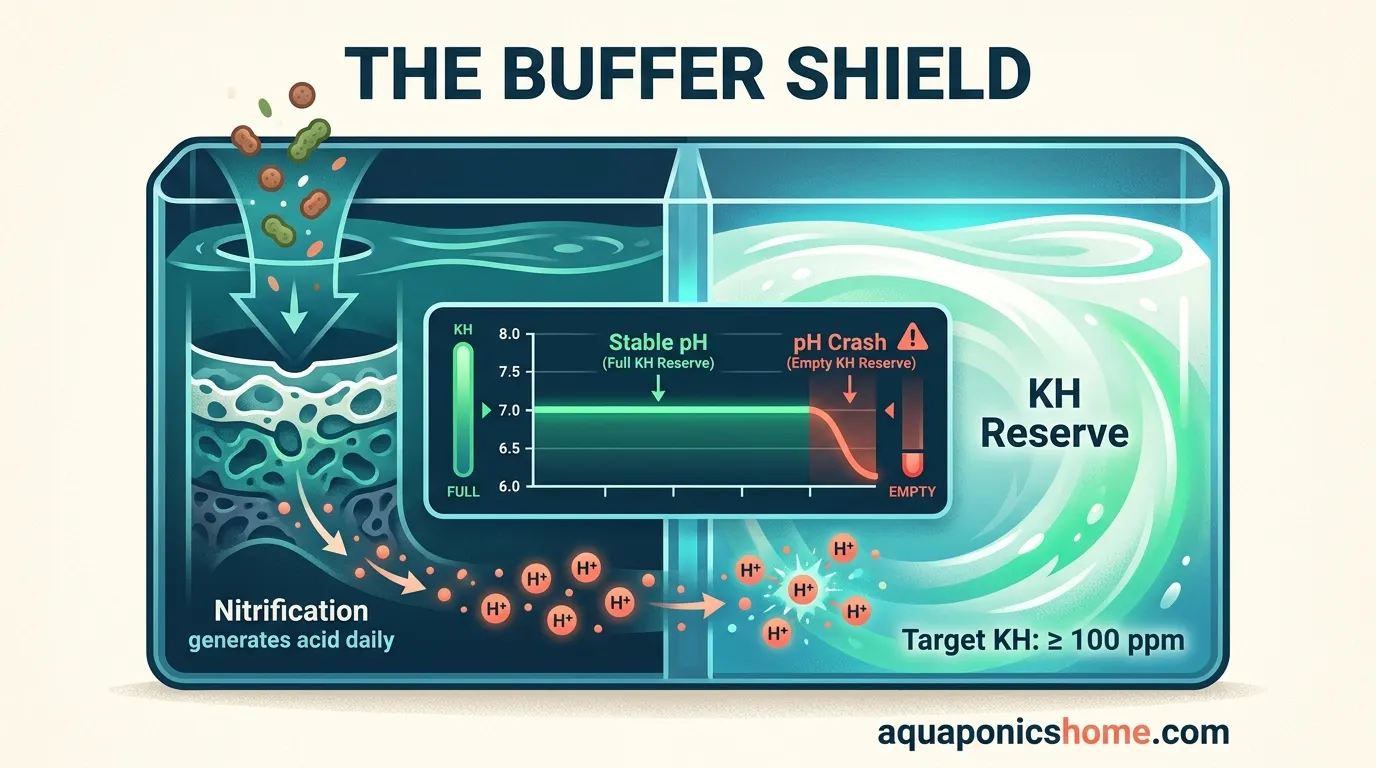
Short answer: KH, the carbonate hardness your test kit may call alkalinity, is the reserve that absorbs the acid your biofilter makes every day. While the reserve lasts, pH holds steady. When it runs low, pH starts falling, and any correction that moves only the pH number snaps back within days, because nothing is left to hold it there. New Mexico State University’s aquaponics circular recommends keeping alkalinity at 100 ppm as calcium carbonate or above, and the University of the Virgin Islands authors of SRAC Publication No. 454 list total alkalinity of 100 mg/L or more among the conditions for a biofilter to perform well.
If your complaint is “I keep correcting pH and it goes right back,” this is the page about the cause. The general drift is covered in why aquaponics pH keeps changing. This page is about the buffer underneath it.
The words are a mess, so start here
Four terms get used interchangeably on forums, and they are not the same thing.
| Term | What it measures | How it is usually expressed |
|---|---|---|
| Alkalinity | Buffering capacity: the water’s ability to resist a change in pH | ppm or mg/L as calcium carbonate (CaCO3) |
| KH (carbonate hardness) | The hobby-kit name for the carbonate buffer; in practice, what most readers mean by alkalinity | dKH or ppm, depending on the kit |
| GH (general hardness) | Dissolved calcium and magnesium | dGH or ppm, depending on the kit |
| Total hardness | The sum of calcium and magnesium | ppm as calcium carbonate |
The definitions come from NMSU’s Circular 680 (Sallenave, revised June 2026, read September 11, 2026). It defines alkalinity as “the buffering capacity, namely the ability to resist changes in pH,” expressed as the equivalent concentration of calcium carbonate, and defines hardness as a measure of positively charged ions, “particularly calcium (Ca2+) and magnesium (Mg2+).”
Because both are written “as calcium carbonate,” people assume they are one number. They are not. One tells you how much acid the water can absorb. The other tells you how much calcium and magnesium are dissolved in it. One reading cannot stand in for the other, so test both. Your kit’s instructions will say which unit it reports in; use that, and do not convert between kit units from memory.
NMSU gives a separate target for each. Alkalinity “should be maintained at 100 ppm CaCO3 or above.” Hardness levels “should be maintained between 50 and 100 ppm,” and the circular notes that dissolved calcium “aids in osmoregulation and relieves stress in fish.” A system can be comfortable on one and short on the other.
Aquaponics KH buffering: how the reserve gets spent
Here is the chain, in plain words.
- You feed the fish.
- The fish excrete ammonia.
- Nitrifying bacteria convert that ammonia to nitrite and then to nitrate, the process explained step by step in the aquaponics nitrogen cycle.
- That conversion produces acid.
- The carbonate buffer absorbs the acid, and is used up doing it.
SRAC Publication No. 454 (Rakocy, Masser and Losordo, 2006 revision, read September 11, 2026) states it directly: “Nitrification is an acid-producing process. Therefore, an alkaline base must be added frequently, depending on feeding rate, to maintain relatively stable pH values.”
The part most pages skip is the last three words: depending on feeding rate. Your buffer is not spent on a calendar. It is spent in proportion to how much feed goes into the system. That has practical consequences:
- A system that ran for months without pH trouble can start drifting when the fish grow and eat more.
- A seasonal jump in feeding speeds up the spending.
- Two systems with the same source water can behave completely differently if one carries a heavier fish load.
If your pH troubles started after a change in stocking or feeding, the buffer is the first suspect.
Why the pH snaps back in two days
Think of KH as a savings account and pH as the balance you see on the screen. While the account has money in it, the daily acid from the biofilter is paid out of savings and the balance on screen barely moves. Once the savings are gone, every day’s acid shows up directly as a falling pH.
Now look at what a pH-only correction does. It moves the number on the screen, but it does not refill the account. The biofilter keeps producing acid at the same rate the next day, and the day after, with nothing to absorb it. So the pH slides back, often within a couple of days, and it looks as if the correction failed. It did not fail. It was aimed at the symptom.
This is why the fix for a snapping-back pH is to restore buffering capacity, and then keep it topped up at the rate your feeding spends it.
Where buffer comes from in a home system
Every system gets its buffer from somewhere. Knowing which of these you have explains most of how your pH behaves.
Your source water. NMSU observes that in the U.S. Southwest, where water is alkaline and high in calcium, adding extra water alone “is often sufficient to raise the pH.” Readers on soft water get almost nothing from their top-ups and have to supply buffer another way.
Rainwater, which brings very little. The UVI commercial system described in SRAC 454 runs on rainwater, because island groundwater carries too much salt, and the publication notes that it “requires supplementation for potassium, calcium and iron.” Soft water is not a problem in itself. It simply means the buffer has to be added deliberately.
Carbonate media. SRAC 454 notes that some gravels release calcium slowly “as the gravel reacts with acid produced during nitrification,” and that aquaponic biofilters have used shells as a substrate. Media like this is a built-in, slow buffer. It is also permanent, so it is a choice best made when choosing grow media rather than discovered later when the pH will not come down.
Deliberate additions. In the UVI system, potassium hydroxide and calcium hydroxide are added alternately several times weekly to keep pH near 7.0, and dolomite is named as an option where magnesium also runs short. Those are caustic products with real handling risks, and the amounts belong to the product label and your own measurements, not to a web page.
The buffer you should not use
Baking soda is the classic cheap way to raise KH in a fish tank, and many pages suggest it. In an aquaponic system it is the wrong tool. SRAC 454 says sodium bicarbonate “should never be added to an aquaponic system for pH control because a high Na+ level in the presence of chloride is toxic to plants.” It adds that sodium above 50 mg/L interferes with the uptake of potassium and calcium, and that in lettuce the result is tip-burn and an unmarketable plant.
The contrast is instructive. The bases the extension literature does describe add potassium, calcium or magnesium, which plants need. Sodium is the one cation the plants cannot use and do not want. Whatever product you choose, read what it adds, not just what it does to pH.
Testing and tracking KH
A single KH reading tells you where you are. A series tells you how fast you are spending, which is the number you actually manage.
- Test KH whenever you test pH. The pair explains each other. Falling pH with healthy KH points to something other than the buffer. Falling pH with low KH is the buffer.
- Follow NMSU’s frequency guidance. Circular 680 says start-up systems should be tested daily and that once nutrient cycles are balanced, weekly testing is usually sufficient.
- Log feed alongside the readings. Date, pH, KH, temperature and roughly how much you fed. After a month you can see how quickly your system spends its buffer at your feeding level.
- Watch the trend, not the single number. A KH that drops a little each week tells you to plan an addition. A KH that has hit bottom tells you the pH is about to fall fast.
When low KH becomes a real problem
Low buffer on its own is a warning. Low buffer with a falling pH is where the biofilter starts to suffer. SRAC 454 gives the optimum pH range for nitrification as 7.0 to 9.0, and NMSU notes nitrifying bacteria perform best above 7.5. As pH falls further below that, the bacteria keeping ammonia in check work less well, and a system can drift into ammonia trouble with no change in how you feed. That slide is one of the routes into a biofilter crash.
NMSU’s trigger for adding base is a pH below 6.4. If you are heading there with a spent buffer, restore buffer slowly and one change at a time, and retest before you add more. If fish are gasping or dying, the physical steps (stop feeding, aerate, dilute with dechlorinated, temperature-matched water) come before any chemistry, and anything that looks like disease belongs with a qualified aquatic veterinarian.
FAQ
What is KH in aquaponics?
KH, or carbonate hardness, is the carbonate buffer in your water, usually what people mean by alkalinity. NMSU Circular 680 defines alkalinity as the ability to resist changes in pH. In aquaponics it matters because the biofilter produces acid every day and the buffer is what absorbs it.
Is KH the same as GH?
No. KH is the acid-absorbing buffer. GH, or general hardness, is the amount of dissolved calcium and magnesium. NMSU gives separate targets for each: alkalinity at 100 ppm as calcium carbonate or above, and hardness between 50 and 100 ppm.
Why does my aquaponics pH keep dropping after I fix it?
Because the fix moved the pH without restoring the buffer. SRAC 454 explains that nitrification is acid-producing and that base must be added frequently, depending on feeding rate. Once the buffer is spent, the daily acid shows up as falling pH again within days.
Can I use baking soda to raise KH in aquaponics?
No. SRAC Publication No. 454 says sodium bicarbonate should never be added to an aquaponic system for pH control, because sodium in the presence of chloride is toxic to plants and interferes with potassium and calcium uptake.
Sources
- Sallenave, R. Important Water Quality Parameters in Aquaponics Systems. New Mexico State University Cooperative Extension Service, Circular 680, revised June 2026. https://pubs.nmsu.edu/_circulars/CR680/ (read September 11, 2026)
- Rakocy, J.E., Masser, M.P. and Losordo, T.M. Recirculating Aquaculture Tank Production Systems: Aquaponics, Integrating Fish and Plant Culture. SRAC Publication No. 454, November 2006 revision. (read September 11, 2026)