
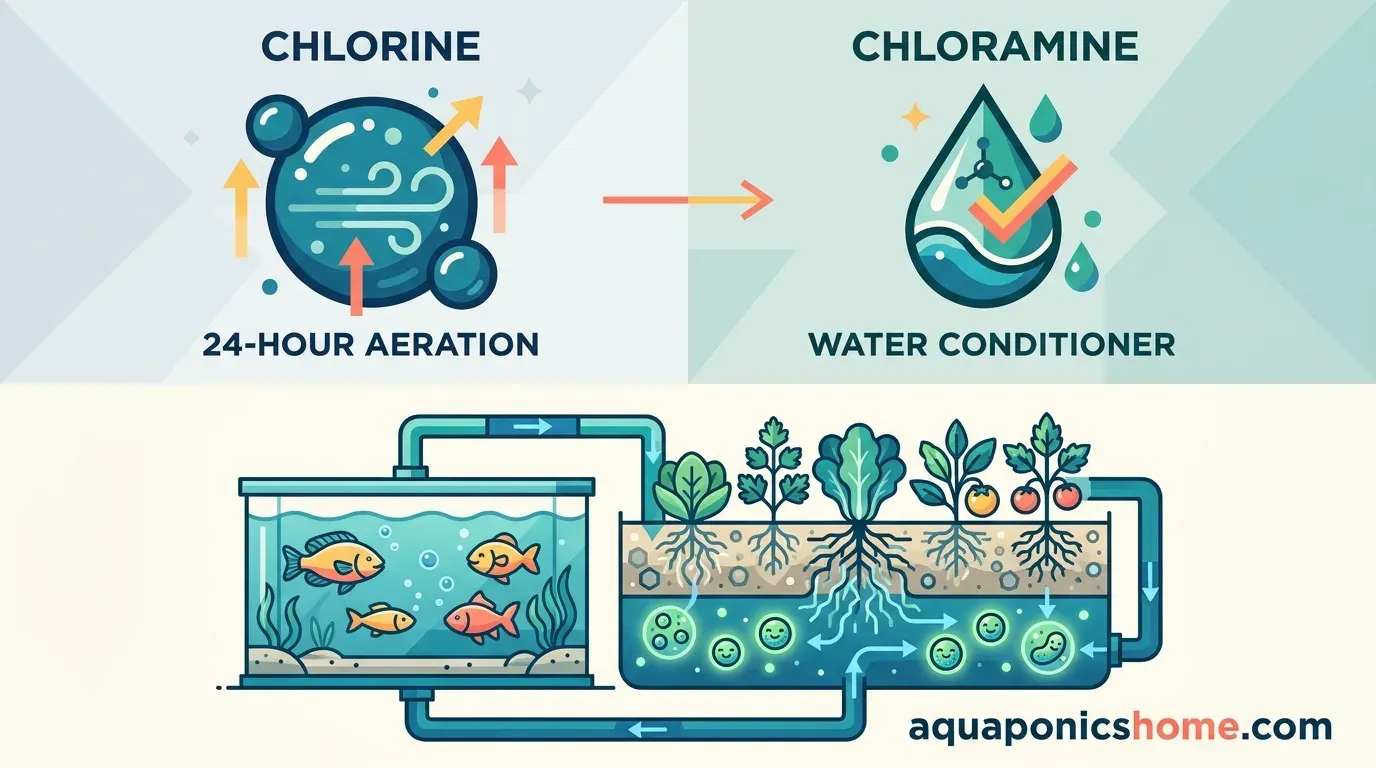
Short answer: to dechlorinate water for aquaponics, first find out whether your water utility disinfects with chlorine or chloramine, because they are removed differently. Chlorine can be driven off by aerating the water, which University of Florida IFAS material describes as about 24 hours, or neutralized instantly with a dechlorinator. Chloramine does not gas off as easily, so it needs a water conditioner labeled for chloramine, used as the label directs. The U.S. EPA states that both must be neutralized or removed for fish, because they enter the bloodstream through the gills and can also stop the growth of the beneficial bacteria your system depends on.
If you have already topped up from the tap and fish are gasping or dying, stop reading here and go to the emergency triage checklist for dying fish. Stop feeding, aerate hard, and work the physical steps before anything else.
Why a tap-water top-up can crash a whole system
Municipal water is disinfected so that it is safe for people to drink. That same disinfectant is designed to kill microorganisms, and an aquaponics system runs on microorganisms.
The EPA’s question-and-answer sheet on chloraminated and chlorinated water in aquariums (February 2009, read September 11, 2026) names two separate harms:
- “Chlorine and monochloramine can be harmful to fish because they directly enter their bloodstream through the gills.”
- “Chlorine and monochloramine can also prevent the growth of beneficial bacteria that are necessary for healthy fish tanks.”
The second harm is the one aquaponics growers underestimate. Your nitrifying bacteria are the reason ammonia does not poison your fish, and they took weeks to establish, as described in cycling a system without killing your fish. A disinfectant that sets them back can leave you with a system that suddenly behaves like a new one, which is exactly the pattern of a biofilter crash.
The University of Florida’s IFAS teaching module Chlorine: Friend or Foe? (FA171, Chapman and colleagues, read September 11, 2026) is blunter about the fish: “even the slightest trace of chlorine can prove fatal” to fish and other aquatic life.
Chlorine vs chloramine: the difference that decides your method
| Chlorine | Chloramine | |
|---|---|---|
| What it is | The disinfectant on its own | Chlorine combined with ammonia |
| Does aeration remove it? | Yes. UF/IFAS describes aerating for 24 hours “to simply de-gas the chlorine” | Not reliably. UF/IFAS says the combination lets the chlorine “remain active and NOT de-gas as easily as chlorine alone” |
| Instant option | A dechlorinator. UF/IFAS names sodium thiosulfate as a chemical neutralizer with instantaneous results | A water conditioner specifically labeled to treat chloramine |
| Hidden extra | None | It contains ammonia, the same compound your biofilter exists to remove |
The practical trap is that the most common advice online, “let your tap water sit out for a day or two,” was written for chlorine. If your utility uses chloramine, letting the water sit does not do the job, and you can follow the advice perfectly and still harm the system.
How to find out what is in your tap water
This depends entirely on where you live, and it can change. The EPA’s page on chloramines in drinking water (read September 11, 2026) notes that some public water systems have changed their secondary disinfectant to chloramines to meet disinfection byproduct requirements. A method that was right for your address last year may not be right this year.
To find out:
- Read your Consumer Confidence Report. According to the EPA’s consumer page on CCRs (read September 11, 2026), community water systems must deliver an annual drinking water quality report to their customers, sent each year by July 1. You can call your supplier or use the EPA’s online search tool to find yours.
- Call your water supplier and ask directly. Ask which disinfectant they use and whether they ever switch. The EPA sheet notes that water utilities typically provide consumers with information about their disinfection processes.
- If you are on a private well, there is no utility report. What is in your water is whatever treatment you, or a previous owner, installed. Test rather than assume.
Treat whatever answer you get as specific to your address. A neighbor in the next town, or a forum post from another state, tells you nothing about your tap.
How to dechlorinate water for aquaponics, step by step
- Know your disinfectant. Chlorine or chloramine, from the steps above.
- Treat in a separate container, never in the system. A clean bucket or a dedicated storage barrel gives the treatment time to work before anything reaches the fish.
- Treat for what you actually have. For chlorine, aerate the water or use a dechlorinator. For chloramine, use a conditioner labeled for chloramine, at the rate on its label for the volume you are treating.
- Match the temperature. NMSU’s aquaponics circular, Circular 680 (Sallenave, revised June 2026, read September 11, 2026), says replacement water should have the same temperature and pH as the water already in the tank.
- Check pH on the new water. Tap water can differ from your system water, and a mismatch is its own stress.
- Add slowly, rather than dumping a full bucket in one go.
- Test if you can. If you own a chlorine test, check the treated water before it goes in. Make sure the test reads total chlorine, not only free chlorine, since chloramine is the combined form; the kit’s instructions will say which it measures.
NMSU is explicit that “municipal water is treated with chlorine and chloramines, which must be removed before it can be used.” SRAC Publication No. 454, from the University of the Virgin Islands aquaponics work (Rakocy, Masser and Losordo, 2006 revision, read September 11, 2026), says the same: “Municipal water should not be used unless it is de-chlorinated.”
The automatic top-up trap
Here is the failure no one plans for. Automatic top-up valves are convenient, and the UVI system described in SRAC 454 uses one. But SRAC’s valve adds water “from a storage reservoir or well,” not straight from the mains.
That detail is the whole point. A float valve plumbed directly to a tap sends untreated water into the system every time the level drops, with no bucket and no waiting period. If you want automatic top-ups, feed the valve from a reservoir of water you have already treated.
Small top-ups vs large volumes
The risk scales with how much of your system you are replacing at once. A small top-up of untreated water is diluted into everything already there. A large partial water change with untreated water replaces a meaningful share of the system with disinfectant-laden water in one step, which is where crashes happen.
The ammonia inside chloramine matters more at large volumes too. After any large exchange with chloraminated source water, test ammonia over the following days, and if it rises, work through what to do when ammonia is too high. Read the conditioner’s label on whether it addresses the ammonia side as well as the chlorine.
A note on what goes into water that grows food
A water conditioner is a chemical input into water that ends up around your vegetables’ roots. Use one product, at the labeled rate, for the job it is labeled for. Do not stack several products “to be safe.” And never use surface water from a pond or stream as a shortcut around the tap: SRAC 454 warns that surface water “may contain disease organisms,” and NMSU does not recommend it because its quality is hard to keep consistent.
Anything that looks like disease in your fish, rather than a water-quality reaction, is a question for a qualified aquatic veterinarian.
FAQ
Does letting tap water sit remove chloramine?
Not reliably. UF/IFAS explains that because chloramine combines chlorine with ammonia, the chlorine does not de-gas as easily as chlorine alone. Letting water sit is a chlorine method. For chloramine, use a water conditioner labeled for chloramine.
How long should tap water sit before adding it to aquaponics?
If your utility uses chlorine only, UF/IFAS describes aerating the water for 24 hours to de-gas it. Aeration, not just standing, is what does the work. If your utility uses chloramine, standing time is not a reliable method at all.
How do I know if my water has chlorine or chloramine?
Check your Consumer Confidence Report, which the EPA requires community water systems to send customers each year by July 1, or call your water supplier and ask. Utilities can change disinfectants, so ask again if your system suddenly struggles after top-ups.
Is rainwater a safer top-up than tap water?
Collected rainwater has not been through municipal disinfection, and the UVI system in SRAC 454 runs on rainwater. It carries very little buffer, though, so pH may need more attention, and stored water brings its own problems, including mosquito larvae in a water tank.
Sources
- U.S. EPA. Common Health Questions Related to Monochloramine, Q22: Can chloraminated or chlorinated water be used for dialysis or in an aquarium? February 24, 2009. (read September 11, 2026)
- U.S. EPA. Chloramines in Drinking Water. https://www.epa.gov/dwreginfo/chloramines-drinking-water (read September 11, 2026)
- U.S. EPA. CCR Information for Consumers. https://www.epa.gov/ccr/ccr-information-consumers (read September 11, 2026)
- Chapman, F.A. and colleagues. Teach Aquaculture Curriculum: Chlorine, Friend or Foe? UF/IFAS, FA171. https://ask.ifas.ufl.edu/publication/FA171 (read September 11, 2026)
- Sallenave, R. Important Water Quality Parameters in Aquaponics Systems. New Mexico State University Cooperative Extension Service, Circular 680, revised June 2026. (read September 11, 2026)
- Rakocy, J.E., Masser, M.P. and Losordo, T.M. Recirculating Aquaculture Tank Production Systems: Aquaponics, Integrating Fish and Plant Culture. SRAC Publication No. 454, November 2006 revision. (read September 11, 2026)