
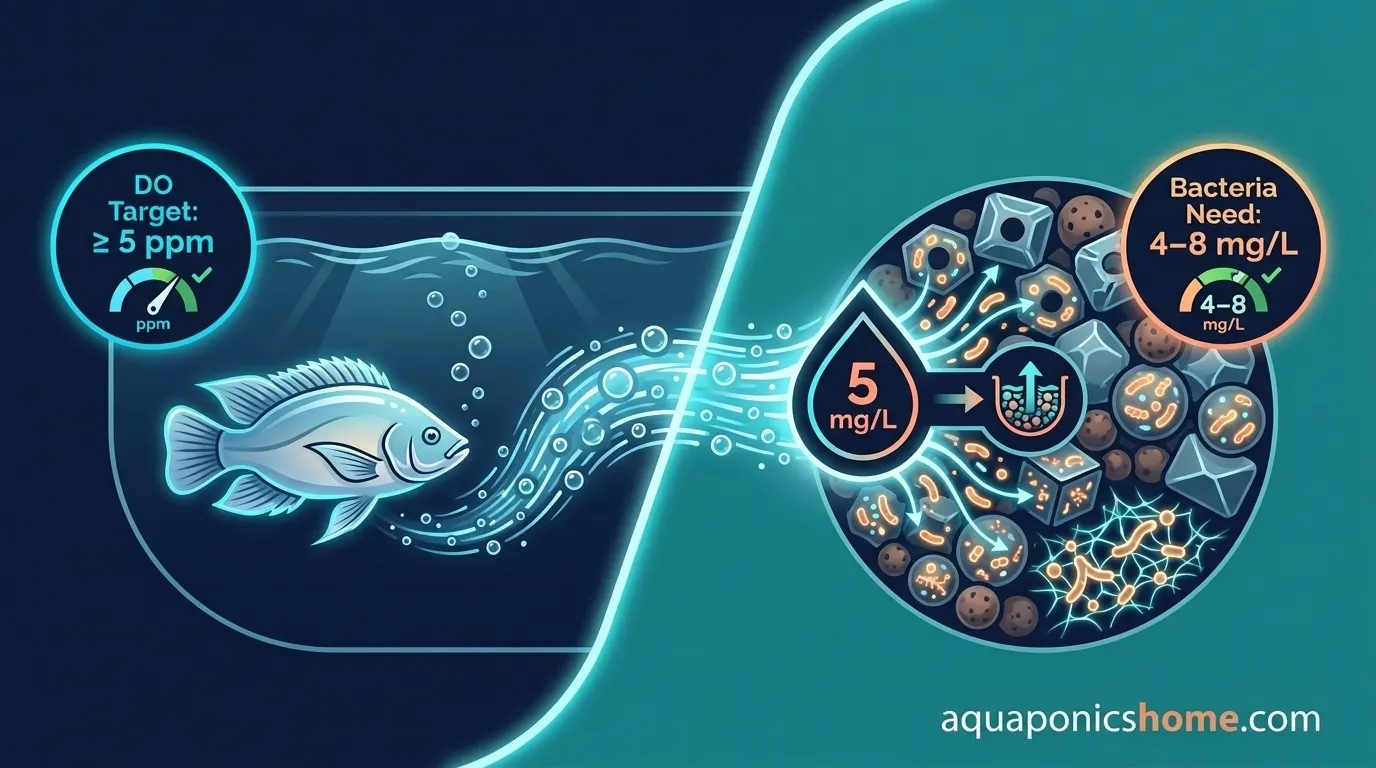
Short answer: dissolved oxygen aquaponics targets sit at or above roughly 5 ppm (mg/L), according to New Mexico State University Extension’s guide to aquaponics water quality. That number is not just a fish-comfort figure. Below it, nitrifying bacteria in your biofilter also slow down, which means the same drop that stresses your fish can let ammonia build back up behind it. Most beginners own a pH pen and an ammonia kit long before they own a dissolved oxygen meter, which is exactly why this is the number nobody tests and the one two separate parts of the system depend on at once.
I did not own a DO meter for the first year of running a media bed on a rented balcony. I watched the pump instead, on the theory that a running pump meant enough oxygen. It usually did. It stopped being true the week Dhaka’s pre-monsoon heat pushed my tank into the low 30s Celsius, and warm water simply holds less oxygen than cool water does, pump or no pump.
Dissolved Oxygen Aquaponics Basics: Why One Number Covers Two Jobs
Every explainer on dissolved oxygen aquaponics content covers the fish half. Fish need oxygen to breathe, obviously, and a fish gasping at the surface is trying to reach the thin, oxygen-richer layer at the top of the tank.
What most beginner guides skip is the second job: your biofilter’s nitrifying bacteria are aerobic too, and they are drawing from the same dissolved oxygen pool as your fish, not a separate supply.
New Mexico State University Extension’s circular on aquaponics water quality parameters explains that nitrification performs best when dissolved oxygen is high and organic matter is low; when oxygen runs short, nitrification slows or stops, and ammonia accumulates to levels toxic to the fish (New Mexico State University Extension, “Important Water Quality Parameters in Aquaponics Systems,” read 2026-09-18).
That is the mechanism worth sitting with: a slow oxygen decline does not just make fish uncomfortable. It can quietly disable the exact process that keeps ammonia from poisoning them, so a single cause produces two problems that look unrelated until you trace them back.
What “Enough” Actually Means
| For | Target range | What happens below it |
|---|---|---|
| Fish (tilapia, extension guidance) | At or above ~5 ppm | Fish move toward the surface seeking oxygen-rich water; NMSU Extension notes tilapia head for the surface once DO falls to around 1 ppm |
| Nitrifying bacteria (biofilter) | 4 to 8 mg/L, per Oklahoma State University Extension | Nitrification slows; ammonia and nitrite readings can climb even with no new fish added |
Oklahoma State University Extension’s fact sheet on nitrification and maintenance in media bed aquaponics puts the bacteria’s optimum dissolved oxygen range at 4 to 8 mg/L, alongside a water temperature window of roughly 63°F to 93°F (about 17°C to 34°C) for reliable colonization (Oklahoma State University Extension, “Nitrification and Maintenance in Media Bed Aquaponics,” read 2026-09-18).
Notice that the fish target and the bacteria target overlap almost exactly. That is not a coincidence you need to manage twice; it means one aeration setup, run well, covers both jobs. It also means there is no safe way to treat a “little low” reading as a fish-only problem and decide it can wait.
Why Warm Water Squeezes You From Both Sides
Dissolved oxygen aquaponics management gets harder in warm weather for a reason that has nothing to do with your equipment failing: warmer water physically holds less dissolved oxygen than cooler water at the same aeration rate.
At the same time, warmth speeds up fish metabolism and bacterial activity, so both your fish and your biofilter are asking for more oxygen exactly when the water can carry less of it.
That double squeeze is why a system that ran fine all spring can start showing gasping fish or a lagging nitrogen cycle the first week of real heat, with nothing else in the system having changed.
This is also why a thermometer belongs next to your dissolved oxygen reading, not instead of it. A reading of 6 ppm on a 22°C morning and the same 6 ppm on a 30°C afternoon are not equally safe, because the afternoon reading has less room to fall before it crosses into stress territory for the same fish and bacteria load.
Signs You’re Already Low, Before You Ever Test
Fish gathering near the surface, moving less, or breathing visibly faster are the classic signs, and they deserve immediate attention rather than a wait-and-see approach; a low-oxygen tank can go from stressed to lethal within hours, especially in a small home volume with no buffer.
If you see this, check your air stone and pump are physically running before anything else, and get surface agitation going by any means available while you sort out the cause. Do not use this moment to add more fish or start a new stocking plan.
A system already short on oxygen has no spare capacity for another animal’s demand, and matching stocking density to your aeration and tank volume, not the other way around, is the welfare-first order to do it in.
Because gasping is also a symptom of ammonia and nitrite poisoning, confirming your equipment is actually running is the fastest way to rule oxygen in or out; if it is a recurring problem you cannot explain, or you are seeing repeated fish losses, a local university aquaculture extension office is the right place to get a system looked at rather than guessing your way through it.
How to Actually Test It
A dissolved oxygen reading needs either a DO meter or a liquid titration kit; the color-strip kits sold for pH and ammonia do not measure it.
If a dedicated meter is not in the budget yet, testing at the warmest, stillest part of the day (usually late afternoon) gives you the worst-case number for that day, which is the more useful one to know.
Fold it into the same ten-minute weekly testing routine you already run for pH, ammonia and nitrite, so a slow decline shows up as a trend instead of a surprise.
What Actually Drops Dissolved Oxygen in a Home System
- Heat, as covered above, lowers the water’s oxygen-carrying capacity on its own.
- Overstocking or overfeeding raises biological oxygen demand faster than a small aerator can keep up with; excess uneaten feed also decays, which consumes oxygen directly.
- A new or recently disturbed biofilter is establishing a large new population of oxygen-hungry bacteria; if you are still inside the early cycling window or troubleshooting a tank that is not cycling, rising oxygen demand from the biofilter itself is part of what you are managing, not a separate issue.
- A failed or clogged air stone or pump is the most common single-cause emergency, and often the most preventable, since it is usually caught by a physical check rather than a water test.
- Algae die-off, after a bloom collapses, consumes oxygen as it decomposes, sometimes overnight.
Fixing It Without Guessing
Surface agitation and mechanical aeration (an air pump and air stone, a venturi return, or a spray bar breaking the surface) address the cause directly, and they are the first move in almost every case.
A partial water change with cooler, dechlorinated water can buy time in an acute heat spike, but it is a bridge, not a fix, since it does not address why the tank is running short in the first place. Reducing feeding temporarily lowers the biological oxygen demand while you get aeration sorted, which is a reasonable short-term step; it is not a substitute for fixing the pump or air stone.
What does not belong on this list is adding fish, adding feed, or waiting to see if it resolves on its own; none of those reduce demand or raise supply, and a fish already stressed by low oxygen has little tolerance left for anything added on top of it.
If ammonia has also started climbing while dissolved oxygen was low, treat that as the expected consequence described above, not a second unrelated emergency: get oxygen back up first, since the biofilter cannot recover while it is still oxygen-starved, and manage the ammonia reading alongside it rather than instead of it.
FAQ
What is a safe dissolved oxygen level for aquaponics?
Extension guidance points to roughly 5 ppm (mg/L) or higher as the working target for both fish and biofilter bacteria, based on New Mexico State University Extension’s aquaponics water quality guidance and Oklahoma State University Extension’s nitrification fact sheet, both read 2026-09-18.
Can dissolved oxygen be too high in aquaponics?
Home aquaponics systems using standard air stones and pumps essentially never reach oxygen levels that harm fish; the practical risk in a hobby setup runs almost entirely in the low direction, not the high one.
Does a running air pump mean dissolved oxygen is fine?
Not on its own. A pump can run while an air stone is clogged, water is unusually warm, or biological demand has outgrown the aeration you set up months ago. A pump running is a good sign, not proof.
Why do my fish gasp at the surface even with the pump running?
Confirm the air stone is actually bubbling, not just the pump humming, since a clogged stone cuts output while sound and vibration stay normal. If aeration is confirmed working and gasping continues, ammonia or nitrite becomes the more likely cause, and testing the water is the next step, not adding more aeration hardware.
Do I need a dissolved oxygen meter for a small home system?
It is not the first test kit most beginners buy, but it becomes worth owning once you are stocking fish at any meaningful density or your system runs through a real hot season, because it is the only way to catch a slow decline before fish start showing it.
Pingback: Integrated Aquaculture Hydroponic Systems: How To Choose